
Unmasking the Phishing Threat: Why Even New Domains Can’t Stop Sophisticated Scams Like the BofA-SMS.com Fraud
In the ever-evolving landscape of online security, vigilance remains our strongest defense against malicious actors. While advancements in domain technology have promised a more secure internet, the reality often falls short. This article delves into a recent, alarming phishing scam targeting Bank of America (BofA) customers, demonstrating how cunning fraudsters exploit human trust and digital vulnerabilities. It also critically examines the limitations of new Top-Level Domains (TLDs) in preventing such sophisticated attacks, offering essential insights for protecting your digital identity and financial assets.
The Anatomy of a Scam: The BofA-SMS.com Deception
The digital world is rife with threats, and phishing remains one of the most persistent and dangerous. A stark reminder of this came through a screenshot shared by domain investor Abdu Tarabichi, revealing a text message from a scammer. This message, designed to induce panic and prompt immediate action, directs unsuspecting users to a fraudulent website.
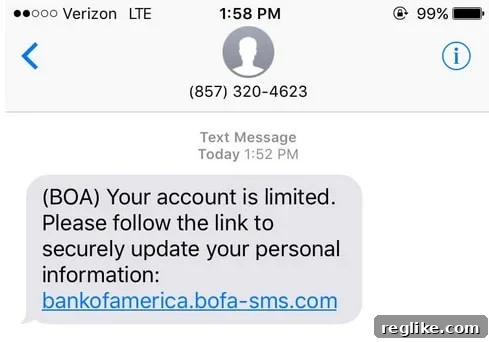
The scam works with a deceptive simplicity. Upon receiving a seemingly urgent text, often disguised as a security alert from Bank of America, individuals are prompted to click on a link. This link, disguised as a legitimate BofA portal, leads them to a subdomain of BofA-SMS.com. The website itself is engineered to mimic the authentic Bank of America online banking portal, complete with familiar logos, layouts, and persuasive language designed to instill a false sense of security.
Once on this fraudulent site, victims are coerced into “unlocking” their account by entering highly sensitive personal and financial information. This includes, but is not limited to, their full credit card number, expiration date, Card Verification Value (CVV), and the last four digits of their Social Security Number (SSN). These details are the keys to a victim’s financial life, enabling fraudsters to commit identity theft, make unauthorized purchases, or drain bank accounts. The psychological pressure applied – the fear of a locked account – often overrides critical judgment, making this type of scam incredibly effective, especially for those who are less tech-savvy or in a hurry.
Deconstructing the “Secure Domain” Myth: New TLDs and Phishing Prevention
The emergence of new Top-Level Domains (TLDs) was once hailed as a potential solution to combat phishing and enhance online trust. Proponents of these new domain extensions, particularly .brand TLDs (e.g., .bofa for Bank of America), argued that they would provide a clear, unmistakable indicator of authenticity. The logic seemed sound: if consumers saw a specific, brand-controlled TLD like “.bofa,” they would instantly recognize it as the legitimate corporate website, thereby eliminating the risk of falling prey to look-alike domains. The promise was a future where users wouldn’t get phished anymore, armed with the undeniable truth of a verified .brand domain.
However, this argument, while well-intentioned, overlooks a crucial aspect of human behavior and the nature of online scams. The fundamental problem isn’t that people fail to identify a “good” or “valid” TLD; it’s that they often fail to notice an *incorrect* or *malicious* URL in the first place. Phishing thrives not on the absence of a positive signal, but on the presence of subtle, negative misdirection.
Most internet users, particularly when navigating on mobile devices or under pressure, don’t meticulously scrutinize every character of a URL. They glance, they recognize familiar patterns (like “BofA”), and they click. Scammers exploit this cognitive shortcut by creating domains that are almost identical to legitimate ones, often adding a hyphen, a slight misspelling, or a common suffix. For instance, `BofA-SMS.com` or `BofA-txt.com` appear credible enough to a hurried or unsuspecting individual who associates “BofA” with their bank. The presence of a “secure” .brand TLD would only be effective if users actively sought out that specific TLD *before* engaging with any link, a behavioral shift that has not widely materialized.
The limitations of TLDs extend even to validated extensions like .bank. While .bank domains have stringent registration requirements designed to ensure that only legitimate financial institutions can acquire them, they face a similar challenge. As explored in a podcast discussing .bank, even with enhanced security measures at the registration level, the ultimate defense still rests on user awareness. A scammer can still create `yourbank-update.com` or `yourbank-security.net` and trick users who aren’t trained to specifically look for `yourbank.bank`. The average user is unlikely to discern the security implications of different TLDs when confronted with an urgent-looking message.
Beyond the Domain: Understanding Sophisticated Scammer Tactics
The BofA-SMS.com scam is a prime example of sophisticated social engineering, a non-technical attack vector that manipulates individuals into divulging confidential information. Scammers meticulously craft their schemes to exploit human psychology:
- Urgency and Fear: Messages claiming “account locked” or “suspicious activity” are designed to bypass rational thought, prompting immediate, unthinking responses.
- Authority and Trust: By mimicking legitimate institutions like Bank of America, scammers leverage the trust consumers place in their financial providers.
- Imitation and Replication: Fraudulent websites often feature near-perfect replicas of official branding, logos, and user interfaces, making them incredibly difficult to distinguish from genuine sites without careful inspection.
Beyond psychological manipulation, these fraudsters also employ technical obfuscation to cover their tracks. A public WHOIS lookup for `BofA-SMS.com` initially appears to offer contact information, but closer inspection reveals it to be false. Attempts to reach the listed phone number often transfer to an international dial tone before defaulting to voicemail, a classic tactic to evade identification. Furthermore, investigative tools like DomainIQ reveal a pattern: the same user associated with `BofA-SMS.com` is also linked to `BofA-txt.com`. This indicates that scammers often register multiple look-alike domains simultaneously, anticipating that some will be shut down and ensuring they have backups ready to deploy. This proactive strategy underscores the persistent and organized nature of these criminal operations.
Protecting Yourself: Essential Steps for Online Banking Security
Given the persistent and evolving nature of phishing scams, proactive user education and vigilant practices are paramount. Here are critical steps to safeguard yourself from online banking fraud:
- Verify, Don’t Click: Never click on links in unsolicited emails or text messages, especially those claiming to be from your bank or any financial institution. Instead, open your browser and manually type the bank’s official URL (e.g., bankofamerica.com) or use a trusted bookmark.
- Hover Before Clicking: On a desktop, hover your mouse cursor over any suspicious link without clicking. The actual URL will usually appear in the bottom-left corner of your browser. Inspect it carefully for any discrepancies or misspellings before deciding to click.
- Examine the URL Critically: Pay close attention to the entire URL, not just the brand name. Look for subtle misspellings (e.g., “bankofamerlca.com”), unusual characters, extra hyphens, or a suspicious TLD. For example, `bankofamerica.com.secure-login.net` is not your bank’s website.
- Look for HTTPS and the Padlock Icon: Always ensure the website address begins with “https://” (not “http://”) and that a padlock icon is visible in the browser’s address bar. While HTTPS encrypts communication and the padlock signifies a secure connection, it does *not* guarantee the legitimacy of the website itself, as even scam sites can obtain SSL certificates. It’s a necessary, but not sufficient, condition for trust.
- Enable Multi-Factor Authentication (MFA): Whenever possible, activate MFA (also known as two-factor authentication or 2FA) on all your financial accounts. This adds an extra layer of security, typically requiring a code from your phone or a biometric scan in addition to your password, making it much harder for unauthorized users to access your account even if they steal your login credentials.
- Banks Won’t Ask for Sensitive Data via Unsolicited Links: Remember, legitimate banks will never ask you to provide your full credit card number, CVV, PIN, or full Social Security Number through an email link, text message, or pop-up. If you receive such a request, it’s a clear red flag.
- Regularly Monitor Accounts: Consistently check your bank statements, credit card transactions, and credit reports for any suspicious or unauthorized activity. Early detection can prevent significant financial losses.
- Report Phishing Attempts: If you receive a suspicious email or text, report it to your bank and then delete it. Forward suspicious emails to the Anti-Phishing Working Group (APWG) at [email protected]. For texts, you can forward them to SPAM (7726) in the US.
What to Do If You’ve Fallen Victim to a Phishing Scam
Despite best efforts, anyone can fall victim to a sophisticated scam. If you suspect you’ve entered your information on a fraudulent site, act immediately:
- Contact Your Bank Immediately: Call your bank’s official fraud department using a number found on their official website or the back of your credit/debit card, not from the suspicious message.
- Change Passwords: Change passwords for your online banking, email, and any other accounts that use similar credentials.
- Monitor Credit Reports: Place a fraud alert or freeze your credit with the three major credit bureaus (Experian, Equifax, TransUnion) to prevent new accounts from being opened in your name.
- File a Police Report: Report the incident to your local police department. This can be crucial for future disputes or identity theft claims.
- Report to Relevant Authorities: File a complaint with the FBI’s Internet Crime Complaint Center (IC3) at ic3.gov and the Federal Trade Commission (FTC) at identitytheft.gov.
The Larger Picture: Responsibility and Continuous Education
The incident with BofA-SMS.com underscores a broader challenge in cybersecurity. While domain registrars and governing bodies strive to enforce policies and combat abuse, the sheer volume and ingenuity of scammers make it an uphill battle. The responsibility also falls on financial institutions to continuously educate their customers about the latest threats and how to identify them. However, ultimately, the most robust defense against phishing and online fraud lies with an informed and vigilant user base.
This episode serves as a powerful reminder that no single technological solution, not even the most secure TLD, can fully inoculate users against the cunning tactics of social engineering. Personal awareness, critical thinking, and adherence to robust security practices are not just recommended; they are indispensable in navigating the complexities of our digital lives. Stay alert, stay informed, and always err on the side of caution when your personal and financial information is at stake.