
Understanding SOPA: Why Informed Debate Matters in Digital Legislation
The Stop Online Piracy Act (SOPA) emerged over a decade ago as a highly contentious piece of legislation, sparking an unprecedented uproar across the internet. While its immediate legislative journey ended in withdrawal, the debates it ignited continue to resonate in discussions about internet freedom, intellectual property, and digital rights. It’s crucial, however, that these vital conversations are built upon a foundation of accurate understanding, not merely on shared outrage.
As someone who, like many, voiced opposition to SOPA—even directing my concerns to my House representative, Lamar Smith, the bill’s sponsor—I observed firsthand a critical disconnect. Amidst the torrent of criticism and online protests, it became apparent that a significant portion of the opposition, while passionate, lacked a fundamental grasp of what the bill truly proposed. This isn’t an indictment of their stance, but rather a reflection on how easily complex legislation can be misunderstood or mischaracterized in the heat of public debate.
The Genesis of SOPA: A Fight Against Online Piracy
To truly understand SOPA, one must first appreciate the context in which it was conceived. The entertainment industry, including film studios, music labels, and publishing houses, along with other intellectual property holders, had long argued that online piracy was causing immense financial losses and threatening jobs. They contended that existing laws were insufficient to combat the scale and anonymity offered by the internet, allowing foreign “rogue websites” to freely distribute copyrighted content without consequence. SOPA, introduced in the U.S. House of Representatives in October 2011, was their proposed solution.
The core objective of the Stop Online Piracy Act was ostensibly to provide the U.S. government and copyright holders with new tools to curb online copyright infringement, particularly from websites operating outside American jurisdiction. Proponents argued it was a necessary step to protect American innovation, creativity, and jobs, ensuring that creators could profit from their work and continue to produce valuable content. They envisioned a world where intellectual property rights were respected online as they were offline, fostering a fairer digital economy.
Deconstructing SOPA: Mechanisms and Controversies
The methods SOPA proposed to achieve its goals were, however, deeply controversial and formed the bedrock of widespread opposition. The bill outlined several key mechanisms:
- Site Blocking Orders: It would empower the Department of Justice to seek court orders requiring internet service providers (ISPs) to block access to foreign websites deemed to be “dedicated to infringing activities.” This raised immediate concerns about internet censorship and the potential for a U.S. “Great Firewall.”
- Payment Processor Blacklisting: Financial service providers, such as credit card companies and online payment systems, could be compelled to cease processing transactions for targeted websites. The aim was to cut off the financial lifeline of pirate sites.
- Advertising Network Restrictions: Advertising networks would be forced to stop displaying ads on infringing websites, thereby removing another critical revenue stream.
- Search Engine Delisting: Search engines could be ordered to remove links to infringing sites from their search results, making them harder for users to find.
- Expanded Private Enforcement: Copyright holders themselves could directly seek court injunctions against websites and service providers that “facilitate” infringement, leading to fears of frivolous lawsuits and chilling effects on legitimate online activity.
These provisions, intended to be powerful deterrents against piracy, were precisely what ignited the most fervent opposition. Critics argued that the broad definitions of “infringing activities” and “facilitating infringement” could easily ensnare legitimate websites, especially those that host user-generated content like YouTube, Wikipedia, or Reddit. The fear was that these platforms would be forced to heavily censor or pre-screen user uploads to avoid legal liability, stifling free speech and innovation online.
The Technical and Ethical Quandaries
Beyond the legal and economic concerns, SOPA presented significant technical and ethical challenges. Site-blocking mechanisms, particularly those involving DNS (Domain Name System) filtering, were seen by internet engineers and experts as potentially breaking the fundamental architecture of the internet. They warned that such measures could undermine the global, open nature of the web, make it more vulnerable to attack, and set a dangerous precedent for other nations to implement similar, more oppressive censorship regimes.
Furthermore, the bill’s lack of robust due process protections was a major sticking point. Critics argued that websites could be taken down or financially isolated based on accusations of infringement, without sufficient opportunity for defense or judicial review. This raised profound questions about fairness and the rule of law in the digital age, suggesting that a website could be “guilty until proven innocent.”
The GoDaddy Controversy and the Pitfalls of Misinformation
One striking example of how misinformation and partial understanding fueled the SOPA debate involved GoDaddy, a major domain registrar. For a time, GoDaddy was a vocal supporter of SOPA, citing its concerns about intellectual property theft. This stance drew considerable ire from the internet community, leading to calls for boycotts and domain transfers away from the company.
An article published by a prominent tech publication at the time perfectly illustrated the kind of superficial understanding that often permeated the discourse. The article, titled with a provocative and unprofessional phrase, criticized GoDaddy’s support for SOPA. However, it went on to misrepresent GoDaddy’s engagement with the bill, suggesting their comments were a recent response to public outcry, when in fact, their support had been long-standing. More critically, the piece, like many others, seemed to narrow SOPA’s scope to a degree that minimized its true implications.
I recall seeing an image embedded within that article, attempting to encapsulate the public’s simplified understanding versus the supposed reality of SOPA:
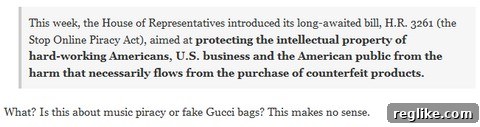
The implication of such a graphic, frequently circulated, was that the public was either overreacting or misunderstanding the bill. Yet, as someone who had delved into the legislative text, it became clear that the bill, in its broad definitions and far-reaching powers, very much encompassed both the explicit goal of combating piracy and the implicit danger of broader internet control. The line between protecting intellectual property and enabling censorship was, in SOPA’s framework, dangerously blurred.
This episode with GoDaddy and the subsequent coverage underscored a larger problem: the propensity for complex legislative issues to be reduced to soundbites and simplified narratives. Many individuals who vehemently opposed SOPA—a stance I shared—did so based on a general sentiment of “internet censorship bad” or because popular figures and platforms they admired were against it. While collective action is powerful, truly effective advocacy stems from a deep, nuanced understanding of the policy itself.
The Internet Rises: A Historic Protest
The public outcry against SOPA and its Senate counterpart, PIPA (PROTECT IP Act), escalated into one of the largest and most successful online protests in history. On January 18, 2012, numerous major websites, including Wikipedia, Reddit, and Google, participated in a coordinated “internet blackout” or displayed prominent banners to raise awareness. Millions of users signed petitions, called their representatives, and educated themselves (or at least attempted to) on the bill’s potential impact.
This unprecedented display of collective digital activism demonstrated the immense power of the internet as a platform for political mobilization. The sheer volume of public opposition, combined with strong criticism from tech companies, legal scholars, and human rights organizations, ultimately led to the withdrawal of both SOPA and PIPA in January 2012. It was a landmark victory for proponents of internet freedom and an undeniable testament to the internet’s ability to defend itself.
Lessons Learned: Vigilance and Informed Participation
The saga of SOPA left an indelible mark on the landscape of digital policy and advocacy. It highlighted several crucial lessons:
- The Need for Technical Literacy in Legislation: Lawmakers must engage with technical experts to understand the profound implications of internet-related legislation. Policies affecting the internet’s infrastructure and operation require careful consideration to avoid unintended consequences that could harm its open, global nature.
- The Power of Collective Action: SOPA proved that when the internet unites, it can effect real change. This power, however, comes with a responsibility for informed engagement.
- The Ongoing Balance of Rights: The tension between protecting intellectual property rights and safeguarding free speech and innovation online remains a critical challenge. Future legislation will undoubtedly continue to grapple with this delicate balance.
- The Peril of Misinformation: As complex as SOPA was, the way it was discussed and debated, often inaccurately, served as a stark reminder of the importance of seeking out primary sources, understanding the nuances, and challenging oversimplified narratives. When 99% of those who claimed to be against SOPA knew little beyond the fact that their favorite platforms opposed it, it speaks to a broader challenge in civic engagement.
Ultimately, the story of SOPA is a powerful reminder that while strong opinions are valuable, informed opinions are essential. As new digital challenges arise and future legislation is proposed—whether concerning data privacy, artificial intelligence, or content moderation—the onus remains on each of us to move beyond superficial headlines and engage with the details. Only then can we ensure that our digital future is shaped by thoughtful deliberation, rather than by mere reaction or widespread confusion.