
Google Adsense Unveils a New Era: Phasing Out Text-Only Ads for Richer, More Engaging Formats
The landscape of online advertising is in constant flux, driven by technological advancements, evolving user expectations, and the relentless pursuit of effectiveness. Google Adsense, a dominant force in connecting publishers with advertisers, is once again at the forefront of this evolution. A significant announcement from Google heralds a transformative shift: a deliberate move away from the long-standing text-only ad units towards more visually compelling and integrated ad formats. This strategic pivot is poised to redefine how advertisements appear across millions of websites, promising enhanced user experiences and optimized performance for all stakeholders.
The End of an Era: Google Adsense Moves Beyond Purely Text-Based Advertising
For decades, Google Adsense’s simple text ads were a familiar fixture across the internet, celebrated for their contextual relevance and unobtrusive nature. They offered a lifeline to countless content creators and website owners, providing a streamlined monetization solution. However, as the digital world matured, characterized by high-definition displays, interactive content, and a preference for visual storytelling, the limitations of purely textual advertisements became increasingly evident. Google’s latest directive marks a pivotal moment, signaling a future where ads are not merely informative but also visually captivating and seamlessly integrated into the user experience.
The communication sent to Adsense publishers clearly outlined these impending changes:
“We’re moving towards richer ad formats, phasing out text-only and display-only ad units to further improve user experience, and to fully reflect the pool of ads we have in the market. As a result, the “Text ads only” and “Display ads only” ad units in your account have been renamed to “Display ads” and from early 2019 will be updated to serve all ad types.”
“We’re deprecating text ad styles for “Text & display ads” ad units. From now on, you won’t be able to create ad styles for your new ad units. Your new ad units will have Google-optimized text ad styling. As this feature is being deprecated, your existing ad styles will also be optimized by Google in the following months.”
This announcement reveals a comprehensive strategy: not only is Google consolidating ad unit management by renaming “Text ads only” and “Display ads only” into a unified “Display ads” category, but it is also significantly enhancing the visual richness and adaptability of these ads. The core message is Google’s unwavering commitment to an advertising ecosystem that aligns with contemporary digital content consumption habits, where visual engagement is increasingly paramount.
The Driving Force: Why Google is Prioritizing Richer Ad Formats
Google’s decision to transition away from text-only ads is underpinned by a dual mandate: significantly enhancing the user experience (UX) and maximizing the efficacy of its vast network of advertisers. In an internet environment saturated with high-quality imagery and video, users naturally gravitate towards content that is visually appealing and easy to digest. Simple text ads, while effective in their time, can now feel out of sync with modern web design and user expectations.
Elevating the User Experience (UX)
Richer ad formats, by incorporating elements such as prominent company logos, compelling product images, and dynamic visual cues, can dramatically improve how users perceive and interact with advertisements. When ads are contextually relevant, aesthetically pleasing, and well-integrated into a website’s design, they are far less likely to be viewed as intrusive. Instead, they can become an organic component of the content, offering genuine value, information, or solutions to the user. This fosters a more positive and less disruptive browsing experience, mitigating ad fatigue and potentially boosting engagement rates.
Optimizing Advertiser Reach and Impact
For advertisers, the ability to weave branding elements like distinctive logos and high-quality product imagery directly into their advertisements is an invaluable asset. This allows for superior brand recall, clearer product or service showcasing, and more impactful messaging. The “pool of ads we have in the market” refers to the immense diversity of businesses leveraging Google’s advertising platforms, many of whom are eager to utilize robust visual assets to distinguish themselves in crowded digital spaces. By enabling richer formats across its expansive publisher network, Google ensures that advertisers’ campaigns can fully capitalize on their creative potential, ultimately driving better conversion rates and a stronger return on investment (ROI).
Google’s Relentless Pursuit of Performance Optimization
At its core, Google’s advertising philosophy has always centered on meticulous performance optimization. Its history of introducing various ad sizes, responsive ad units, and sophisticated targeting options consistently aimed at maximizing click-through rates (CTR) and effective cost per mille (eCPM) for publishers. This latest shift is a continuation of that trajectory. By serving ads that are more visually compelling and thoughtfully aligned with contemporary web design principles, Google anticipates a significant uplift in overall ad performance, translating into higher potential earnings for publishers and improved campaign effectiveness for advertisers.
Unpacking “Richer Ad Formats”: What Publishers Can Expect
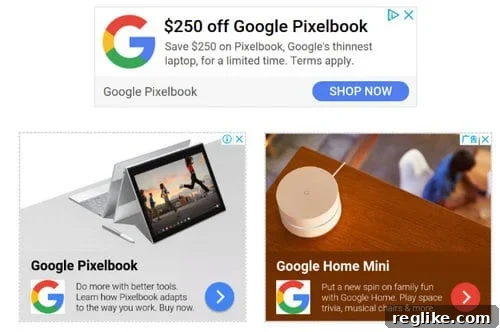
The examples provided by Google offer a clear glimpse into this new advertising paradigm. Moving beyond simple headlines and text descriptions, publishers will increasingly see ads that seamlessly blend textual and graphical elements:
- Prominent Company Logos: A distinctive visual identifier that allows for instant brand recognition and builds trust with the user.
- Engaging Product Images: Direct visual representation of the item or service being advertised, providing immediate context and appeal.
- Text Overlays and Blended Visuals: The intelligent combination of concise, impactful text with captivating imagery to deliver a powerful, cohesive message.
- Dynamic and Responsive Elements: Ads designed to intelligently adapt their layout, content, and visual components based on the available space, device type, and user context, guaranteeing optimal presentation across desktops, tablets, and smartphones.
These sophisticated elements collaboratively create a more immersive and effective advertisement, bridging the divide between traditional text ads and conventional banner ads. They offer the best of both worlds: the contextual precision of text with the immediate visual impact of graphics.
Implications for Publishers: Navigating the Evolving Adsense Landscape
For website owners and content creators who rely on Adsense for monetization, this update presents both exciting opportunities and necessary adjustments.
The Potential for Enhanced Revenue Streams
The most tangible benefit for publishers is the potential for increased earnings. More engaging and visually appealing ads naturally tend to generate higher click-through rates (CTR). When users find advertisements more relevant and aesthetically pleasing, their propensity to interact with them rises, directly translating into improved revenue for the publisher.
The Shift in Styling Control to Google
A notable change is the deprecation of manual text ad styling. Publishers will no longer possess the ability to create custom ad styles for new units, and existing custom styles will progressively be optimized by Google. While some publishers might express concern over the loss of granular control, it’s crucial to recognize that Google’s advanced optimization algorithms are engineered to generate styles that deliver superior performance and integrate seamlessly with diverse site designs. This transition effectively transfers the responsibility of ad styling from individual publishers to Google’s sophisticated AI and vast data analytics, ensuring optimal visual presentation.
Simplified Ad Unit Management
The consolidation of “Text ads only” and “Display ads only” into a singular “Display ads” unit significantly streamlines ad management. Publishers will benefit from a more simplified suite of ad unit types to configure and oversee, potentially reducing complexity and accelerating the implementation of Adsense across their digital properties. This unified approach implies that the “Display ads” unit will intelligently serve the most appropriate ad type – be it purely visual, text-based, or a rich hybrid – based on real-time inventory, user context, and historical performance data.
Renewed Focus on Core Content and User Experience
With Google assuming a more active and intelligent role in ad presentation, publishers are freed to further dedicate their efforts to their core strengths: producing exceptional, high-quality content and cultivating an outstanding overall user experience. Adsense will strive to deliver ads that genuinely complement, rather than detract from, the website’s design and the intrinsic value of its content.
Benefits for Advertisers: Unlocking Creative Potential and Effectiveness
Advertisers stand to gain immensely from this progressive evolution. The newfound capability to incorporate robust visual elements directly into their ads empowers them to craft more compelling, memorable, and impactful campaigns. Brands can now ensure their distinct visual identity and core messaging remain consistent and prominent across all Google Adsense placements, thereby reinforcing brand recognition, fostering trust, and enhancing brand equity.
This strategic shift also implicitly encourages advertisers to invest more judiciously in the creation of high-quality visual assets, confident that these will be prominently and effectively showcased. For performance marketers, richer ad formats unlock new opportunities for rigorous A/B testing of visuals, messaging, and calls-to-action, potentially leading to deeper insights into audience engagement and significantly improved conversion funnels.
Broader Trends: Adsense Aligns with the Visual Internet
Google Adsense’s current transformation is not an isolated phenomenon; rather, it reflects a pervasive trend across the entire digital advertising ecosystem. Social media giants like Facebook and Instagram have long leveraged the power of visually rich advertisements as a cornerstone of their platforms. E-commerce websites inherently prioritize striking product imagery to drive sales. The internet itself has undeniably evolved into an increasingly visual medium, characterized by high-resolution imagery, immersive videos, and dynamic, aesthetically pleasing layouts dominating user interfaces.
This evolution ensures that Adsense remains competitively positioned and highly relevant within an advertising landscape where visual appeal and seamless integration are paramount. It allows Google to effectively compete with other advanced ad networks that have already embraced more graphical, interactive, and data-driven ad experiences.
The Future Trajectory of Online Advertising: Beyond Today’s Innovations
While this current update marks a substantial leap forward, the journey of digital advertising is far from its culmination. We can confidently anticipate further groundbreaking innovations in the years to come:
- Enhanced Interactivity: Beyond static images, future ads could incorporate micro-interactions, swipeable galleries, or even short, engaging video snippets directly within the ad unit.
- Hyper-Personalized Experiences: Even more sophisticated, AI-driven ad serving will likely emerge, tailoring not just the message but also the visual style and content of ads to individual user preferences and real-time contextual cues.
- Augmented Reality (AR) Integration: Though perhaps a more distant prospect, AR ads could eventually offer immersive and interactive experiences, allowing users to virtually “try on” products or place items in their environment directly through web content.
It is important to draw a distinction between advertisements displayed on publisher websites and those appearing on Google’s own search results pages. While publisher sites are increasingly embracing rich visuals, Google Search results, by their fundamental nature, prioritize speed, relevance, and information density. Although elements like rich snippets and shopping ads already incorporate visuals, the core text ad format on the main search results page may continue to lean towards a more text-focused approach to maintain clarity and lightning-fast loading speeds, albeit continuously evolving with subtle visual cues and more descriptive ad extensions.
Conclusion: Embracing a Richer, More Engaging Digital Advertising Ecosystem
Google Adsense’s strategic transition away from purely text-based ads towards richer, more visually dynamic formats represents a watershed moment in online advertising. This forward-thinking decision is perfectly aligned with contemporary digital consumption trends, promising a superior user experience, enhanced monetization opportunities for publishers, and demonstrably more effective campaigns for advertisers.
Publishers should perceive this evolution as a significant opportunity to integrate more visually appealing and dynamic advertisements seamlessly into their websites, placing trust in Google’s advanced optimization algorithms to deliver peak performance. Advertisers, in turn, are empowered with an expanded canvas for creative expression, enabling them to showcase their brands and products with unprecedented clarity and impact. As the digital world continues its inexorable march towards prioritizing engaging visuals and fluid interactions, Google Adsense is proactively ensuring its platform remains at the cutting edge, fostering a more vibrant, efficient, and productive advertising ecosystem for every participant.