
The Unscripted Star: How a Fly Buzzed Its Way into Political History at the Vice Presidential Debate
In the high-stakes arena of political debates, every word, gesture, and even stray glance is scrutinized. Yet, sometimes, the most unforgettable moment isn’t a sharp retort or a profound policy declaration, but an entirely unscripted, almost absurd incident. Such was the case during the Vice Presidential debate between then-Vice President Mike Pence and Senator Kamala Harris. Amidst discussions on critical national issues, a tiny, unassuming creature managed to steal the spotlight, creating a viral sensation that reverberated across social media and even influenced campaign tactics.
The Unexpected Intruder: A Moment of Unintended Levity
The 2020 Vice Presidential debate was anticipated as a pivotal event. With the presidential race tightening and both candidates eager to make their case, the atmosphere was charged with tension. Millions tuned in, expecting a clash of ideas and a fierce defense of their respective tickets. What unfolded, however, included a moment that transcended the political discourse, offering a rare, spontaneous comedic interlude that quickly became the talk of the nation.
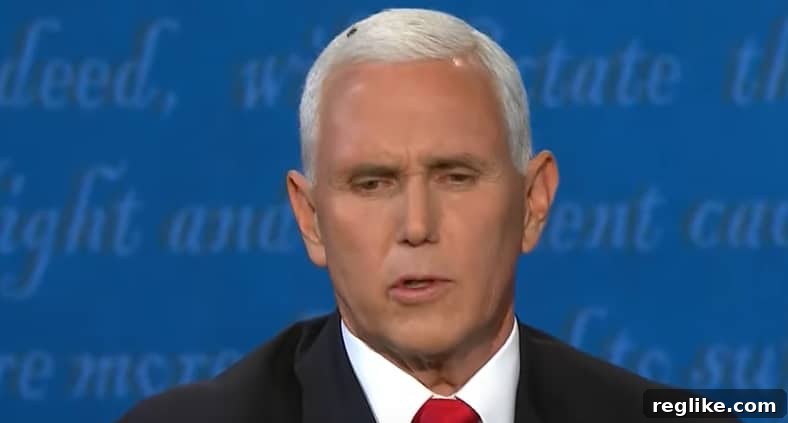
Approximately an hour into the debate, as Vice President Pence was responding to a question, a housefly made an unannounced appearance. It landed squarely on his distinguished white hair, near his right ear. For an astonishing two minutes, the fly remained perched, seemingly unfazed by the bright lights, the intense rhetoric, or the millions of eyes fixed upon the stage. The stark contrast of the dark insect against Pence’s impeccably groomed, light hair made it an undeniable visual focal point. Neither Pence nor Harris visibly reacted to the intruder, maintaining their composure and continuing the debate as if nothing unusual were happening. This lack of acknowledgment only heightened the surreal nature of the moment for viewers at home.
The internet, ever-vigilant for viral content, erupted instantly. Screenshots and video clips of the “debate fly” began flooding social media platforms. Hashtags like #PenceFly and #DebateFly quickly trended, dominating conversations and temporarily overshadowing the substantive policy discussions that had taken place. Memes, jokes, and satirical commentary proliferated at an astonishing rate, demonstrating the power of a single, unexpected visual to capture collective attention in the digital age. This fleeting, non-political moment became a powerful symbol, not just of the unexpected, but of the way trivial occurrences can sometimes eclipse even the most carefully orchestrated political narratives.
The Swift Campaign Response: Capitalizing on a Viral Buzz
In modern political campaigns, agility and the ability to capitalize on unexpected moments are paramount. The Joe Biden campaign demonstrated this prowess with remarkable speed and precision in the wake of the fly incident. Recognizing the immediate virality and widespread public engagement with the event, Biden’s team wasted no time in transforming a random insect encounter into a strategic campaign talking point and fundraising opportunity.
Within minutes of the fly’s departure from Vice President Pence’s head, the Biden campaign acted decisively. They quickly registered the domain name FlyWillVote.com. This brilliantly simple and memorable URL was then immediately configured to redirect users to IWillVote.com, a crucial voter registration and information portal. This direct link served multiple purposes: it leveraged the public’s current fascination with the “fly” to drive traffic, and it subtly reinforced the campaign’s core message of voter participation, framing even a whimsical moment within the serious context of civic duty.
https://t.co/TtWm3i4eaq.
— Joe Biden (@JoeBiden) October 8, 2020
Following the domain registration, Joe Biden’s official Twitter account, known for its rapid-response capabilities, wasted no time in promoting the newly acquired domain. A tweet simply stating “https://t.co/TtWm3i4eaq” (the shortened URL for FlyWillVote.com) was posted, directly engaging with the trending topic and inviting followers to click. This move was a masterclass in real-time political marketing. It was concise, timely, and directly tapped into the prevailing cultural conversation, ensuring maximum reach and engagement. The tweet quickly garnered hundreds of thousands of likes and retweets, further amplifying the campaign’s message and demonstrating the immediate impact of social media in shaping political narratives.
The campaign’s efforts didn’t stop there. They also rolled out “truth over flies” fly swatters for sale, priced at an auspicious $15. This merchandise capitalized on the humor of the situation while subtly reinforcing a campaign message of honesty and transparency. The fly swatters quickly sold out, proving the financial viability of such rapid-response merchandising and the public’s appetite for engaging with political campaigns through unique, often humorous, channels. This integrated approach—from domain registration and social media promotion to merchandise sales—showcased a sophisticated understanding of how to transform an unforeseen event into a multi-faceted campaign advantage.
Beyond the Buzz: The Deeper Implications of a Viral Moment
While a fly landing on a political figure’s head might seem like a triviality, its widespread impact and the strategic responses it elicited offer fascinating insights into modern politics, media, and human psychology. Such moments, seemingly insignificant, often reveal deeper truths about our collective attention spans, the pervasive influence of social media, and the delicate balance between substance and spectacle in public discourse.
Firstly, the “fly incident” underscored the unpredictable nature of live events and the inherent human tendency to be drawn to the unusual. In a heavily managed political environment, where every word and image is carefully curated, the appearance of an uncontrollable element like a fly acts as a momentary rupture in the fabric of political theater. It provides a rare glimpse of unscripted reality, a break from the often-stilted formality of debates, which many viewers find refreshing and relatable.
Secondly, it highlighted the immense power of social media to amplify and accelerate public reactions. Before the era of instantaneous global communication, such an incident might have been a footnote in newspaper reports or a passing anecdote. Today, however, a single screenshot or video clip can become a global phenomenon within minutes, generating countless memes, jokes, and discussions that far outstrip the original event in terms of reach and cultural impact. This rapid dissemination means that campaigns must be perpetually ready to react, both defensively and offensively, to unforeseen circumstances.
Furthermore, the incident served as a stark reminder that in an increasingly polarized political landscape, any opportunity to inject levity or a common talking point, even a humorous one, can be seized upon. For a brief period, discussions about the fly provided a shared cultural reference point that transcended partisan divides, at least superficially. It offered a moment of collective amusement that, while not directly political, could subtly influence public perception and provide a distraction from the more contentious aspects of the campaign.
Finally, the Biden campaign’s response demonstrated the evolution of political communication strategies. Modern campaigns are no longer just about rallies and TV ads; they are about agile, real-time engagement with popular culture. By transforming a fleeting viral moment into a concrete call to action (voter registration) and a fundraising opportunity (fly swatters), the campaign showcased an advanced understanding of how to leverage digital tools and public sentiment to achieve strategic objectives. It confirmed that in contemporary politics, the ability to connect with voters on a human, often humorous, level can be just as important as policy pronouncements.
Conclusion: The Buzz That Lasted Beyond the Debate
The fly that landed on Vice President Mike Pence’s head during the 2020 Vice Presidential debate was far more than a mere insect. It was an emblem of the unexpected, a catalyst for widespread humor, and a testament to the lightning-fast nature of modern political campaigns and social media. What began as a brief, unscripted moment quickly evolved into a national talking point, inspiring countless memes, generating significant online engagement, and even becoming a successful fundraising tool for a presidential campaign.
This incident serves as a compelling case study in how minor, seemingly irrelevant occurrences can achieve monumental visibility and influence in the digital age. It underscores the importance of adaptability and quick thinking for political entities operating within a media landscape characterized by constant flux and an insatiable appetite for viral content. While the substantive policy discussions of the debate may fade from memory, the image of the fly perched defiantly on Mike Pence’s head is likely to endure as one of the most memorable and peculiar moments in recent American political history. The buzz it created certainly lasted far beyond the debate hall, proving that sometimes, the smallest creatures can indeed make the biggest impact.