
Reflecting on Bido.com: A Retrospective on Innovation and Challenges in the Domain Market
The closing of any innovative venture offers a valuable opportunity for introspection and learning. As the dust settles on Bido.com, a unique platform that aimed to revolutionize domain auctions, it provides a poignant moment to reflect on its journey. The founders, Sahar and Jarred, deserve immense credit for their vision, dedication, and the substantial resources they invested in bringing Bido to life. Their courage to innovate in a traditionally slow-moving industry should be celebrated, and it’s likely that the spirit and some core elements of their platform will endure, perhaps in a new incarnation as assets are liquidated.
While Bido introduced several forward-thinking concepts, its ultimate cessation can largely be attributed to two critical factors: an unsustainable business model that evolved into rapid feature bloat, and a subsequent loss of focus on its core value proposition. This retrospective aims to dissect these challenges and highlight the valuable lessons Bido’s journey offers to the broader domain industry and aspiring startups alike.
The Genesis of Bido: A Vision of Simplicity (June 2008)
Bido burst onto the scene in June 2008 with an incredibly simple, yet compelling, premise. As reported by Domain Name Wire, it promised one domain auction per day, starting at a mere $1, with no stated reserve price. This model aimed to generate excitement and accessibility, drawing in a wide audience of potential buyers. Initially, Bido had a subtle safety net for sellers, guaranteeing a certain price by occasionally placing a bid itself. However, within weeks, this “guarantee” was dropped, signaling an early adjustment to its auction mechanics.
The initial simplicity was Bido’s strength. It was easy to understand, easy to participate in, and fostered a sense of urgency with its daily auction format. Users knew exactly what to expect: a single, high-stakes event each day. This clean interface and clear value proposition were crucial in attracting early adopters and generating initial buzz within the domain community.
Unearthing the Business Model Conundrum
Despite its initial allure, the core business model of selling just one domain a day quickly presented significant challenges. While novel, this approach proved inherently difficult to scale and sustain profitability. As early as July 2008, the financial viability was questioned, even with optimistic projections. I articulated these concerns in an analysis:
One question I have is how it will make significant money for its founders. Let’s say Bido sells 365 domains a year at $5,000 each (and these aren’t “house listings”). At a 10% commission (I believe they are starting at 8%), that comes out to only $182,500. That’s not enough to justify the cost of developing, marketing, and running the service. Bido either needs to offer more that one domain a day, increase the average selling price to mid-five figures, or treat Bido as a loss leader to promote other services.
This assessment highlighted a fundamental truth: the operational costs of developing, maintaining, marketing, and staffing an online platform are substantial. Generating less than $200,000 in annual revenue from commissions on 365 domains, even at a respectable average price, was simply insufficient to cover these overheads, let alone yield a profit or a return on the significant investment made by the founders. A sustainable business model required either a drastic increase in transaction volume, a much higher average selling price for domains, or a different strategic role within a larger portfolio of services. This early warning sign foreshadowed many of the difficulties Bido would face.
The Rocky Path: Downtime and Relaunch Challenges (Late 2008 – Early 2009)
The challenges weren’t purely financial. After its initial burst of activity, Bido encountered technical problems that led to a significant period of downtime, lasting from August 2008 until February 2009. This hiatus was detrimental, disrupting user engagement and eroding the momentum gained during its launch phase. In the fast-paced online world, extended downtime can be fatal, making it difficult to regain user trust and attention.
When Bido eventually relaunched, it initially saw some successful auctions. However, the underlying business model problem, exacerbated by the downtime, quickly resurfaced in the form of poor inventory quality. The platform struggled to attract premium domains, leading to a visible decline in the value of the assets being auctioned. This reached a nadir when a domain sold for a paltry $2, an incident that starkly underscored the platform’s struggle to consistently attract valuable listings. Such low sale prices naturally deterred potential sellers who were unwilling to list their valuable domains for a $1 start, fearing they might not achieve a fair market price. In response to this dwindling inventory quality and seller apprehension, Bido reintroduced reserve pricing, a necessary measure to reassure sellers but one that further complicated the initial simple premise.
The Descent into Complexity: Feature Bloat and User Alienation
Recognizing the inherent limitations of a single-auction-per-day model, Bido made a pragmatic decision to allow multiple domains to be auctioned concurrently. This was a sensible strategic pivot, addressing the scalability issue and increasing potential revenue streams. A multiple-auction-per-day format, if implemented judiciously, could have significantly bolstered the platform’s viability. However, this period marked the beginning of what would become a debilitating problem: rampant feature bloat.
It seemed that almost every week, Bido was rolling out multiple new features. The platform rapidly introduced so many new features and changes that it became incredibly difficult for a typical user to keep pace. Many of these additions appeared to be introduced without sufficient strategic planning or user testing, often being changed or even removed shortly after their launch. This constant flux created an environment of instability and uncertainty for users.
The platform that was once lauded for its elegant simplicity gradually transformed into a labyrinth of options and functionalities. What started as a clean, intuitive interface evolved into a complex and overwhelming experience, as illustrated by the platform’s later appearance:
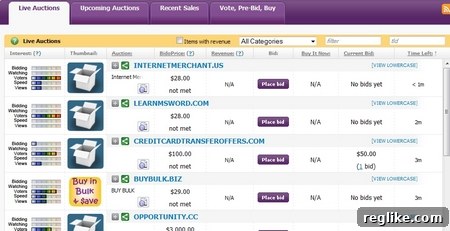
This escalating complexity was detrimental on several fronts. New users, encountering a bewildering array of choices and an overly intricate domain submission process, were often intimidated and quickly abandoned the platform. The sheer number of options for submitting a domain, coupled with changing rules and features, made the user journey confusing and frustrating. This directly impacted inventory quality, as only the most persistent or least discerning sellers continued to list. Bido began to be perceived as a place to “dump” domains whose annual registration fees were approaching, rather than a marketplace for high-value assets.
From a business perspective, managing and selling a high volume of low-value domains (e.g., under $100) requires almost the same amount of platform resources and administrative effort as selling a single domain for $10,000. This created a highly inefficient and financially draining proposition. The platform became a money-losing endeavor, trapped in a cycle where poor inventory led to low prices, which in turn deterred quality sellers, further exacerbating the inventory problem.
Bido’s Enduring Legacy: Pioneering Innovations
Despite the challenges and its ultimate closure, Bido deserves significant commendation for its relentless drive to innovate. In an industry where major marketplaces often take a considerable time to adopt new features, Bido was a trailblazer, pushing the boundaries of what a domain auction platform could be. Many of its pioneering features, though perhaps ahead of their time or not perfectly executed, will undoubtedly influence future domain marketplaces – possibly even a “new” Bido.com, should it emerge. Here are some of its most notable contributions:
1. Economic Incentives in Auction Submissions
One of the persistent headaches for domain auctioneers is sifting through tens of thousands of domain submissions, with the vast majority being of low quality or “junk.” Bido recognized this fundamental problem and ingeniously sought to address it by implementing economic incentives for sellers. The idea was to encourage the submission of genuinely valuable domains at realistic prices by structuring the submission process with financial implications, aiming to align the seller’s interest with the platform’s need for quality inventory. This innovative approach attempted to filter out low-quality submissions at the source, saving considerable time and resources on vetting.
2. Fostering Social Interaction and Community
In the vast majority of domain marketplaces, interaction between buyers and sellers is minimal, often limited to private messages or post-auction communication. Bido broke this mold by enabling public chat and commenting functionalities directly on domain listings. This seemingly simple addition had a profound impact, transforming Bido from a transactional platform into a vibrant community hub. A dedicated group of domainers made Bido a focal point of their daily routine, discussing domains, sharing insights, and building camaraderie. This social layer enriched the user experience significantly, turning a solitary activity into a communal one.
3. Harnessing the Wisdom of the Crowds
Bido tapped into the power of collective intelligence through its “bid for profits” system. This innovative feature allowed users to vote for domains they believed would sell well, essentially democratizing the domain selection process. By leveraging the combined knowledge and instincts of its active user base, Bido sought to identify and elevate higher-quality domains for auction. This “wisdom of the crowds” approach was a brilliant mechanism for vetting potential listings and ensuring that the most promising domains received visibility, potentially leading to better sales outcomes.
4. Mastery of Social Media Engagement
Long before social media became an indispensable tool for marketing, Bido demonstrated an exceptional aptitude for leveraging these nascent platforms. More than any other domain seller or marketplace of its time, Bido effectively utilized blogs and social media channels to promote its auctions, engage with its community, and disseminate information. This proactive and skillful use of social media not only generated significant buzz and traffic but also helped build a strong brand identity and a loyal following, showcasing a forward-thinking approach to digital marketing.
Lessons Learned from Bido’s Journey
Bido’s two-year tenure, though ending in closure, offers invaluable lessons for startups, entrepreneurs, and established businesses within the domain industry and beyond:
- Simplicity vs. Feature Creep: The delicate balance between innovation and maintaining a simple, intuitive user experience is paramount. While innovation is crucial, overwhelming users with too many features can lead to confusion, decreased engagement, and a diluted value proposition. A Minimum Viable Product (MVP) approach, focused on core functionality, often serves as a stronger foundation.
- Sustainable Business Model First: A clever idea is not enough without a robust and scalable business model. Early and rigorous testing of financial viability is essential to ensure long-term sustainability, rather than hoping volume or higher prices will materialize.
- Inventory Quality is King: For any auction or marketplace, the quality of inventory is a direct reflection of the platform’s health and desirability. Attracting and retaining high-value listings should be a constant priority, as poor inventory can create a negative feedback loop.
- User Experience is Non-Negotiable: A confusing interface, frequent changes, or an overly complex process will alienate users, regardless of how innovative the underlying features are. User-centric design and consistent experience are critical for retention and growth.
- The Value of Community: Bido proved that fostering a sense of community and enabling social interaction can significantly enhance user engagement and platform stickiness. This goes beyond mere transactions, building a loyal base that champions the platform.
Concluding Thoughts: A Toast to Bido’s Spirit
In conclusion, my hat’s off to Bido and its visionary founders. It’s easy for “drive-by detractors” to criticize from the sidelines, but the monumental effort required to conceive, build, and operate a company from the ground up, especially one attempting to disrupt an established market, is immense. Bido certainly had its flaws and challenges, but its courage to experiment and innovate has undeniably left an imprint on the domain industry.
To any future buyer or inheritor of the Bido.com assets, I extend my best wishes. The platform showcased a pioneering spirit, and the core ideas behind its innovations remain highly relevant. May the essence of Bido, with its focus on community, intelligent curation, and user engagement, live on and inspire future advancements in the dynamic world of domain names.