
Do automated domain name appraisals truly work? Can they accurately determine a domain’s market value? This is a question that consistently sparks debate within the dynamic domain name industry, often leading to varied and sometimes contradictory answers.
The inherent complexity of domain valuation makes it a challenging endeavor, whether undertaken by sophisticated algorithms or seasoned human experts. As we delve into the intricate world of domain transactions, it becomes clear that while automated appraisal tools offer valuable insights, they also come with significant limitations that astute domain investors, buyers, and sellers must understand.
My recent analysis of end-user sales reports once again brought this debate to the forefront. It’s not uncommon for observers to comment on seemingly low sale prices for certain domains, prompting questions about how these valuations are reached and whether they reflect true market worth. To shed light on this, I conducted a non-scientific sample examination of recent Afternic sales, comparing actual transaction prices against the valuations provided by a prominent automated appraisal tool, Estibot.
The initial focus was on the top 15 reported sales from the past week. The findings, illustrated in the comparison below, reveal a fascinating dichotomy:
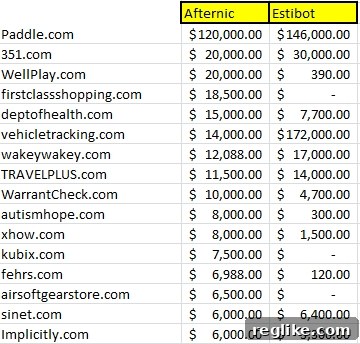
As you can clearly see, some valuations from Estibot were remarkably close to the actual sale prices, demonstrating a degree of accuracy. However, a significant number of appraisals were considerably off the mark, with some values being either drastically higher or lower than what buyers ultimately paid. This initial observation immediately highlights the types of domains where automated appraisals tend to struggle, often failing to capture the full spectrum of market dynamics.
To further broaden our understanding and avoid drawing premature generalizations, I extended this comparison to Afternic sales that more closely reflect the venue’s mean domain sale value, which hovers around $1,200. This allowed for an examination of how automated tools perform on more “average” transactions:
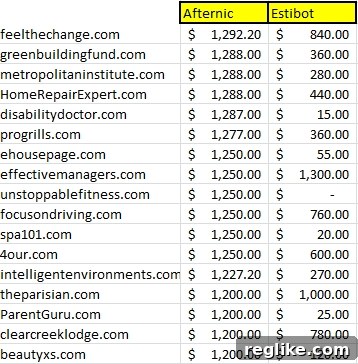
In this second sample, a majority of these domains received valuations “in the range” of their selling price. However, a noticeable trend emerged: Estibot tended to peg these domains a bit lower than their actual sale prices. This consistent pattern across different value tiers suggests that while automated tools can provide a baseline, they might often undervalue certain aspects that contribute to a domain’s real-world market appeal.
Unpacking the Limitations: Four Key Generalizations About Automated Domain Valuation
Based on over a decade of experience within the domain name industry, observing countless sales and appraisal attempts, I’ve developed several key generalizations regarding automated domain valuation techniques. These insights are crucial for anyone looking to either buy, sell, or manage a portfolio of domain names effectively.
1. Automated Appraisals Primarily Focus on Data-Specific Elements
The core methodology of automated appraisal tools like Estibot revolves around quantifiable data points. When you run an appraisal, you’re typically presented with a wealth of information: keyword frequency, Cost-Per-Click (CPC) rates, search volume, age of the domain, TLD popularity, domain length, presence of hyphens or numbers, and sometimes even estimated traffic. These are the kinds of objective, data-specific elements that can be readily processed and analyzed by algorithms to generate a valuation.
While this data is undoubtedly valuable, it represents only a fraction of what truly drives a domain’s market value. Algorithms excel at pattern recognition within structured data but struggle immensely with subjective factors such as brandability, memorability, market trends, cultural relevance, potential for development, or the emotional connection an end-user might have with a specific name. They cannot gauge the “feel” of a domain or its strategic fit for an emerging business concept. This reliance on purely quantitative metrics means that a significant portion of a domain’s intrinsic and perceived value often goes uncaptured.
2. Automated Appraisals Often Miss the Mark on Unique and Generic Domains
One of the most significant challenges for automated tools is accurately valuing generic, brandable, or highly specific domain names that might resonate deeply with a particular end-user. How can an algorithm like Estibot possibly account for the sudden emergence of a startup that decides to name their business “Kubix.com” or a similar, seemingly arbitrary, yet perfectly brandable term? It’s exceptionally difficult, if not impossible, for code to predict such specific, unique demand.
For a domain name like Kubix.com, an automated appraisal might logically assign a low valuation based on its lack of immediate keyword relevance or high search volume. Yet, a motivated buyer with a strong vision for their brand could pay $7,500, as was the case with Kubix.com, because for them, that specific name perfectly aligns with their business identity and future aspirations. This disparity highlights the gap between a data-driven “commodity” valuation and the “end-user” value driven by specific business needs and branding strategies. These tools are simply not designed to predict the specific circumstances or desires of a single, highly motivated buyer, which often dictate the true ceiling price for such names.
3. Actual Sales Prices Are Heavily Influenced by Buyer and Seller Circumstances
The domain trading market is, by its very nature, a relatively inefficient one. Unlike highly liquid markets where assets trade at a universally accepted value, domain sales are often subject to the unique circumstances of both the buyer and the seller. This inefficiency means that comparable sales data (comps) can be difficult to accurately conjure up, and even when available, they may not fully reflect the dynamic interplay of individual motivations.
Consider the top sales reported on Afternic recently: Kubix.com for $7,500, AirsoftGearStore.com for $6,500, and FirstClassShopping.com for $18,500. Many of these domains might have sold for significantly less had their owners not possessed the financial stability and patience to “hold out” for the right buyer and the right price. If a domain owner faced an urgent need for capital, they might be compelled to accept a fraction of these prices. This “holding power” on the seller’s side is a critical, yet unquantifiable, factor that automated systems cannot possibly integrate into their calculations.
Conversely, the buyer’s circumstances play an equally vital role. Take WellPlay.com, which sold for an impressive $20,000. Estibot had valued it at a mere $390. Before knowing the sale price, I might have estimated its worth at around $1,000 to the “right” buyer. The significant disparity arose because a substantial, strategic buyer stepped forward. While the identity of this buyer might not be public, it’s known that they leveraged services like Marksmen, often utilized by large entities for strategic domain acquisitions. This illustrates how a specific, well-funded buyer with a clear vision can drive the price far beyond any algorithmic prediction, demonstrating the immense value of a domain when it perfectly fits a corporate strategy or a major marketing initiative.
4. Automated Appraisals Have a Crucial and Undeniable Place
Despite their limitations, it would be a mistake to dismiss automated appraisals entirely. In fact, I firmly believe they are incredibly important and possess a legitimate, valuable role within the domain name business. Their utility is particularly pronounced for large portfolio holders who manage hundreds, if not thousands, of domain names.
For such individuals or entities, automated appraisals offer the only truly efficient way to “separate the wheat from the chaff.” Manually appraising every single domain in a vast portfolio would be an impossibly time-consuming and expensive task. Automated tools provide a quick, scalable first pass, helping identify potential high-value assets that warrant further human review, as well as flagging low-value domains that might be candidates for deletion or quick liquidation.
Crucially, in the long run, automated appraisals are often directionally correct. They can accurately identify general trends and differentiate between categories of domains. For example, they can generally distinguish between a premium .com, a generic keyword-rich domain, and a niche, less desirable name. The most common and perhaps most valuable scenario is when an automated appraisal helps an owner discover that one of their domain names is worth significantly more than they initially thought. This often occurs because the appraisal identifies specific data points about the domain—such as a changing use of a particular term, increased search volume, or related registrations—that the owner might not have been aware of. In this capacity, automated tools serve as an excellent starting point and an invaluable alert system, guiding further human investigation and potentially uncovering hidden gems within a portfolio.
Beyond Algorithms: Understanding the Multifaceted Layers of Domain Value
To truly grasp domain valuation, we must look beyond what algorithms can process. The value of a domain name is a complex tapestry woven from various threads, many of which are subjective and evolve with market trends and technological advancements. What makes a domain truly valuable often lies in its potential and perception, rather than just its raw data points.
Brandability and Memorability: A domain that is easy to remember, pronounce, and type has inherent value. Brandable domains, even if they don’t contain exact keywords, can command high prices due to their marketing potential and ability to create a strong brand identity. This qualitative aspect is nearly impossible for an algorithm to quantify.
Relevance to Target Audience: A domain’s value is significantly boosted if it directly appeals to a specific market or niche. For example, a domain ending in “.store” might be perfect for an e-commerce business, even if its individual words don’t have extremely high CPCs.
Scarcity and Age: Shorter, older domains, especially those in popular TLDs like .com, are inherently scarcer. The limited supply of truly premium, short, and memorable domains drives up their value. Older domains can also carry historical SEO benefits, which, while diminishing, can still be a factor.
Future Development Potential: Sometimes, a domain’s true value lies in what it *could* become. A simple, broad domain might be acquired with the vision of building a massive online platform, a global brand, or a vital community hub. Automated appraisals cannot predict entrepreneurial vision or market shifts that might elevate a seemingly average domain to extreme prominence.
Emotional and Strategic Value: For many end-users, a domain isn’t just an asset; it’s the online embodiment of their business or passion project. The emotional connection or strategic importance of securing a perfect-fit domain can override any purely numerical appraisal, driving prices upwards significantly, as seen with WellPlay.com.
Conclusion: A Balanced Perspective on Domain Valuation
In conclusion, the question of whether automated domain name appraisals “work” is not a simple yes or no. They do work, but within defined parameters and with notable limitations. Automated tools like Estibot are invaluable for their ability to process vast amounts of data quickly, providing directional correctness and serving as essential filtering mechanisms, especially for large domain portfolios. They can highlight potential opportunities and flag domains that warrant further investigation, often uncovering value an owner might have overlooked.
However, these tools are not infallible and should never be considered the sole authority on a domain’s worth. They fundamentally lack the capacity to account for the nuanced human elements that often dictate real-world transaction prices: the unique motivations of buyers and sellers, the inefficiencies of the market, the intangible power of brandability, and the strategic vision of an entrepreneur. True domain valuation is a holistic exercise that combines the objective data provided by automated tools with the subjective insights, market experience, and strategic understanding that only human expertise can provide. For optimal results, domain investors and businesses should leverage automated appraisals as a powerful initial screening tool, always complementing them with a deeper human analysis to truly unlock and understand the multifaceted value of their digital assets.