
The Curious Case of DotChicago: Trademark, TLD Aspirations, and a Unique Digital Strategy
In the dynamic and often complex world of digital identity and domain names, the narrative surrounding Chicago.com Inc. presents a compelling paradox. This prominent digital entity has made a strategic move by filing a trademark application for the ‘DotChicago’ mark with the U.S. Patent and Trademark Office (USPTO), a clear indication of its long-standing commitment to a Chicago-centric online presence. Yet, intriguingly, the company’s founder, Josh Metnick, confirms that Chicago.com Inc. has not pursued the official Top-Level Domain (TLD) .Chicago through ICANN’s rigorous application process. This nuanced decision, coupled with decades of fostering a robust ecosystem of third-level domains, unveils a distinctive and unconventional approach to digital branding and market penetration within one of America’s most iconic cities.
Understanding the Digital Landscape: TLDs vs. Trademarks
To fully grasp the intricacies of Chicago.com Inc.’s strategy, it is essential to differentiate between a Top-Level Domain (TLD) and a trademark. A TLD represents the final segment of a web address, such as .com, .org, or the newer generic TLDs (gTLDs) like .app, .shop, or even geographically specific ones like .nyc or .london. These digital frontiers are meticulously governed by ICANN (Internet Corporation for Assigned Names and Numbers). Securing a TLD involves a demanding, capital-intensive, and highly competitive application process. Once an entity is approved as a registry operator, it assumes the responsibility for managing all second-level domains (e.g., yourbusiness.chicago) that fall under that specific TLD.
In contrast, a trademark serves as a distinctive mark, design, or phrase that legally identifies and differentiates the goods or services of one source from those of others. In the United States, trademarks are registered with the USPTO and are fundamental for protecting brand names, logos, and slogans against infringement. Chicago.com Inc.’s proactive step to trademark “DotChicago” falls squarely within this realm, aiming to safeguard this identifier specifically in connection with domain registration services. This distinction is critical: the ownership of a trademark does not automatically confer rights to a corresponding TLD, nor vice-versa, though a well-established trademark can certainly fortify an argument in a TLD application process.
The ‘DotChicago’ Trademark: A Strategic Niche in Domain Services
On May 31, Chicago.com Inc. officially lodged its trademark application for the “DotChicago” mark with the U.S. Patent and Trademark Office. The application’s scope is clearly defined: it pertains to “Domain name registration services; Domain name registration services, namely, conducting domain name searches for the purpose of providing legal advice on domain name registration.” This strategic filing underscores Chicago.com Inc.’s dedication to solidifying its brand identity and expertise within the domain services sector, specifically around digital identifiers intrinsically linked to the city of Chicago.
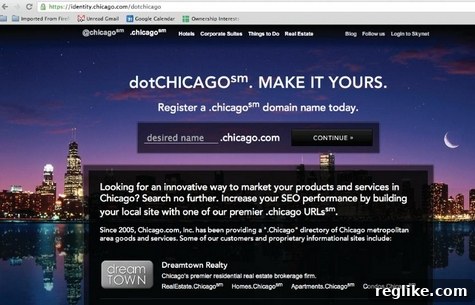
The application details that Chicago.com Inc. claims continuous commercial use of the “DotChicago” mark dating back to “as early as 05/01/2012.” As concrete proof of this established usage, the filing included a copy of a specific page from Chicago.com’s website. This documentation is crucial for establishing the company’s historical claim and ongoing engagement with the ‘DotChicago’ concept, thereby bolstering its legal standing for trademark protection. Nevertheless, as founder Josh Metnick candidly conveyed, this trademark endeavor deliberately excluded a bid for the actual .Chicago Top-Level Domain from ICANN, leaving the ultimate stewardship of the city’s official TLD an unresolved and intriguing possibility.
Pioneering Digital Identities: Two Decades of Third-Level Domains
Despite the absence of a direct pursuit for the .Chicago TLD, Chicago.com Inc. has been far from passive in shaping its digital footprint. A closer examination of the webpage referenced in their trademark application reveals a cornerstone of their long-standing operational strategy: the successful offering of third-level domains. These domains are structured as `subdomain.chicago.com`, distinct from the second-level domains (e.g., example.chicago) that would typically reside directly under an official .Chicago TLD. For example, rather than striving for `realestate.chicago`, their current offerings manifest as `realestate.chicago.com` or `yourbusiness.chicago.com`.
Josh Metnick has confirmed that Chicago.com Inc. has been actively curating what it describes as a “.Chicago directory of Chicago metropolitan area goods and services” since as far back as 2005. This remarkable longevity means that for nearly two decades, the company has diligently built a comprehensive digital ecosystem around its primary `chicago.com` domain. This platform empowers local businesses and individuals to secure personalized, location-specific digital identities. The examples frequently displayed on their verification page often resolve to simple Google Sites pages, underscoring the accessibility and practical utility of these third-level domain solutions for a wide range of users.
Bridging the Gap: Clarifying Digital Identity for a Broad Audience
The subtle distinctions between a top-level domain, a second-level domain, and a third-level domain can be a source of considerable confusion, particularly for those not immersed in the intricacies of internet infrastructure. As Metnick candidly observed, “for domainers it’s probably confusing, but for most business owners it’s not.” This insight highlights a fundamental challenge within the domain industry: effectively conveying complex technical hierarchies to a general audience. While seasoned domain professionals might meticulously analyze every segment of a web address, an average local entrepreneur might simply perceive `yourbusiness.chicago.com` as an appealing, locally branded web presence for their enterprise.
Recognizing this potential for misunderstanding, Chicago.com Inc. has strategically employed other communication channels to simplify its offerings. For instance, their messaging on the official @chicago Twitter page is notably more direct and user-friendly: “Get [email protected] or register your idea.chicago.com.” This streamlined approach skillfully sidesteps technical jargon, instead emphasizing the tangible advantages of acquiring a localized, memorable digital identity for both email and web services. This pragmatic and clear communication strategy has undoubtedly played a significant role in their success in cultivating a specialized niche within Chicago’s competitive digital market.
A Robust Track Record and a Multi-Layered Trademark Portfolio
Indeed, Chicago.com Inc. boasts a proven track record of success in distributing and managing digital identities under its well-established `chicago.com` umbrella. Their strategic vision extends beyond merely providing web addresses; it encompasses the sale of personalized email addresses, such as `[email protected]`. This integrated service model often results in customers who purchase an email address also acquiring the corresponding rights to a third-level domain, thereby creating a seamless and convenient digital package. This innovative approach has allowed the company to cultivate a loyal customer base and generate a substantial revenue stream over many years.
The company’s steadfast commitment to intellectual property protection is further evidenced by its comprehensive trademark portfolio. Beyond the recent “DotChicago” application, Chicago.com Inc. holds two officially granted U.S. trademarks, including “THE .CHICAGO LOWDOWN” for its newsletter, showcasing a consistent and proactive effort to safeguard its associated branding elements. Intriguingly, the company previously attempted to register “.chicago” (implying a TLD or a direct second-level domain) with the U.S. Patent and Trademark Office back in 2005 but was unsuccessful in that endeavor. Despite this setback at the federal level, Chicago.com Inc. has successfully secured numerous state of Illinois trademarks, notably including for “.chicago” itself. This multi-layered approach demonstrates a sophisticated strategy for protecting its brand assets across various legal jurisdictions.
Adding another layer of complexity to their strategy, Chicago.com Inc. has also filed trademarks for several of its third-level domains, but structured these filings in a way that makes them appear akin to second-level domains. A prime illustration of this tactic is the trademark application for “realestate.chicago.” This seemingly minor detail could carry significant implications, particularly if an official .Chicago TLD were ever to be launched. Such filings might be interpreted as an attempt to establish a perceived right or a strong associative claim to a future second-level domain under a hypothetical official TLD, potentially setting the stage for future legal disputes or ownership discussions in the dynamic domain space.
The Aspirations for a True .Chicago Top-Level Domain: Challenges and Vision
This intricate history and current strategic positioning naturally lead to the paramount question: what is the company’s stance on acquiring the actual .Chicago Top-Level Domain? Josh Metnick readily admits to this ambitious goal. “We want to own the top level domain,” he states unequivocally. “That’s our goal.” His rationale is deeply rooted in Chicago.com Inc.’s extensive, long-term use and profound association with the name. He emphasizes, “We’ve been using the name since 2005 and we don’t know anyone else who’s using it…They’re our marks. We were the first ones using them.” This assertion forms the core of their potential claim to the TLD.
However, Metnick is pragmatic about the significant undertaking involved. He acknowledges that applying for, securing, and subsequently managing a TLD is an monumental endeavor, demanding substantial financial investment and robust technical resources. He suggests that his company may pursue the .Chicago TLD in the future, but only “if it has the resources.” The most recent ICANN new gTLD program, which concluded its application phase in 2012, entailed application fees alone of $185,000 per submission. Beyond that, there are substantial ongoing operational costs for registry management, maintaining complex technical infrastructure, and ensuring continuous compliance with ICANN’s stringent regulations. For a geographically specific TLD like .Chicago, additional hurdles could include garnering widespread community support from local stakeholders or navigating potential interests from governmental bodies.
The potential emergence of an official .Chicago TLD introduces a fascinating and complex scenario. If another entity were to successfully apply for and launch .Chicago, it could create a multifaceted environment for digital identity within the city. Chicago.com Inc.’s extensive prior use and its robust portfolio of state-level trademarks for “.chicago” and related identifiers could provide a strong foundation for legal challenges or at the very least, a significant claim to preferential treatment during the TLD’s “sunrise” period, which typically allows trademark holders to register domains first. Conversely, a failure to secure the TLD could, in the long run, diminish the perceived value and authority of their current third-level domain strategy, as the official TLD would naturally command greater recognition and prestige.
Conclusion: A Pioneering Path in Shaping Chicago’s Digital Identity
Chicago.com Inc.’s journey with the “DotChicago” trademark and its long-established third-level domain strategy stands as a compelling testament to innovation within the ever-evolving digital identity space. By artfully leveraging an existing powerful domain and ingeniously offering localized web and email addresses for nearly two decades, the company has successfully cultivated a rich and intricate digital ecosystem. Their strategically executed trademark filings, while not directly securing the ultimate .Chicago TLD, undoubtedly lay crucial groundwork and assert a strong historical claim to this vital identifier. As the internet continues its rapid evolution, and the prospect of the next round of gTLD applications potentially approaches, Chicago.com Inc.’s eventual decision regarding the .Chicago TLD will represent a pivotal moment. This choice will not only shape the future trajectory of their own enterprise but also potentially redefine the digital landscape of the iconic Windy City itself. This ongoing saga beautifully illustrates the intricate and often delicate interplay between branding, intellectual property rights, and the continually architectural transformation of the internet.