
Unlocking Potential: Are .Radio’s Generic Domain Rules Stifling Innovation?
The dawn of new top-level domains (TLDs) brought with it a promise of greater specialization, clearer branding, and dedicated online spaces for various communities and industries. Among these, ‘community TLDs’ like .radio were specifically designed to serve and protect their respective sectors. However, a crucial question arises: at what point do the protective measures intended for a community TLD cross the line, transitioning from safeguarding its members to actively stifling innovation and limiting its own potential for growth?
Many community-oriented TLDs implement stringent restrictions aimed at preventing domain investors and speculators from monopolizing valuable names, ensuring that these digital assets remain in the hands of legitimate community members. While this intent is commendable, the case of the .radio TLD, operated by the European Broadcasting Union (EBU), prompts a serious reflection on whether such policies can, in practice, be taken too far, inadvertently harming the very community they aim to serve.
The .Radio TLD: A Noble Vision with Restrictive Realities
The .radio TLD was established with the ambitious goal of creating a dedicated online home for the global radio community. Its vision was to provide a recognizable and trusted space for broadcasters, radio stations, podcast creators, and associated services. To achieve this, the European Broadcasting Union, as the registry operator, put forth a registration policy designed to prevent speculative registrations and ensure domains are used by bona fide radio entities. Central to this policy are its rules regarding generic names, which have become a point of contention and a bottleneck for genuine innovation.
Understanding .Radio’s Generic Name Policies
The .radio registration policy outlines specific conditions for registering generic names. Let’s delve into the key clauses that dictate what can and cannot be registered:
A. Generic names
Generic names (understood in this context as any word that contains a class or group of things) can only be registered by registrants whose company name, commercial name, or any of its commercial activities associated with that registrant broadcasting business do have a connection with said generic name.
B. Generic names with specific significance for the .radio community
Certain generic names with specific meaning for the .radio community (categories of radio stations of services, news, info, musical styles or genres, radio-related technologies, etc.) may not be registered. Such names should be reserved for community oriented usages. Registry Operator may consider specific requests for said names once the appropriate procedure is adopted and published in https://nic.radio/policies.
Names registered bypassing this provision may be suspended or even cancelled by the Registry Operator.
These policies, on the surface, appear to be a robust defense against cybersquatting and domain warehousing. They aim to keep names like “music.radio” or “news.radio” for collective community use or for entities with a direct, demonstrable link to those terms within their core broadcasting activities. However, the interpretation and enforcement of these rules can lead to outcomes that undermine the very purpose of the TLD.
The Case Study: Victory 91.5 and Ondemand.Radio
To illustrate the practical implications of these stringent policies, consider the experience of Victory 91.5, a Christian radio station based in Atlanta. As an active member of the radio community, Victory 91.5 was an early adopter, participating in the .radio Pioneers program. This allowed them to secure Victory.Radio before general availability, a domain they actively use for their online presence, demonstrating their genuine involvement and commitment to the .radio ecosystem.
When .radio became generally available late last year, Victory 91.5 identified a clear opportunity for expansion. Recognizing the evolving landscape of radio consumption, where on-demand streaming is increasingly prevalent, the station launched its own streaming music platform. To brand this new service effectively and intuitively for their audience, they registered ondemand.radio. This choice was not only logical but also perfectly aligned with their active broadcasting business and its new digital offerings.
However, a few weeks after this seemingly legitimate registration, Victory 91.5 received a disconcerting cancellation notice from the .radio registry:
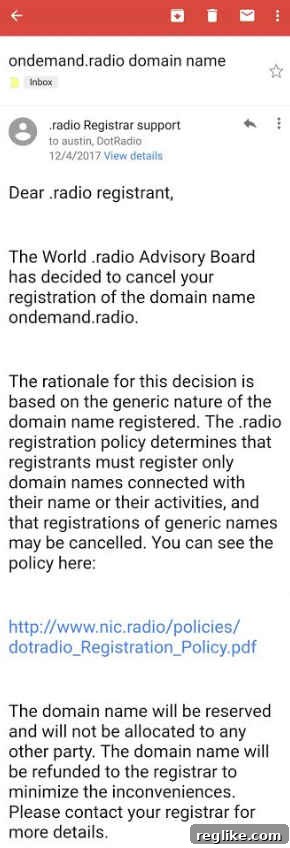
The cancellation of “ondemand.radio” for an active, legitimate radio station providing an on-demand service highlights a critical flaw in the current policy’s application. While one might argue this falls under “Generic names with specific significance for the .radio community” (Clause B), the fact that the registrant is a bonafide radio station directly engaged in “on-demand” broadcasting activities makes the cancellation puzzling. It suggests an interpretation that prioritizes literal generic term reservation over the actual, innovative use by a community member.
The Counterproductive Nature of Overly Restrictive Policies
Taking away a domain like “ondemand.radio” from an established radio station that is actively using it for a relevant service is not merely an isolated incident; it represents a significant missed opportunity for the entire .radio TLD and the broader broadcasting industry. Such decisions lead to several counterproductive outcomes:
- Stifling Innovation and Digital Transformation: The radio industry is undergoing a profound digital transformation. Listeners are increasingly consuming content through streaming, podcasts, and on-demand services. A TLD dedicated to radio should embrace and facilitate this evolution, not hinder it. By preventing legitimate broadcasters from registering descriptive and intuitive domains for their new digital offerings, .radio discourages innovation and pushes community members to use other, less relevant TLDs.
- Limiting TLD Growth and Adoption: The .radio TLD currently has a relatively modest number of registered names in its zone file (around 2,500 according to the original text). This low adoption rate is, in part, a direct consequence of its restrictive policies. When legitimate use cases are denied, potential registrants are deterred, leading to stagnant growth and underutilization of the TLD’s potential.
- Undermining Organic Marketing and Brand Visibility: One of the most powerful advantages of a niche TLD like .radio is the organic marketing it can generate. Imagine a radio DJ saying, “Stream our station at something.radio.” Every such mention is a free, authentic advertisement for the .radio extension itself. If valuable, memorable, and descriptive domains are unavailable or revoked, this crucial word-of-mouth promotion is severely curtailed. Similarly, if a person uses a domain with a new TLD for email, then every email they send is an advertisement for that TLD!
- Creating Frustration and Disillusionment within the Community: When genuine community members, who are actively investing in the TLD, face arbitrary cancellations, it breeds frustration and disillusionment. This can lead to a withdrawal of support, making it harder for the TLD to achieve its stated mission of serving and uniting the global radio community.
While the initial intent of community TLDs to protect against speculation is understandable, the key lies in striking a transparent and consistent balance. As long as restrictions are handled with clear communication and fairness, the power ultimately rests with the operator. However, the efficacy of the operator’s approach must be continuously evaluated against its impact on the community it purports to serve.
A Call for Flexibility: Reimagining .Radio’s Future
The .radio TLD holds immense potential. It has a built-in advantage of having registrants who are inherently in the media business, constantly promoting their content and, by extension, their domain extension. This unique characteristic should be leveraged, not stifled. To truly become a vibrant and indispensable online home for the radio community, the EBU should consider a more flexible and forward-thinking approach to its domain registration policies.
Suggestions for improvement could include:
- Nuanced Interpretation of “Generic”: Differentiating between speculative registration of generic terms and the legitimate, innovative use of a descriptive generic term by an active broadcasting entity.
- “Use It or Lose It” Principle: Prioritizing actual use within the radio community. If a community member actively uses a generic domain for a relevant service, this should be a strong factor in its favor, even if the term is generic.
- Fair and Transparent Appeal Process: Establishing a clear and accessible appeal process for registrants whose domains are challenged or cancelled, allowing them to present their case for legitimate use.
- Encouraging Innovation-Driven Registrations: Actively encouraging and facilitating the registration of domains that support new and evolving aspects of the radio industry, such as podcasting, digital streaming, and interactive content platforms.
- Tiered Registration or Prioritized Access: Implementing mechanisms that give active members of the radio community priority or preferential access to certain generic terms, rather than outright banning them for legitimate use.
By adapting its policies to reflect the dynamic nature of the broadcasting industry and prioritizing genuine utility over overly strict semantic interpretation, .radio could dramatically increase its adoption, become a true hub for digital radio innovation, and ultimately fulfill its promise to the global radio community. The goal should be to empower broadcasters, not to inadvertently restrict their digital expansion in an increasingly competitive media landscape. It’s time for .radio to embrace its full potential and truly serve as a beacon for the future of radio online.