
A fascinating legal battle is unfolding in the digital assets space, pitting a newly established business against a long-held domain name. At the heart of the dispute lies the domain CryptoSecurities.com, which was registered back in 2013, against a plaintiff whose business concept and trademark application only emerged in early 2018. This significant chronological discrepancy forms the crux of a lawsuit that raises critical questions about trademark law, domain registration ethics, and the evolving landscape of digital identity in the cryptocurrency era.
The CryptoSecurities Domain Dispute: A Clash of Timelines and Trademarks
In an increasingly digital world, a domain name is more than just an address; it’s a cornerstone of brand identity and business operations. This principle is being rigorously tested in a recent lawsuit filed by Castro & Co, the entity behind CryptoSecurities.exchange, against the owner of the domain CryptoSecurities.com. The plaintiff, a law firm by profession, launched their business on a domain registered mere months ago and now seeks to claim rights over a domain that has existed for nearly a decade.
Unpacking the Plaintiff’s Claims: A “Federal Trademark” and Extensive Marketing
The lawsuit, initiated by Castro & Co, asserts a strong claim over the term “CRYPTOSECURITIES.” Specifically, the plaintiff states to possess “a federal trademark registration, no. 87756075, for the mark CRYPTOSECURITIES.” Furthermore, the complaint highlights the plaintiff’s alleged extensive efforts to cultivate its brand, stating, “Plaintiff has engaged in extensive marketing activities in connection with its mark CRYPTOSECURITIES, and has expended significant resources to develop its goodwill in and consumer identification with the mark.” These assertions are typical of trademark infringement cases, where brand recognition and investment are presented as evidence of proprietary rights.
The Nuances of Trademark Registration: “Intent-to-Use” and Provisional Rights
While the plaintiff’s claim of a federal trademark registration sounds formidable, a closer look at the details reveals a crucial distinction. The cited “federal trademark registration” is not yet a fully granted registration based on active use, but rather an application. This application, filed on January 16, 2018, was made on an “intent-to-use” basis. An “intent-to-use” application signifies that the applicant has a bona fide intention to use the mark in commerce but has not yet done so. While it reserves a place in line for future registration, it does not confer the same immediate rights as a mark already in active use and fully registered. This distinction is paramount in intellectual property disputes, particularly when challenging existing domain registrations.
The Timeline Discrepancy: A Critical Factor in Domain Disputes
Perhaps the most compelling aspect of this lawsuit is the stark contrast in timelines between the defendant’s domain registration and the plaintiff’s business inception. Cryptosecurities.com, the target of the lawsuit, was registered as early as 2013. For context, this was a time when Bitcoin was trading under $1,000, and the broader concept of “crypto securities” was nascent, if not entirely theoretical for most. The domain has been under consistent Whois privacy protection since at least 2014, suggesting continuous, albeit private, ownership.
In contrast, the plaintiff’s business, operating under Cryptosecurities.exchange, was launched on a domain registered much more recently—on February 20 of this year. Furthermore, the plaintiff’s own website features a timeline that candidly outlines the origin of their business idea, dating it to January 2, 2018. This “genesis moment” is described as:
“The Genesis of CSX. Dr. Castro texts Mo Iqbal at 11:41pm stating ‘You can basically create a stock exchange that’s blockchain-based.’”
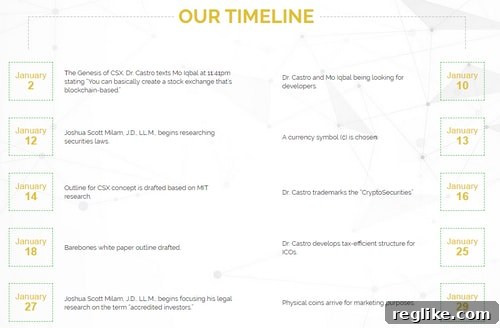
This internal timeline explicitly places the conception of the plaintiff’s business several years after CryptoSecurities.com was first registered. This chronological conflict creates a significant challenge for the plaintiff in proving a critical element of domain disputes: “bad faith” registration.
Proving “Bad Faith”: The Uphill Battle for the Plaintiff
In domain name disputes, especially those alleging cybersquatting or “bad faith” registration, a plaintiff typically needs to demonstrate that the defendant registered the domain with the specific intent to profit from or unfairly capitalize on the plaintiff’s trademark. The Anticybersquatting Consumer Protection Act (ACPA) and UDRP (Uniform Domain-Name Dispute-Resolution Policy) are the primary legal frameworks for such cases, and both require strong evidence of malicious intent.
Given that CryptoSecurities.com was registered in 2013—long before Castro & Co conceived of their business, filed their “intent-to-use” trademark application, or even registered their domain—it becomes exceedingly difficult for the plaintiff to argue that the defendant registered CryptoSecurities.com in “bad faith” to specifically target the plaintiff’s non-existent trademark. The concept of “bad faith” hinges on knowledge and intent at the time of registration. It is highly improbable that the defendant in 2013 could have foreseen, let alone intended to exploit, a trademark that would not be conceived until 2018.
This situation often leads to accusations of “reverse domain hijacking,” where a trademark holder attempts to use the legal system to unfairly acquire a domain name from its legitimate registrant, despite the trademark rights arising much later than the domain registration.
The Value of Foresight: Early Domain Registrations in Emerging Industries
The cryptocurrency and blockchain industry has experienced an explosive boom in recent years, making domain names related to these technologies incredibly valuable. Terms like “cryptocurrency,” “blockchain,” “token,” and “security token” have evolved from niche jargon to mainstream financial concepts. Individuals and entities who registered such generic yet descriptive domains years ago often did so with foresight, anticipating future trends, or simply for speculative investment, which is a legitimate practice in the domain market.
The early registration of CryptoSecurities.com in 2013 can be seen as an example of such foresight. At that time, “crypto securities” was a visionary term, perhaps even ahead of its commercial viability. To suggest that such an early registration was made in “bad faith” against a trademark that did not exist for another five years fundamentally misunderstands the principles of trademark law and domain name ownership.
Potential Outcomes and Legal Precedents
This case presents a compelling scenario for the courts to consider the interplay between early domain registration, the evolution of nascent industries, and the timing of trademark protection. Legal precedents generally lean heavily on the “first-in-time, first-in-right” principle, especially in domain disputes. While trademark rights can sometimes supersede older domain registrations, this typically occurs when the domain was registered specifically to exploit a well-established mark. In this instance, the chronological order strongly favors the defendant.
It is likely that the court will scrutinize the plaintiff’s arguments for “bad faith” with a high degree of skepticism, given the clear timeline discrepancies. The burden of proof rests firmly on Castro & Co to demonstrate how the owner of CryptoSecurities.com could have registered the domain in 2013 with an intent to target a trademark that wouldn’t exist until 2018. Without compelling evidence to bridge this temporal gap, the plaintiff’s case faces significant hurdles and could potentially be dismissed.
Conclusion: Navigating the Complexities of Digital Identity in a Rapidly Evolving Landscape
The CryptoSecurities domain dispute serves as a vivid reminder of the complexities inherent in establishing and protecting digital identity in a rapidly evolving technological landscape. It underscores the critical importance of domain registration dates, the nuanced distinctions within trademark law, and the challenges faced by new entrants attempting to assert rights over terms already claimed by earlier registrants.
For businesses venturing into emerging sectors like blockchain and digital assets, securing appropriate domain names early is often a strategic imperative. However, attempting to retroactively claim ownership over established domains through legal action, especially when one’s own brand conception post-dates the original registration by several years, can prove to be a protracted and difficult endeavor. This case will undoubtedly contribute to the ongoing discourse surrounding intellectual property rights and domain name disputes in the digital age, offering valuable lessons for brand owners and legal practitioners alike.