
Unlocking the True Value of Domains: A Deep Dive into Namecheap’s 2020 Report
The domain name industry is a dynamic landscape, constantly shaped by technological advancements, evolving user preferences, and aggressive marketing strategies. To truly understand its脉搏, one must look beyond superficial registration numbers and delve into the deeper analytics that reveal the genuine engagement and long-term value of domain assets. Today, we’re dissecting the comprehensive 2020 Domain Insights & Trends Report released by leading domain name registrar, Namecheap (available in PDF format).
With an impressive portfolio of over 12 million domains under management, Namecheap stands as a significant player whose data offers invaluable perspectives on prevailing registration trends. However, interpreting raw registration figures can be misleading, as they are often heavily influenced by aggressive promotional pricing. It’s by digging a bit deeper, examining metrics like renewal rates, that we can truly unearth the “real story” behind the initial hype and identify the domains that truly matter to users and businesses alike.
The Initial Surge: Most Registered Domain Extensions in 2020
An initial glance at the most registered domain extensions for 2020 at Namecheap reveals a familiar pattern, echoing broader industry trends often observed in reports like nTLDStats. The list below predominantly features domains known for their affordability and frequent promotional offers, attracting a large volume of first-time registrants and speculative buyers. It’s important to note that Namecheap, in an effort to present cleaner data, specifically excluded registrations from Famous Four Media due to their historically low pricing points, which would otherwise skew the statistics even further.
- .Com
- .XYZ
- .Club
- .Site
- .Net
- .Info
- .Online
- .Org
- .Live
- .ICU
While .Com predictably holds the top spot, its presence alongside a multitude of newer, often inexpensive Generic Top-Level Domains (gTLDs) like .XYZ, .Club, .Site, and .ICU highlights a common industry phenomenon. Many users are drawn to the low introductory prices of these new gTLDs, either for short-term projects, experimental websites, or simply to secure a name without a significant initial investment. This high volume of initial registrations, while good for registrar market share in the short term, doesn’t always translate into long-term commitment or sustained value, a distinction that becomes remarkably clear when we examine renewal rates.
Unveiling True Intent: Domains with the Lowest Renewal Rates
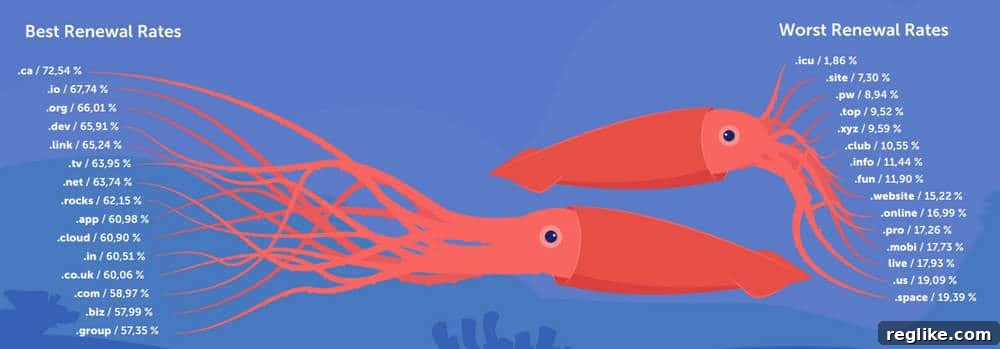
The true measure of a domain’s utility and perceived value often lies not in its initial registration count, but in its renewal rate. Domains that are registered with serious intent, for established businesses, long-term personal projects, or critical online identities, tend to be renewed year after year. Conversely, domains acquired on impulse, for temporary campaigns, or purely for speculative purposes with minimal investment, frequently exhibit low renewal rates. At Namecheap, a significant number of domains registered in 2020 saw renewal rates plummeting below 20%, a stark indicator of their transient nature. This list offers a revealing counter-narrative to the initial registration popularity contest.
- .ICU
- .Site
- .PW
- .Top
- .XYZ
- .Club
- .Info
- .Fun
- .Website
- .Online
- .Pro
- .Mobi
- .Live
- .US
- .Space
This extensive list of low-performing domains vividly illustrates the impact of pricing strategies on domain lifecycle. Many of these TLDs, despite appearing high on the “most registered” list, clearly fail to retain their registrants. TLDs like .ICU, .Site, .XYZ, .Club, and .Online appear on both lists, underscoring the point that while their initial price point makes them attractive for mass acquisition, they often lack the inherent perceived value or specific use cases that would compel long-term ownership. If one were to filter out these low-renewal domains from the top 10 registration list, the enduring giants emerge: .Com, .Net, and .Org. This outcome is hardly surprising, reinforcing their status as the foundational pillars of the internet for serious web presence.
Identifying Resilience: Domains with the Highest Renewal Rates
Shifting our focus to the other end of the spectrum, domains exhibiting high renewal rates are often those that serve critical functions, represent established brands, or are perceived as premium digital assets. These domains are less likely to be abandoned after the first year, indicating a higher level of commitment and perceived value from their registrants. Namecheap’s report highlights several TLDs that demonstrated exceptional renewal performance in 2020, painting a picture of stability and long-term utility.
- .CA
- .IO
- .Org
- .Dev
- .Link
The presence of .CA is particularly noteworthy, reflecting the strong national identity and local business focus associated with country-code Top-Level Domains (ccTLDs). For Canadian businesses and individuals, a .CA domain is often a non-negotiable part of their digital identity. Similarly, .IO and .Dev have carved out significant niches within the tech and developer communities, becoming synonymous with innovation and technical projects, hence their high retention. The inclusion of .Link is somewhat more intriguing, suggesting specific use cases where its branding resonates strongly with users. .Org, a traditional powerhouse, consistently demonstrates high renewal rates, reaffirming its role for non-profit organizations and community-driven initiatives that require a stable, long-term online presence.
The Enduring Power of .Com: A Closer Look
While not topping the highest renewal rate list, .Com’s performance demands specific attention. At Namecheap, .Com domains renewed at 58.97%. This figure might appear modest when compared to Verisign’s blended global .Com renewal rate, which typically hovers in the low 70s. However, it’s crucial to consider the context: first-year renewal rates are inherently lower across the board, and Namecheap is a fast-growing registrar. This implies that a significant portion of their .Com registrations are newer acquisitions, often from individuals or small businesses embarking on their first online ventures. These newer registrants, especially in their first year, might be more prone to experimentation or project abandonment than long-standing domain owners.
Despite this, .Com’s trajectory at Namecheap is undeniably on an upward curve. The report indicates a substantial gain in market share for .Com, rising from 37% of all registrations in 2019 to an impressive 48% in 2020. This significant increase underscores the continued, unwavering preference for .Com as the default and most trusted TLD for establishing a credible online presence, even amidst the proliferation of new gTLDs. It reinforces .Com’s status as the internet’s premier address, a perception unlikely to diminish anytime soon.
Seasonal Peaks: When Domains Come to Life
Beyond “what” domains are registered and renewed, “when” they are registered also offers fascinating insights into user behavior and market dynamics. Industry reports often show varied peak registration periods across different registrars. For instance, Verisign, the registry for .Com and .Net, typically observes its strongest registration activity in the first quarter of the year. However, Namecheap’s data paints a slightly different picture, indicating that their “hottest months” for new domain registrations occur later in the year, specifically from August to November.
This divergence could be attributed to several factors unique to Namecheap’s customer base or specific market strategies. It might align with academic calendars, where students or educational institutions launch new projects, or perhaps with small business cycles, as companies plan year-end campaigns or prepare for the upcoming holiday season. It could also reflect strategic promotional initiatives undertaken by Namecheap during these months. Understanding these seasonal trends allows registrars to optimize their marketing efforts and resource allocation, catering to the specific needs and timing of their target audience.
A Health Check: Understanding Namecheap’s Customer Base
A registrar’s customer profile is a crucial indicator of its health and long-term stability. A diversified customer base, less reliant on a handful of large-volume clients, generally signifies a more resilient business model. Namecheap’s 2020 report provides reassuring statistics in this regard:
- Half of its customers own just one domain.
- Over 90% of its customers own ten domains or fewer.
These figures strongly suggest a customer base dominated by individual users, small businesses, and startups – the “end-users” who purchase domains for their primary online presence rather than for speculative investment. This broad distribution of ownership translates into a healthy registrar that is not overly dependent on the often volatile domain investor market. While domain investors play a vital role in the ecosystem, a heavy reliance on them can introduce unique risks. Namecheap’s profile indicates a strong focus on serving the foundational needs of the broader internet community.
It’s also interesting to note the extreme ends of this spectrum: only a tiny fraction, 0.5% of Namecheap’s customers, own 100 or more domains. Within this elite group, one highly active individual or entity stands out, managing an astonishing 108,776 domains. This singular outlier showcases the diverse range of domain ownership, from the casual user with a single website to professional domain portfolio managers, all coexisting within Namecheap’s ecosystem.
Conclusion: Navigating the Nuances of the Domain Market
Namecheap’s 2020 Domain Insights & Trends Report offers far more than just raw numbers; it provides a valuable lens through which to understand the complex interplay of pricing, perceived value, and user behavior in the domain name industry. The clear distinction between initial registration popularity and long-term domain commitment, as evidenced by renewal rates, is a critical takeaway for anyone involved in digital strategy, web development, or online business.
The report reinforces the enduring dominance of traditional TLDs like .Com, .Net, and .Org, especially for sustained online presence, while simultaneously highlighting the dynamic nature of new gTLDs, many of which serve as affordable entry points but often lack the staying power. Namecheap’s robust and diversified customer base, heavily weighted towards single-domain owners, paints the picture of a strong, user-centric registrar. As the digital landscape continues to evolve, detailed analyses like these will remain indispensable tools for navigating its nuances and making informed decisions about digital identity and online strategy.