
In a highly pertinent analysis for the domain name industry, DOT TBA founder Christa Taylor offers critical insights into the payback period for new Top-Level Domains (TLDs). Her research, meticulously grounded in recent auction prices and current registration volumes, provides a vital financial perspective on the burgeoning yet challenging landscape of generic Top-Level Domains (gTLDs). This examination aims to shed light on the economic realities facing registry operators and potential investors, emphasizing the strategic decisions necessary to navigate this evolving market successfully.
Understanding the Investment Landscape: Recent gTLD Auction Highlights
The expanding market for new gTLDs has been characterized by intense bidding wars and significant capital investments, underscoring the perceived long-term value and strategic importance of these digital assets. Recent high-profile auctions serve as clear indicators of the substantial financial commitments being made by various entities. For instance, the ICANN new TLD auction on October 22nd saw the resolution of several TLDs selling for remarkable sums, signaling robust competition and considerable market confidence:
- .Realty: $5.6 million – This impressive figure highlights the perceived value of industry-specific TLDs, offering a targeted and authoritative online identity for the real estate sector.
- .Salon: $5.1 million – Similarly, the acquisition price for .Salon demonstrates the strong demand for niche TLDs that cater to specialized professional communities, creating dedicated digital spaces for beauty and wellness businesses.
- .Spot: $2.2 million – While more broadly applicable, .Spot still commanded a significant price, suggesting its versatility and potential for diverse branding strategies across various applications.
These results were further reinforced by the September 17th auction, which also delivered substantial valuations:
- .buy: $4.6 million – The acquisition of .buy by an industry giant like Amazon exemplifies the strategic imperative for established businesses to secure direct, brand-aligned presences that enhance their core operations and customer engagement. This purchase reflects a clear business integration strategy rather than a pure domain resale play.
- .tech: $6.8 million – The highest price recorded in these auctions, .tech, clearly indicates widespread recognition of the immense appeal and vast potential registrant base within the global technology sector.
- .vip: $3 million – This TLD caters to the premium segment, focusing on exclusivity and high-end branding, underscoring a market for domains that communicate status and offer specialized services.
The consistent appearance of multi-million dollar outcomes across these diverse TLD categories reflects not only the substantial financial investment by bidders but also the significant expected value attributed to these new gTLDs. For large, established corporations like Amazon, the integration of a TLD such as .buy into an existing, vast business model can be more easily justified; it serves an immediate strategic purpose, enhances brand identity, and streamlines consumer experience. However, for a registry operator whose core business model is solely based on the wholesale and retail of domain names, these elevated auction values necessitate a far more rigorous financial analysis and a clear, viable pathway to profitability and return on investment.
The Current State of New gTLDs: Registration Trends and Market Performance
With over 200 new gTLDs having successfully launched and the initial anniversary of their introduction rapidly approaching, the industry is now equipped with preliminary yet crucial data regarding their performance. Insights into registration volumes, pricing dynamics, and the implications of high auction values are becoming increasingly accessible, allowing for a more informed and realistic assessment of the market’s evolving landscape. This early data is indispensable for all stakeholders—from ICANN and registry operators to registrars and potential registrants—to understand which TLDs are gaining traction and the underlying factors contributing to their success or struggle.
A detailed examination of the current marketplace reveals significant disparities in the adoption rates among the launched TLDs. Among the approximately 200 TLDs that have been in public availability for over a month, a clear pattern emerges when analyzing registration volumes across quartiles. The top quartile, representing the most successful TLDs, exhibits a registration volume that is approximately four times greater than that of the second quartile. This stark difference immediately highlights a “winner-takes-most” phenomenon, where a select few TLDs capture a disproportionately large share of the market, leaving others to contend for smaller segments.
Extrapolating these current registration rates over a full year provides a more comprehensive projection of performance:
- Top Quartile: These high-performing TLDs are projected to achieve an impressive approximately 60,000 registrations within their first year. It is important to clarify that this top quartile has been meticulously adjusted to exclude TLDs known for offering free registrations. Such promotions, while boosting initial numbers, typically do not reflect sustainable payback periods or genuine renewal rates, thereby skewing average TLD performance.
- Second Quartile: The volume drops significantly in this segment, with TLDs in the second quartile projected to reach only about 15,000 registrations in their first year. This represents a substantial 75% reduction in volume compared to the top tier, indicating a much more challenging environment for TLDs that, while not at the bottom, struggle to secure a dominant market position.
- Third Quartile: Performance continues its downward trend, with an expected 8,700 registrations in the first year for TLDs in this quartile. This tier faces an even steeper uphill battle to achieve financial viability and requires exceptionally careful management.
- Fourth Quartile: The bottom tier of TLDs performs the most poorly, generally achieving nearly half the registrations of the third quartile. This places them in a highly precarious financial position, making it exceptionally difficult to justify initial investments.
These pronounced differences in registration volumes are absolutely critical for evaluating the financial models of registry operators. The initial investment required to acquire a TLD, whether through an auction or application fees, is substantial. The ability to recoup these significant costs is directly contingent upon the volume of domain names sold and the wholesale price achieved per registration. Lower registration volumes inherently necessitate higher per-domain revenues or, more often, result in significantly extended payback periods, posing considerable risks to the long-term sustainability of the registry.
Calculating the Payback Period: A Financial Viability Analysis
To provide a clear understanding of the financial implications stemming from high auction values and varying registration volumes, a simplified yet insightful payback calculation can be applied. While a truly comprehensive financial model would incorporate a multitude of other operational and marketing expenses, this basic analysis serves as a crucial initial indicator of an investment’s profitability and recovery timeline. For the purpose of this exercise, we will consider three different net wholesale price tiers that the registry might achieve per registration, offering a clear comparative overview across performance quartiles.
Tier 1: High-Performing TLDs – A Promising Outlook
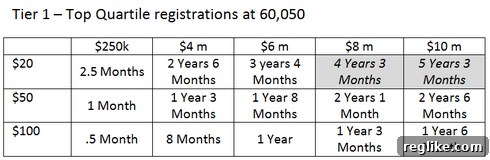
For TLDs that fall into the top quartile, achieving projected first-year registrations of approximately 60,000, the financial outlook generally appears quite reasonable. This makes the often-high initial auction values seem more justifiable and aligns with typical business investment expectations. Let’s examine the payback period for a TLD acquired at an auction value of $4 million:
- If the registry is able to sell registrations at a net wholesale price of $20 per domain, it would recover the entire $4 million initial auction amount in approximately two years and six months. This is often considered an acceptable timeframe for a significant capital investment.
- Should the registry successfully increase its net wholesale price to $50 per domain, the payback period dramatically shortens to a mere 15 months, indicating a swift return on investment.
These payback periods are generally deemed acceptable within standard business and investment contexts, suggesting that high-volume TLDs can indeed generate substantial returns relatively quickly, provided there are sustained registration rates and effective pricing strategies are in place. The image below visually represents these calculations specifically for Tier 1 TLDs, clearly demonstrating how rapidly investment capital can be recouped with strong initial market adoption.
Tier 2: Mid-Range Performing TLDs – Navigating Increased Risk
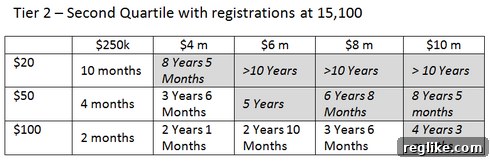
The financial landscape shifts dramatically as we move into the second quartile, referred to as Tier 2, where the volume of registrations experiences a significant 75% drop compared to the top tier, settling at around 15,000 projected first-year registrations. This substantial decline in volume has a profound impact on the payback period, posing considerable challenges to the viability of similar auction expenditures.
Considering a TLD that was also acquired for $4 million in an auction, the outlook is notably different:
- At a wholesale registration price of $20 per domain, it would take almost 8.5 years to reach the breakeven point. This extended timeframe often renders such an investment unattractive for many investors who anticipate quicker returns.
- To accelerate the payback, the wholesale price would need to be significantly increased. At $50 per domain, the breakeven period shortens to just over 3.5 years.
- Further increasing the price to $100 per domain would bring the payback period down to just over 2 years.
If an acceptable payback period for an investor is, for instance, three years, then any TLD in this second tier with an auction value exceeding $4 million would necessitate netting over $50 per registration to the registry. It is critical to remember that this figure represents the wholesale price to the registry, not including the additional markup applied by registrars to the end registrant. Achieving such a significant price increase from what registries currently charge in the broader market is a substantial challenge, and it also carries the inherent risk of potentially impacting overall registration volumes due to the higher cost for the end user. The visual aid below vividly illustrates the significantly extended payback timelines characteristic of Tier 2 TLDs.
Tier 3: Lower-Performing TLDs – A Steep Uphill Battle
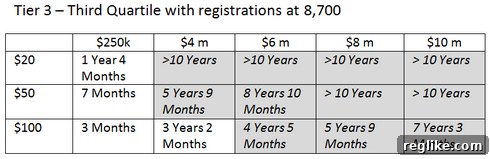
The financial sustainability challenges grow significantly more acute as we analyze TLDs within the third quartile, or Tier 3, which are projected to achieve only about 8,700 registrations in their first year. The severely diminished registration volume at this level makes justifying high auction values exceedingly difficult under typical market conditions, transforming these investments into high-risk propositions.
The payback period for a TLD with a $4 million auction value in this tier becomes exceptionally prolonged, pushing well beyond commonly accepted investment horizons, even when aggressive wholesale pricing strategies are considered. This tier frequently represents a substantial financial risk, particularly for independent registry operators who may not possess diversified income streams or robust marketing budgets to drive adoption. The graphic below clearly underscores the severity of the payback period for Tier 3 TLDs, starkly demonstrating the immense difficulty in recouping initial investments when faced with persistently low registration volumes.
Tier 4: The Most Challenging TLDs – On the Brink of Viability
The final quartile presents the most formidable financial hurdles, representing the lowest performers in the new gTLD market. TLDs in this tier typically achieve almost half the registrations of Tier 3, making any substantial auction value exceptionally difficult, if not impossible, to recover within a reasonable timeframe. For instance, a TLD acquired for $4 million would likely take well over ten years to pay back, even if a relatively modest wholesale price of $20 per registration could be maintained consistently. Even a minimal application fee of $250,000—without accounting for any additional auction costs—would require over two years to recover solely from registration revenues in this tier, highlighting the critical lack of scale.
These findings, while derived from intentionally ‘back of the napkin’ calculations that simplify the multifaceted complexities of real-world business operations, are undeniably troubling. They paint a stark and challenging picture of the financial sustainability for a significant portion of the new gTLD market, urging a critical reevaluation of existing strategies and market expectations. The visual data below further illustrates the dire payback periods facing Tier 4 TLDs, unequivocally emphasizing the urgent need for a revised and proactive approach to market growth and viability.
ICANN’s Forecasts vs. Market Reality: A Troubling Discrepancy
The significant discrepancies between initial market expectations and actual performance are further illuminated when comparing these real-world registration volumes with ICANN’s historical forecasts. ICANN’s “Report of Public Comments,” specifically item 3, had initially discussed projected revenues based on an ambitious target of 33 million domain name registrations for its Fiscal Year 2015 budget. This figure, however, was subsequently lowered to a more conservative, though still optimistic, 15 million—a substantial downward revision that, in light of current market data, still appears to be a stretch.
Setting aside the detail that the breakdown within ICANN’s own report did not perfectly sum to 100%, the response indicated a specific expectation for high-performing registries: those exceeding 50,000 registrations were projected to average 60,000 registrations per registry. This specific projection aligns remarkably closely with the performance observed in the top quartile of Christa Taylor’s analysis. However, ICANN’s forecast went further, envisioning a total of 6.7 million registrations emanating from these high-performing registries. This would imply that ICANN’s budget was predicated on the assumption that 134 delegated registries would each achieve transactions surpassing 50,000 registrations annually.
The reality, based on the current number of delegated TLDs, is considerably less optimistic. At present, only 26 TLDs meet this criterion of over 50,000 registrations. This represents a mere 20% of ICANN’s budgetary assumptions for this critical high-performance category, revealing a significant miscalculation of the market’s capacity. While the second quartile’s average of 15,100 registrations does indeed align closely with ICANN’s forecast of 15,000 registrations for “other registries,” suggesting a more accurate estimation for a segment of the market, this still leaves a vast portion unaccounted for. Critically, the remaining third and fourth quartiles—which collectively comprise 50% of all registries—are significantly falling short of even these revised yearly registration expectations of 15,000. This substantial and persistent gap between forecasted and actual registration volumes points to either a fundamental misjudgment of market demand or a pronounced lack of effective market stimulation. The financial sustainability of the entire new gTLD program, and indeed the individual viability of numerous registries, is directly contingent upon these volumes. Without adequate registration numbers, the long-term prospects for many TLDs, particularly those in the lower performing quartiles, remain critically uncertain and challenging.
A Call to Action: Revitalizing the New gTLD Ecosystem for Sustainable Growth
Given that current registration volumes are consistently falling significantly below both initial and even revised expectations, it is imperative that the broader domain name industry takes decisive and concerted action. The present trajectory strongly suggests that a considerable portion of the new gTLD market faces an arduous uphill battle toward achieving profitability and sustained growth. To counter this, a multi-faceted and proactive approach is urgently required to revitalize interest, drive adoption, and ensure the long-term health of the ecosystem.
Initiating a Global Awareness Campaign
One of the most pressing and foundational needs is the immediate initiation of a comprehensive global awareness campaign. This campaign must be strategically designed to target a diverse and broad audience, encompassing individuals, small and medium-sized businesses, large enterprises, and various organizations across different sectors. Its primary objective must be dual-pronged: first, to effectively educate potential registrants about the very existence, myriad benefits, and strategic value propositions of new gTLDs; and second, to actively encourage their purchase and seamless integration into online identities and digital strategies. A significant portion of the potential user base remains largely unaware of the vast array of new domain options available beyond the traditional .com or .org extensions. Effective messaging should compellingly highlight the unparalleled opportunities for enhanced branding, clearer market positioning, and precise niche market targeting that new TLDs offer, thereby unlocking their full potential.
Strategic Allocation of ICANN Auction Funds
To complement the vital awareness campaign, a robust and well-structured marketing plan must be promptly put into place for the strategic allocation of the substantial funds accrued from ICANN’s new gTLD auctions. These funds represent a unique and invaluable opportunity to directly reinvest in the growth and sustainability of the very ecosystem from which they were generated. A meticulously designed marketing plan should primarily focus on initiatives that can demonstrably increase registrations across all TLDs, not just exclusively the top performers. This could encompass a range of activities including, but not limited to, cooperative advertising programs, strategic promotional partnerships with key industry players, the creation and dissemination of high-quality educational content, and even targeted incentives for registrars to more aggressively promote the new gTLDs to their customer bases.
Such concerted efforts are undeniably beneficial to every stakeholder across the entire domain name value chain: from backend providers who manage the technical infrastructure, to ICANN itself which inherently benefits from a healthy and expanding market, and crucially, to the registries whose very existence and profitability are directly dependent on successful registration numbers. Furthermore, careful consideration should be given to the judicious timing of these fund deployments. For instance, if the average time from a TLD’s auction to its General Availability (the point at which it becomes open for public registration) is, for example, four months, then it might be strategically prudent to delay the direct expenditure of these funds for a corresponding period. This approach would help ensure that the auction participants, who made significant initial investments, have the opportunity to directly receive a portion of the benefit derived from the collective industry-growth initiatives funded by these auction proceeds, fostering greater trust and collaboration within the ecosystem.
Seizing the Opportunity for Industry Growth and Future Prosperity
As the domain name industry collectively reflects on the outcomes and crucial discussions from past ICANN meetings, particularly significant events like the Los Angeles conference, now unequivocally presents a critical window for united and decisive collective action. It is an opportune moment to initiate comprehensive community consultations focused on the productive, transparent, and timely utilization of these accumulated funds. The overarching goal should be to strategically deploy this substantial capital in a manner that equitably benefits all new gTLDs, thereby fostering widespread growth and adoption across the board in the most timely and efficient way possible. With over $27 million already accrued from past auctions and more than 35 additional TLDs scheduled for auction before the year-end, there will be a significant and continuously growing pool of funds available. This considerable capital, if strategically and intelligently deployed, possesses the immense potential to catalyze unparalleled industry expansion, substantially drive up registration volumes, and ultimately secure a more robust, sustainable, and prosperous future for the entire new gTLD ecosystem, ensuring its long-term viability and success.
* Calculation Notes and Model Limitations
It is imperative to reiterate that the calculations presented throughout this analysis are intentionally simplistic. They serve primarily as ‘back of the napkin’ estimates, meticulously designed to provide a broad and accessible understanding of payback periods rather than offering a precise or exhaustive financial forecast. For the sake of clarity and to specifically highlight the core relationship between auction price, wholesale revenue, and achievable registration volume, several critical business expenses have been consciously excluded from this model. These omitted costs, which would be significant in a real-world scenario, include, but are not limited to, comprehensive marketing and promotional expenditures, ongoing operational costs (such as server infrastructure, dedicated customer support, and administrative overhead), recurring fees paid to backend providers, annual ICANN fees, and various legal and administrative overheads.
The projections for new registration volumes are based on a predefined declining rate over time to reflect market saturation and initial enthusiasm tapering off: 100% of the projected annual volume is assumed for Year 1, followed by 75% in Year 2, 60% in Year 3, 45% in Year 4, and a steady 30% thereafter. Renewal rates are consistently assumed to be 70% for all domains, based on a standard one-year registration period. Furthermore, this model deliberately excludes potential additional, yet often variable, revenue streams. These include earnings derived from Sunrise and Landrush periods (early registration phases typically commanding premium prices for trademark holders or early adopters) and the sales of premium domains (high-value domain names often sold at significantly elevated, non-standard prices). While the inclusion of these factors would likely, in many cases, shorten the calculated payback periods, particularly for high-demand TLDs, their variability and episodic nature would also introduce considerable complexity and unpredictability, thereby making the generalized analysis less straightforward and potentially less illustrative of the core trends. Despite these intentional simplifications, the fundamental findings regarding the significant disparities in payback periods across the various TLD performance tiers remain robust and serve as a crucial warning and strategic guide to the industry as it navigates the ongoing evolution of the new gTLD market.