
Germany’s Digital Footprint: Unpacking the .de Domain Statistics for 2020
The digital landscape of Germany is robust and continually evolving, with its national domain, .de, serving as a critical indicator of online activity and economic health. DENIC, the authoritative registry for .de domains, meticulously compiles and releases an annual report that offers invaluable insights into the trends, geographic distribution, and international appeal of this prominent country code top-level domain (ccTLD). The 2020 annual statistics provide a fascinating snapshot, revealing both steadfast stability and significant growth across various sectors.
Understanding DENIC and the Significance of .de Domains
At the heart of Germany’s internet infrastructure lies DENIC (Deutsches Network Information Center eG), a cooperative organization responsible for operating and managing the .de top-level domain. Established to ensure the stable, secure, and reliable operation of the .de namespace, DENIC plays a pivotal role in the digital economy not only in Germany but also globally. The .de domain itself is one of the most popular and trusted ccTLDs worldwide, symbolizing quality, reliability, and a strong connection to the German market.
For businesses, individuals, and organizations, a .de domain signifies a commitment to the German audience, fostering trust and providing a clear geographic identity. Its widespread adoption reflects Germany’s position as a leading economic power and a hub for innovation and technology. Each year, DENIC’s comprehensive data reports serve as an essential resource for market analysts, policymakers, and anyone interested in the evolving digital landscape.
Overall Growth and Stability: A Snapshot of 2020
The end of 2020 marked a significant milestone for the .de domain, with a grand total of 16.7 million registered domains. This impressive figure underscores the continuous expansion of Germany’s online presence and the increasing digitalization across various sectors. The year 2020 was unique, characterized by unprecedented global shifts, yet the .de domain demonstrated remarkable resilience and sustained growth, reflecting the accelerated digital transformation prompted by the circumstances.
This consistent growth isn’t just a number; it represents millions of businesses establishing an online presence, individuals connecting digitally, and organizations leveraging the internet for communication and commerce. The .de domain’s stability throughout a challenging year highlights its fundamental role in Germany’s national and international digital interactions, solidifying its status as a cornerstone of the German internet.
Unwavering Dominance: Top German Cities for .de Registrations
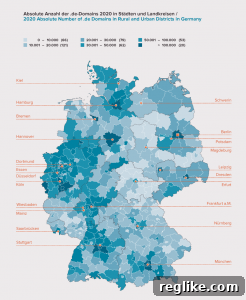
One of the most striking findings from DENIC’s 2020 report is the remarkable stability among the top-ranking German cities for .de domain registrations. For the second consecutive year, the list of the top ten cities remained unchanged from 2019 to 2020, a testament to the enduring economic and digital strength of these urban centers. This consistency suggests deeply entrenched digital economies and strong entrepreneurial activity in these metropolitan areas.
Berlin: The Digital Capital Leads the Way
As Germany’s capital and a burgeoning tech hub, Berlin predictably maintained its lead, boasting nearly one million registered .de domains. This dominance reflects Berlin’s vibrant startup scene, its role as a political and cultural center, and a magnet for international businesses and creative professionals. The city’s diverse economy and high population density naturally translate into a high demand for online identities, making it the undisputed leader in domain registrations.
Munich: Economic Powerhouse with a Strong Online Presence
Following Berlin, Munich secured its position as the second-largest hub for .de domains, with approximately 630,000 registrations. Munich is renowned for its strong economy, particularly in high-tech industries, automotive manufacturing, and finance. This concentration of economic powerhouses and innovative companies drives a significant need for digital representation, positioning Munich as a vital player in the German domain landscape.
Hamburg: A Port City’s Digital Expansion
Rounding out the top three was Hamburg, with an impressive 587,000 .de domains. As a major port city and a hub for media, logistics, and aerospace industries, Hamburg has a diverse and dynamic economy. Its increasing digital footprint underscores its transformation into a modern business center, where online visibility is paramount for both local and international trade. The city’s consistent presence in the top tier highlights its ongoing digital growth and economic vitality.
The sustained leadership of these three cities underscores their importance as economic engines and digital innovation centers within Germany. Their unchanging positions from one year to the next indicate mature, stable markets with consistent demand for digital presence.
Per Capita Insights: Osnabrück’s Surprising Digital Intensity
While absolute numbers often highlight the largest metropolitan areas, a look at per capita domain registrations reveals intriguing insights into local digital intensity. In this regard, Osnabrück stood out significantly in 2020, registering an astounding 1,563 .de domains per 1,000 inhabitants. This statistic places Osnabrück at the forefront of digital engagement relative to its population size, surpassing even larger cities in terms of digital saturation.
What makes Osnabrück such a digitally active city? Located in Lower Saxony, Osnabrück is known for its strong mittelstand (medium-sized businesses), vibrant retail sector, and a growing higher education presence. This high per capita rate could be attributed to several factors:
- Strong Local Business Ecosystem: A high number of small and medium-sized enterprises (SMEs) actively establishing an online presence to reach customers locally and nationally.
- Early Digital Adopters: A community that has embraced digitalization early and consistently.
- Local Initiatives: Potentially strong local government or business initiatives promoting digital literacy and online presence among its citizens and businesses.
- Specialized Industries: The presence of specific industries that inherently require a high degree of online activity and domain usage.
Osnabrück’s performance serves as a reminder that digital strength is not solely confined to mega-cities but can be deeply embedded within regional economies, reflecting a broad-based commitment to digital transformation across Germany.
Global Reach: International Interest in .de Domains Continues to Surge
The appeal of the .de domain extends far beyond Germany’s borders, attracting a significant and growing international audience. In 2020, domains registered to foreign entities witnessed a substantial increase, climbing from 1.32 million to 1.45 million. This growth of over 100,000 international registrations within a single year underscores the global trust and value associated with the .de brand.
Several factors contribute to this international allure:
- German Market Access: For businesses worldwide, a .de domain is a gateway to the lucrative German market, signaling credibility and a local presence to German customers.
- Trust and Reliability: The “Made in Germany” ethos of quality and reliability extends to its digital infrastructure, making .de domains a trusted choice for international companies.
- Legal Certainty: Germany’s robust legal framework provides a sense of security for domain registrants, which is highly valued by international entities.
- Economic Powerhouse: Germany’s status as Europe’s largest economy and a major global trading nation naturally attracts foreign investment and digital engagement.
The United States Leads Foreign Registrants
Among the international registrants, the United States consistently stands out as the dominant foreign country, accounting for approximately a quarter of all internationally registered .de domains. This strong presence is indicative of the significant trade relationships, economic ties, and strategic interests that American businesses have in Germany and the wider European market. US companies frequently use .de domains to localize their marketing efforts, establish regional headquarters, or target German-speaking customers.
The continuous increase in foreign-held .de domains highlights the domain’s enduring global relevance and Germany’s integral role in the international digital economy. It demonstrates that the .de domain is not just a national asset but a global symbol of digital opportunity and trust.
The Broader Implications of .de Domain Trends
The annual statistics provided by DENIC offer more than just numbers; they paint a comprehensive picture of Germany’s digital health and future trajectory. The sustained growth, urban distribution, and international appeal of .de domains are critical indicators of several overarching trends:
- Accelerated Digitalization: The consistent increase in registrations reflects a society and economy that are rapidly adopting digital solutions across all sectors, from small businesses to large corporations.
- Economic Resilience: The stability of top city rankings and overall growth, even in a challenging year like 2020, demonstrates the underlying resilience and strength of the German economy.
- Global Connectivity: The rising international interest in .de domains underscores Germany’s pivotal role in global trade and its appeal as a market for foreign enterprises.
- Importance of Online Presence: These statistics reaffirm the indispensable nature of an online presence for businesses and individuals in the modern era, emphasizing the value of a trusted and localized domain name.
DENIC’s commitment to publishing these detailed reports empowers stakeholders to make informed decisions, understand market dynamics, and anticipate future developments in the German digital space. The .de domain remains a crucial piece of the puzzle, reflecting not just digital addresses but the evolving economic and social fabric of Germany.
Conclusion: A Digitally Vibrant Germany
The 2020 .de domain statistics confirm a clear picture of digital vibrancy and stability within Germany. From the unwavering leadership of its major cities to the surprising digital intensity of Osnabrück, and the expanding global footprint of the .de domain, the report underscores the critical role this ccTLD plays in Germany’s digital infrastructure. The total of 16.7 million registered domains by the end of 2020 is not just a figure; it represents a dynamic and ever-growing digital ecosystem that continues to attract both national and international engagement.
As Germany continues to navigate the complexities of the digital age, the .de domain will undoubtedly remain a cornerstone of its online identity and economic prosperity, facilitating connections, commerce, and communication for millions worldwide.
For more detailed information and statistics, the full annual report is available directly from DENIC:
Access the full DENIC Annual Statistics 2020 Report here.