
Urgent Scam Alert: How Fraudsters Exploit GoDaddy’s New Contact System for Domain Appraisal Scams
In the ever-evolving landscape of online fraud, domain name owners remain prime targets for sophisticated scams. A new tactic has emerged, adding a cunning twist to the long-running domain appraisal scam, specifically leveraging GoDaddy’s recently updated contact system. This sophisticated approach is designed to ensnare unsuspecting individuals, promising lucrative domain sales while secretly siphoning funds through fraudulent appraisal fees.
The digital frontier, while offering immense opportunities, is also a fertile ground for illicit activities. Domain names, often seen as valuable digital real estate, frequently attract the attention of both legitimate investors and malicious actors. Understanding the mechanisms of these scams, especially as they adapt to new technological changes, is paramount for every domain owner’s online security strategy.
The Enduring Threat: A Deep Dive into the Domain Appraisal Scam
The domain appraisal scam is not a new phenomenon; it’s a persistent threat that has plagued the domain industry for years. Its core premise is deceptively simple yet highly effective. It typically begins with an unsolicited, friendly email sent to a domain owner, inquiring about the availability of their domain name for sale. These initial offers are often exceptionally generous, designed to immediately pique the owner’s interest and activate a sense of potential financial gain. The scammer’s goal is to create an illusion of a highly motivated buyer willing to pay a premium price.
Once the domain owner expresses interest in selling, the scam progresses to its critical phase. The supposed “buyer” then mandates that the seller obtain a “domain appraisal” or “certification” from a specific, often obscure, service. Crucially, this appraisal service is either directly owned and operated by the scammer or is an accomplice service designed solely to collect fees. The moment the unsuspecting domain owner pays for this mandatory appraisal, the “buyer” — and the entire lucrative offer — vanishes, leaving the victim out of pocket and with a worthless appraisal report.
This scam preys on the hope of a quick profit and the unfamiliarity many domain owners have with the intricacies of domain valuation and transaction processes. The promise of a substantial payout often overshadows the critical red flags, leading individuals to overlook their gut instincts and make costly mistakes.
GoDaddy’s Evolving Contact System and Its Unintended Vulnerability
GoDaddy, as the world’s largest domain name registrar, plays a significant role in facilitating domain ownership and communication. Recently, GoDaddy implemented a change in how individuals can contact domain name owners whose privacy settings prevent direct email disclosure. Previously, GoDaddy might have provided a forwarding email address, acting as an intermediary. Now, the system requires interested parties to fill out a structured form on GoDaddy’s website.
This form allows a sender to submit their email address and a pre-defined message template or a short customized message explaining their intent to contact the domain owner. This change was likely intended to enhance privacy, reduce spam, and streamline legitimate inquiries. However, like many security enhancements, it has inadvertently opened a new avenue for opportunistic scammers.
Fraudsters are now actively attempting to exploit this new system, either by carefully crafting messages through GoDaddy’s legitimate contact form or, more commonly, by spoofing emails to mimic the appearance of a GoDaddy-generated inquiry. The goal is to lend an air of authenticity and official endorsement to their initial contact, making their deceptive offers seem more credible from the outset.
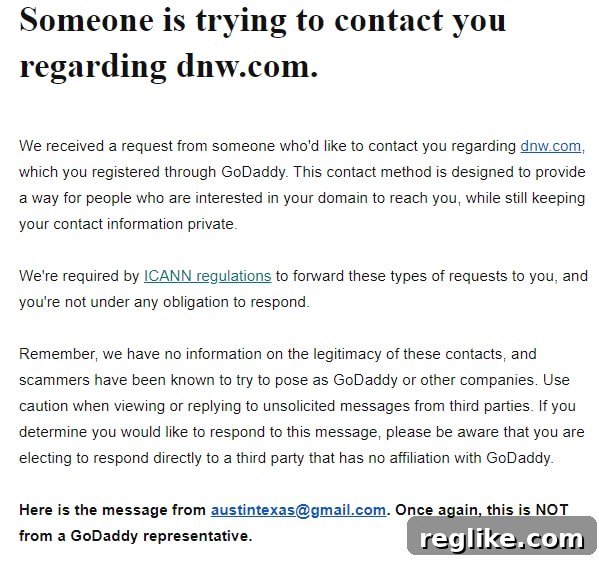
Here’s an example of what an email sent through GoDaddy’s form might look like, as demonstrated by an inquiry sent by an individual to themselves. While the image explicitly warns about potential scams, fraudsters often craft their follow-up emails to remove such warnings and appear more legitimate.
Dissecting the Deception: A “Certified Offer” That Isn’t
The true cunning of this scam becomes apparent in the follow-up communications. Once a domain owner responds to the initial inquiry, the scammer elevates the deception. They often claim that GoDaddy has “verified” the communication and that the offer is a “certified offer” from GoDaddy itself, thereby fabricating a layer of security and legitimacy. This tactic is designed to disarm the victim, making them believe that a reputable entity like GoDaddy has endorsed the transaction. It’s crucial to understand that GoDaddy does not certify or endorse specific domain purchase offers from third parties.
Let’s examine a typical “certified offer” email, dissecting its elements to expose the fraudulent nature:
Hello!
Just passed the GoDaddy’s verification so we can communicate direct. It’s a Godaddy’s certified offer and you will be protected during the transaction.
My name is Elisa Pressler. I work as a broker of International clients in a hosting company – Galcomm Co. from Israel. I will help you to finish the sale.
I am reaching out to you on behalf of a buyer from Tel Aviv. Your buyer is a company from Israel. Your domain will be used to generate traffic to their new mutli-million dollar web project so they offer a good price. Commission of our company is 6%. It’s paid when you get the money.
They will pay you via the Escrow.com or Swiss Escrow service. You can be paid via wire, Paypal, check or any other method you prefer.
The buyer offers $60,000 usd.
Do you have a certificate? It’s required by their bank.
The final sale price will depend on the certificate ($60,000 minimum – if it comes higher they will pay more).
If you don’t have the certificate it’s not a problem. You can order it online.
Please note he cannot accept it from any agency. He needs a manual service. It also must be a third party independent agency (not your broker our auction site) and must be accepted by his bank.
The certification includes the following:
1. Independent valuation of the market price. It will show your domain name is not overpriced. On the other hand if the valuation comes higher, he will increase the price accordingly. In the domain name industry, there are many appraisal tools that people use to estimate the value of a domain name. My client does not want to risk and doesn’t accept services that use scripts. If you are unsure about some service feel free to ask me.
2. TM and law compliance verification. It proves your domain has no trademark problems. He would like this verification to be included in the appraisal report. It’s not a problem because some companies include the TM verification for free.
3. Copy in Hebrew.
The process is very easy:
1. Go to the certificate agency site and order a certificate. Just submit your domains and let them know you have a buyer with $XX,XXX offer. It will help you to get a better valuation.
If your domain is worth at least $10000, they will send you the payment instructions. If it’s not possible, they won’t send you the instructions. This way you will not lose anything. It’s very convenient and gives you the full protection. Other services charge you upfront even if your domain is not worth spending the appraisal fee, so I don’t recommend them.
2. Send the certificate to me and we will start the sale process. As soon as the buyer receives your certificate they will buy your domain.
If you are new to the certification process, I can help you with the step by step instructions.
To read the review you must have Telegram Messenger installed on your smartphone. To communicate with me online please use Telegram messenger. Here is the invitation link to our Domain Sale Group: https://t.me/godaddysales
Add me (@ElisaAttorney) to your contacts and we will be able to chat in Telegram. If you don’t have Telegram you may install it on your smartphone from Google Play or AppStore.
One of my sellers already sold to this buyer from Tel Aviv. You may read his review at https://t.me/godaddysales/1754 Feel free to contact him.
Please respond ASAP. No risk for you to proceed since this is a certified by GoDaddy domain offer with full proof of funds. If you send the certificate the buyer will have to pay you the same day.
Elisa Pressler
Vice President
Investor Relations
Galcomm Co.
Aba Hillel Silver St 99
Haifa 3269514
Israel
Analyzing the Red Flags within the “Certified Offer”
Every line of the above email is carefully constructed to manipulate the recipient. Here’s why it’s a scam:
- Fake GoDaddy Verification: The claim of “GoDaddy’s verification” and a “Godaddy’s certified offer” is a complete fabrication. GoDaddy does not certify individual sales offers. Any such claim is a blatant lie designed to instill false confidence.
- Fictional Broker/Registrar Persona: “Elisa Pressler” from “Galcomm Co.” is likely a fictitious persona or an impersonation. While Galcomm is a real registrar, scammers often impersonate or misuse the names of legitimate companies to appear credible. A quick independent search for “Elisa Pressler Galcomm” may reveal no matching public profiles or corporate roles.
- Overly Generous Offer & “Multi-Million Dollar Project”: A $60,000 offer for a domain, coupled with the narrative of a “multi-million dollar web project,” is a classic psychological hook. Offers that seem too good to be true almost always are, especially when unsolicited.
- Mandatory, Seller-Paid “Certificate”: This is the linchpin of the scam. Legitimate buyers who are serious about a domain purchase conduct their own due diligence, including valuation. They would never demand that the seller pay for a specific, third-party appraisal or “certificate” from an agency dictated by the buyer. The cost of this certificate is the scammer’s profit.
- Highly Specific Appraisal Requirements: Demanding a “manual service,” “third party independent agency” (but only one that can be “accepted by his bank,” meaning the scammer’s own service), “TM and law compliance verification,” and a “Copy in Hebrew” are all designed to narrow the victim’s options, guiding them directly to the scammer’s pre-selected fraudulent appraisal service.
- Misuse of Legitimate Escrow Services: Mentioning Escrow.com or Swiss Escrow is a common tactic. These are legitimate services, but scammers will either direct victims to a spoofed version of these sites or simply use their names to add credibility while intending to bypass them entirely once the appraisal fee is paid.
- Pressure Tactics and False Urgency: Phrases like “Please respond ASAP,” “No risk for you to proceed,” and “the buyer will have to pay you the same day” are classic scammer tactics to rush the victim into action, preventing them from pausing to critically evaluate the situation or seek independent advice.
- Reliance on Telegram for Official Communication: While Telegram is a popular messaging app, relying on it for high-value business transactions, especially with “invitation links” to “Domain Sale Groups” and “reviews,” is highly unprofessional and a significant red flag. Legitimate businesses conduct official communications through secure email, phone calls, or established business platforms. The provided “review” links are likely to a controlled environment where the scammer posts fake testimonials.
- False Sense of Protection: The repeated assurances of “protection during the transaction” and “full proof of funds” are designed to counteract any natural skepticism.
The Deceptive “GoDaddy Verification” Email: A Second Layer of Fraud
To further solidify their deception, scammers often send a follow-up email, meticulously crafted to appear as if it originates from GoDaddy itself. This email acts as a critical second layer of legitimization, attempting to silence any remaining doubts the domain owner might have:
Thank you for confirming you have received our email. We’re required by ICANN regulations to forward these types of requests to you. However this is our obligation to verify the legitimacy of such requests.
To protect you we have verified this contact and may confirm the legitimacy of the request to purchase your domain. The buyer has provided the proof of funds ($60000) so now you can communicate with the buyer safely.
To respond safely to the domain buyer, simply reply to this email and he will receive your response on his email account. Then you will be able to communicate direct without GoDaddy.
This email is almost certainly a spoofed communication, likely originating from an address like [email protected], carefully faked to impersonate a legitimate GoDaddy sender. Its purpose is to officially “verify” the scammer’s initial contact and the buyer’s (fictional) proof of funds, pushing the victim toward direct, unsupervised communication outside of GoDaddy’s protective oversight. GoDaddy, or any legitimate registrar, does not “verify” buyer funds or endorse specific offers in this manner. This is a crucial distinction that domain owners must recognize.
Key Red Flags: How to Spot a Domain Appraisal Scam
Staying vigilant is your best defense. Look out for these critical warning signs:
- Unsolicited Offers with Exaggerated Prices: If an offer seems significantly higher than your domain’s realistic market value, proceed with extreme caution.
- Demand for Seller-Paid Appraisal/Certificate: A legitimate buyer performs their own due diligence. They will not ask you to pay for a specific appraisal service as a prerequisite for the sale.
- Claims of “GoDaddy Certification” or “Verification”: GoDaddy does not certify individual domain sale offers or verify buyer funds. Any such claim is fraudulent.
- Pressure to Act Quickly (ASAP): Scammers thrive on urgency, pushing victims to make quick decisions without proper investigation.
- Unusual Communication Methods: Relying on instant messaging apps like Telegram for official, high-value business transactions, especially with group invites and “reviews,” is highly suspicious.
- Specific Appraisal Agency Requirements: When a “buyer” insists on a very particular type of appraisal, or from a specific, unknown agency, it’s almost always a front for the scammer’s own fraudulent service.
- Fake Escrow or Payment Process: While legitimate escrow services exist, be wary if the scammer tries to direct you to a fake escrow site or insists on a payment method that lacks buyer protection.
- Inconsistent or Poor Communication: Although some scams are well-written, look for grammatical errors, odd phrasing, or inconsistencies in the scammer’s story.
- Lack of Verifiable Information: Always independently research the “broker,” “company,” and “buyer” mentioned. Absence of credible online presence or verifiable contact information is a major red flag.
Protecting Your Digital Assets: Essential Steps Against Domain Scams
To safeguard your valuable domain names and prevent falling victim to these elaborate schemes, follow these protective measures:
- Verify Sender Identity: Always inspect email headers to confirm the true origin of an email, especially if it claims to be from GoDaddy or another trusted entity. Be wary of spoofed addresses.
- Independent Research: Never take claims at face value. Independently research any company, broker, or individual claiming to be interested in your domain. Use multiple search engines and verify contact details.
- Never Pay Upfront for Appraisals: A golden rule: a legitimate buyer pays for their own due diligence. If a buyer demands you pay for an appraisal, certificate, or any other upfront fee, it’s a scam.
- Utilize Reputable Domain Marketplaces: When selling, use established and trusted domain marketplaces and brokers who offer secure transaction processes.
- Understand GoDaddy’s Policies: Familiarize yourself with how GoDaddy operates, especially regarding communications and transactions. If an email claims GoDaddy has “certified” an offer, it immediately contradicts their standard practices.
- Consult a Professional: If you receive a genuinely high offer and are unsure about its legitimacy, consult with an experienced domain broker or legal professional specializing in domain sales before proceeding.
- Report Suspicious Activity: If you encounter a scam, report it to GoDaddy, relevant authorities (like the FTC or IC3 in the US), and your local law enforcement. This helps protect others.
- Trust Your Gut: If something feels off, or an offer seems too good to be true, it likely is. Your intuition is a powerful defense mechanism against fraud.
The Broader Impact: Why Domain Owners are Prime Targets
Domain names represent significant digital assets, often serving as the foundation for businesses, brands, and personal identities online. Their inherent value, coupled with the sometimes complex and technical nature of the domain industry, makes domain owners attractive targets for scammers. Fraudsters understand that the promise of a substantial sale can bypass critical thinking, especially for those who may not regularly engage in domain trading.
The evolution of these scams, from simple phishing to sophisticated impersonations leveraging registrar systems, underscores the constant need for vigilance. As digital interactions become more integrated into our daily lives, so too do the methods of those seeking to exploit them. Protecting your domain name isn’t just about safeguarding a web address; it’s about securing a piece of your digital identity and investment.
Stay Alert, Stay Secure: Your Vigilance is Your Best Defense
The latest iteration of the domain appraisal scam, cleverly weaving in elements of GoDaddy’s new contact system and fake “certification,” serves as a stark reminder of the persistent and evolving nature of online fraud. By understanding the classic scam, recognizing the red flags in the “certified offer” emails, and implementing proactive protective measures, domain owners can significantly reduce their risk of becoming victims.
Your vigilance and skepticism are your most potent tools against these deceptive tactics. Always verify, never rush, and prioritize your security over the allure of an instant, too-good-to-be-true profit. Stay informed, stay alert, and protect your digital assets.