
Mastering Your Digital Identity: A Small Business Guide to Choosing the Perfect Domain Name
In today’s fiercely competitive digital landscape, a small business’s online identity is paramount, often proving as critical as its physical storefront. While a compelling product or service forms the bedrock of any successful venture, how customers discover, remember, and connect with your business online often hinges on a single, vital element: your domain name. This isn’t merely a technical address on the internet; it’s a cornerstone of your brand, a key driver for search engine optimization (SEO), and a direct reflection of your professionalism and credibility.
This fundamental truth became strikingly apparent to me during a recent Labor Day trip to San Francisco. As is often the case when traveling with a three-year-old, I found myself in a local laundromat, methodically feeding quarters into a washing machine. This otherwise mundane task provided an unexpected and fascinating opportunity to observe the digital strategies of various local small businesses through their advertisements plastered on the walls. As someone who owns both SanFrancisco.us and Laundromats.us, I harbor a particular professional interest in domain names, and these colorful flyers offered a real-world, non-scientific study of effective and less-effective domain name choices.
It was genuinely encouraging to see that many local businesses, ranging from writing services to psychic readers, had embraced the digital age by including a domain name on their flyers. This indicates a growing awareness among small business owners of the absolute necessity for an online presence. However, the quality and strategic effectiveness of these chosen domain names varied dramatically. Some were exemplary, perfectly aligned with their brand and easy to remember, while others inadvertently presented significant hurdles for potential customers. My observations from that San Francisco laundromat highlight common pitfalls and illuminate best practices that every small business owner should meticulously consider when crafting their digital identity.
Why Your Domain Name is an Indispensable Asset for Small Business Success
A domain name transcends its basic function as a web address. It is a strategic investment in your brand, a powerful marketing tool, and an foundational component of your overarching digital strategy. Understanding its multifaceted importance is the first step towards leveraging it effectively for your business.
1. Establishes Unwavering Professionalism and Credibility
Consider the stark difference in perception between receiving an email from “[email protected]” versus “[email protected]”. The latter instantly conveys a higher echelon of professionalism, seriousness, and trustworthiness. A custom domain name signals to your audience that your business is legitimate, established, and committed to its operations. It builds immediate credibility with potential clients, partners, and investors, significantly setting you apart from less serious or amateur ventures that rely on generic, free email services. This perception of professionalism translates directly into customer confidence.
2. Enhances Brand Recognition and Maximizes Recall
Your domain name frequently serves as the very first interaction a potential customer has with your brand online. A meticulously chosen domain that is short, memorable, and effortlessly easy to spell will indelibly etch itself into people’s minds. It acts as a constant reinforcement of your brand identity every single time it is seen, spoken, or typed. Conversely, a confusing, overly complicated, or excessively long domain name can severely hinder recall, making it an arduous task for customers to locate you again, even if they vaguely remember your business name. Your domain should be an extension of your brand, not a barrier to it.
3. Significant Benefits for Search Engine Optimization (SEO)
While the direct impact of exact-match keywords within domain names on search rankings has naturally evolved and somewhat diminished over the years, a relevant, concise, and brandable domain still plays a crucial, albeit indirect, role in SEO. It assists search engines in comprehending the core subject matter of your website and, more importantly, a memorable domain actively encourages direct traffic and brand-specific searches. Both of these are powerful, positive signals to search engines, indicating relevance and authority. Furthermore, a clear and intuitive domain makes it inherently easier for other websites to link to your site, distributing valuable “link juice” and incrementally improving your domain authority and search visibility.
4. Provides a Definitive Competitive Advantage
In today’s saturated marketplace, every incremental advantage contributes significantly to success. A robust, relevant, and well-structured domain name can be instrumental in distinguishing your business from competitors who may possess less effective or poorly conceived online branding. It projects an image of your business as forward-thinking, digitally savvy, and client-focused, thereby attracting customers who prioritize convenience, professionalism, and a seamless online experience. Never underestimate the subtle yet profound power of a meticulously chosen digital address in swaying customer preference and securing market share.
5. Offers Unparalleled Flexibility and Future Growth Potential
Proprietary ownership of your domain name grants you complete and absolute control over your entire online presence. This empowers you to host your website with any provider you choose, establish an unlimited number of professional email addresses, and effortlessly redirect traffic if you ever decide to rebrand, expand your service offerings, or pivot your business model. It is a foundational digital asset that robustly supports your business’s evolution, guaranteeing that your digital home remains stable, adaptable, and fully responsive to your strategic growth requirements over the long term. Your domain is the bedrock upon which your future online endeavors will be built.
Real-World Domain Name Lessons from a Laundromat Wall: A Detailed Analysis
Let’s delve deeper into the specific examples I encountered on that San Francisco laundromat wall, meticulously analyzing what strategies proved effective and what areas presented clear opportunities for improvement. These real-world instances offer invaluable lessons for your own small business domain name strategy.

RipeFruitWriting.com: The Art of Making Longer Domains Work Effectively
Upon initial inspection, RipeFruitWriting.com might appear somewhat lengthy, which generally goes against the prevailing wisdom that brevity is paramount for domain names. However, this particular example brilliantly illustrates that a longer domain name can still be remarkably effective if it is inherently clear, highly descriptive, and genuinely memorable. The absolute key to its success on the flyer was its prominent and strategic positioning as the focal point, ensuring maximum visibility and impact even when situated high on a crowded wall. The name itself is quite creative and evocatively suggests both the quality and the precise nature of the service offered – professional writing. While such a descriptive, longer domain may not be the ideal choice for every type of business, RipeFruitWriting.com effectively demonstrates that strong brandability, coupled with a crystal-clear presentation in marketing materials, can indeed mitigate the inherent disadvantage of a longer domain. The invaluable lesson here is that even an extended, descriptive domain can be powerful and effective if it’s unique, highly relevant, and consistently and strategically highlighted across all your marketing collateral.

PanTheater.com: Navigating the Pitfalls of Ambiguity and Enhancing Clarity
PanTheater.com is, at face value, a logical and straightforward choice for a theater company bearing the name “Pan Theater.” However, a closer examination reveals a common and often overlooked pitfall: phonetic ambiguity. When read quickly, or entirely out of its intended context, the domain can easily be misconstrued as “PantHeater.com” – a vastly different, and potentially humorous or even embarrassing, concept entirely. This vividly underscores the critical importance of rigorously evaluating your chosen domain name for any conceivable misreadings, mispronunciations, or misinterpretations. While capitalization is not technically part of a URL, explicitly suggesting “PanTheater.com” on all marketing materials (as opposed to the lowercase “pantheater.com”) could dramatically improve readability and significantly reduce potential confusion for the audience. Always make it a practice to thoroughly test your selected domain name by verbally articulating it and requesting several unbiased individuals to write it down without any prior prompting; this simple exercise can help you preemptively catch such issues and ensure universal understanding.
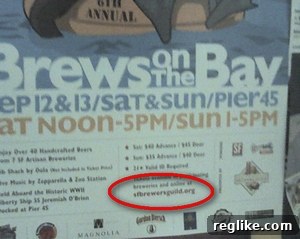
SFbrewersguild.org: The Prudence of Proactive Defensive Domain Registration
This particular organization truly exemplifies a profound understanding of effective domain strategy. While their primary website is logically SFbrewersguild.org, they have astutely secured the .com version as well, SFbrewersguild.com, and meticulously configured it to forward seamlessly and directly to their .org site. This represents a brilliant and highly recommended example of defensive domain registration and comprehensive brand protection. The .com extension unequivocally remains the most recognized, trusted, and instinctively typed domain suffix across the globe. By strategically owning both variations, the SF Brewers Guild ensures that no potential visitor is inadvertently lost due to a simple typo of the wrong extension. Furthermore, it proactively prevents opportunistic competitors or malicious cybersquatters from registering the .com version and potentially siphoning off valuable traffic or causing irreparable confusion among their dedicated audience. For any small business, the practice of registering multiple popular domain extensions (such as .com, .net, .org, or even relevant new generic TLDs and country-specific TLDs) and subsequently redirecting them to your primary website is an unequivocally recommended best practice for robust online brand management.

The Absence of a Domain: Why a Generic Yahoo Email Address Is Utterly Insufficient
Perhaps the most concerning and disheartening observation among the laundromat flyers was the complete and utter absence of a proper domain name for some businesses. Instead, these entities relied exclusively on a generic, free email address, such as one provided by Yahoo. While undeniably convenient in the short term, this practice severely undermines a small business’s credibility, compromises its professionalism, and sends all the wrong signals to potential customers. An email address like “[email protected]” instantly triggers red flags for many discerning customers, suggesting either a very nascent, unstable business or one that lacks the foresight and commitment to invest in its own essential digital assets. Crucially, setting up professional email services for your custom domain (e.g., [email protected]) is both remarkably easy and highly affordable, yet it makes an exponentially massive impact on how your business is perceived. It vigorously reinforces your brand, significantly enhances trust, and provides a centralized, professional, and consistent communication channel. Neglecting to secure a domain means missing out on invaluable brand building, crucial search visibility, and the fundamental trust of your customer base.

The Invisible Domain: When Your Web Address Is Too Obscure to Be Effective
Another flyer, this one advertising a psychic, took the issue of a proper domain to an even more extreme and problematic level. The web address, if one even existed on the flyer, was utterly indecipherable, completely lost within a maze of tiny, overly decorative script and cluttered design. The poignant irony was not lost on me: if one requires psychic abilities just to decipher their own web address, then visiting that psychic might be an entirely unnecessary endeavor. This vivid example powerfully highlights two absolutely crucial points for small businesses. First, simply possessing a domain name is utterly insufficient; it must be manifestly clear, prominently visible, and easily legible to your target audience. Second, it profoundly underscores the paramount importance of selecting a domain name that is simple enough to be quickly grasped and understood, even from a considerable distance or in less-than-ideal viewing conditions. An obscure, illegible, or convoluted web presence is, for all practical purposes, functionally no online presence at all, representing a squandered marketing opportunity and an inevitably frustrating experience for potential customers.

JustAwesomeTheWebsite.com: The Perils of Overly Long and Excessively Descriptive Domains
This particular domain, JustAwesomeTheWebsite.com, was arguably the most “painful” to encounter and analyze. While the business, which specializes in selling board games, commendably also owns JustAwesomeGames.com (a vastly superior and more appropriate choice), it was the excruciatingly longer domain that was prominently featured on the flyer. Domain names of this excessive length are inherently difficult to remember, highly prone to frustrating typos, and notoriously awkward to communicate verbally. While some businesses might judiciously use such extended domains for very specific tracking purposes or highly niche marketing campaigns, presenting it as the primary web address for general public consumption is undeniably detrimental. It creates a significant and unnecessary barrier for customers diligently attempting to locate the business online. In stark contrast, the shorter, more precise JustAwesomeGames.com immediately conveys the essence of the business to visitors and is infinitely easier to recall, pronounce, and accurately type. This compelling example serves as a potent and unequivocal reminder: for your primary domain name, always prioritize brevity, absolute clarity, and maximum ease of use above all other considerations. Make it simple for your customers to find you.
Essential Best Practices for Choosing an Effective Small Business Domain Name
Drawing from these real-world observations and broader industry insights, here are actionable best practices specifically tailored to guide you in selecting a domain name that genuinely empowers your small business and optimizes its online presence:
1. Keep it Short, Simple, and Effortlessly Memorable
This is the undisputed golden rule of domain selection. A domain name must be intuitively easy to type, pronounce correctly, and readily recallable. Rigorously avoid overly complex spellings, numbers that can be easily confused with their word counterparts (e.g., ‘4’ vs ‘for’), and any gratuitous or unnecessary hyphens. The more succinct and straightforward your domain, the better it will perform in terms of brand recall and significantly reducing potential user error.
2. Ensure it is Relevant, Descriptive, and Distinctly Brandable
Ideally, your domain should directly reflect your business name or clearly communicate your core service. It needs to be unique and distinctive enough to unequivocally stand out in a crowded digital marketplace. While strategically incorporating relevant keywords can offer some SEO benefits, never sacrifice brandability for the sake of keyword stuffing. A truly brandable name is inherently memorable, fosters a unique identity, and steadily builds valuable equity over time.
3. Prioritize the .COM Extension Whenever Feasible
The .com extension steadfastly remains the most trusted, universally recognized, and instinctively typed domain suffix across the entire globe. If your desired business name or brand-related keyword is available with the .com extension, secure it as your absolute first priority. If the .com is unavailable, thoughtfully consider highly relevant alternatives such as .net, .org (especially pertinent for non-profit organizations), or carefully selected industry-specific gTLDs (e.g., .io for tech startups, .store for e-commerce, .academy for educational services). Always, however, critically evaluate their clarity, memorability, and perceived trustworthiness.
4. Protect Your Brand with Strategic Defensive Registrations
Once you have meticulously chosen your primary domain, it is highly advisable to consider proactively registering common misspellings, singular/plural variations, and other popular top-level domains (.net, .org, .co, .biz, etc.) that directly relate to your core brand. Immediately redirect all these defensively registered domains to your main website. This proactive measure provides robust protection for your brand against opportunistic competitors, malicious typosquatters, and effectively ensures that you capture all potential inbound traffic, minimizing lost opportunities and maintaining brand integrity.
5. Strictly Avoid Hyphens and Numbers (Unless Absolutely Imperative)
The inclusion of hyphens and numbers in domain names is a frequent source of significant confusion. Consider the dilemma: Is it “mybusiness.com” or “my-business.com”? Is it “fourteenservices.com” or “14services.com”? Such ambiguities dramatically increase the likelihood of customers mistyping your web address, potentially leading them to an incorrect site or, worse, to no site at all. Simplicity and clarity are paramount to avoid frustrating your audience.
6. Thoroughly Check for Availability and Prevent Trademark Conflicts
Before making any financial commitment, conduct an exhaustive search to confirm that your chosen domain name (including all relevant variations) is indeed available for registration. More critically, perform a swift but comprehensive trademark search to guarantee that your proposed name does not infringe upon any existing brands or registered trademarks. Neglecting this crucial step could lead to costly legal disputes and necessitate an unwanted rebrand down the line.
7. Integrate Professional Email Services From Day One
Once your domain is secured, it is imperative to immediately set up professional email addresses that utilize your new domain (e.g., [email protected], [email protected], [email protected]). This seemingly small but incredibly impactful step will profoundly boost your perceived professionalism, significantly enhance customer trust, and build a cohesive brand image far more effectively than relying on outdated or generic free email providers. Professional email is an extension of your professional identity.
Your Digital Cornerstone: The Unwavering Value of a Strong Domain Name
The collective observations gleaned from that mundane yet insightful San Francisco laundromat were a simple, enduring, and exceptionally powerful reminder: in the dynamic and rapidly evolving digital age, your domain name is profoundly more than just a mere address; it is an absolutely critical component of your brand’s very foundation. It directly influences your perceived professionalism, dictates your online visibility, underpins your memorability among consumers, and ultimately, has a tangible impact on your business’s bottom line.
For small businesses, every single interaction with a potential customer is invaluable and counts immeasurably. A thoughtfully chosen, easy-to-remember, and strategically optimized domain name seamlessly reduces friction for your audience, steadily builds unwavering trust, and meticulously paves the way for a robust, enduring, and ultimately successful online presence. Do not, under any circumstances, leave this foundational aspect of your digital identity to mere chance or an afterthought. Instead, invest the requisite time, effort, and strategic foresight to meticulously select a domain name that not only authentically represents your brand but also meticulously sets you up for unparalleled, long-term triumph in the fiercely competitive online world.