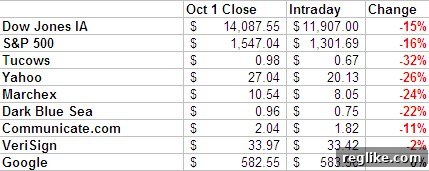
Domain Name Related Stocks Face Sharp Decline in Q4 2007 Amidst Broader Market Sell-Off
The final quarter of 2007 ushered in a period of significant volatility across global financial markets, and the domain name industry was no exception. While the inherent value of premium domain names and digital assets continued to show resilience, the publicly traded companies operating within this space found themselves grappling with the harsh realities of a widespread stock market downturn. This period highlighted a critical divergence: the perceived intrinsic value of domain names often stood in stark contrast to the fluctuating market capitalization of the companies built around them.
As the fourth quarter commenced, a palpable sense of unease began to sweep through investor communities. Concerns over the burgeoning subprime mortgage crisis and the subsequent credit crunch started to translate into tangible market corrections. The repercussions were swift and impactful. From the close of trading on October 1, 2007, the Dow Jones Industrial Average plummeted by 15%, while the S&P 500 experienced an even steeper decline of 16%. This broad-market retreat signaled a widespread “risk-off” sentiment, prompting investors to divest from perceived speculative or growth-oriented assets in favor of more stable, established holdings. For many companies within the nascent yet dynamic domain name sector, this environment proved particularly challenging, leading to far more pronounced drops in their share prices compared to the broader averages.
Understanding the Domain Name Industry Landscape in 2007
The domain name industry in 2007 was a vibrant ecosystem encompassing various business models. It included domain registrars, who facilitate the registration and management of domain names; domain parking companies, which monetize undeveloped domains through advertising; premium domain marketplaces and brokerage services; and technology providers offering infrastructure and advertising solutions. Each segment, while connected to the overarching theme of digital real estate, had unique revenue streams and inherent vulnerabilities. Companies relying heavily on advertising revenue, new registrations, or the speculative buying and selling of premium assets were particularly exposed when economic headwinds began to gather force.
The distinction between the value of domain assets and the performance of domain-related stocks is crucial. A highly sought-after domain name might retain or even increase its value as a digital asset due to its brand potential or traffic-generating capabilities. However, a company whose business model leverages these assets, perhaps through advertising or development, is subject to the broader economic climate, investor sentiment, and its operational efficiencies. A downturn in advertising spend, for instance, directly impacts the profitability of domain parking operations, regardless of how valuable the underlying domains are.
A Closer Look at Underperforming Domain Stocks
The challenging market conditions were clearly reflected in the performance of several key players within the domain name space. A review of their stock prices relative to their October 1, 2007, closing values revealed a stark and often painful picture for investors.
Tucows (AMEX TCX): A Registrar’s Vulnerability
Tucows Inc., a prominent domain registrar, experienced a significant drop, with its shares falling by 32%. As a registrar, Tucows’ core business relies on new domain registrations and annual renewals. While renewals offer a relatively stable income stream, new registrations can be sensitive to economic confidence. During periods of market uncertainty, businesses and individuals might delay new ventures or marketing efforts, leading to a slowdown in new domain acquisitions. Furthermore, registrars operate in a competitive market, where margins can be tight, making them vulnerable to broader economic pressures that affect discretionary spending on digital services.
Yahoo! (NASDAQ YHOO): Advertising Feeds Under Pressure
Yahoo!, a tech giant that played a crucial role in providing advertising feeds to major domain parking companies, including Parked.com, saw its stock decline by 26%. Domain parking relies almost entirely on advertising revenue generated from traffic to undeveloped domain names. As the economy tightened and businesses reduced their advertising budgets, the revenue streams for companies like Yahoo! and their partners in the domain parking sector were directly impacted. Yahoo! itself was navigating a complex period of strategic re-evaluation and increasing competition from Google, amplifying the downward pressure on its stock.
Marchex (NASDAQ MCHX): Navigating Local Advertising & Domain Holdings
Marchex, a company specializing in domain holding and local advertising solutions, continued its downward trajectory, shedding 24% from its October 1 close of $10.54. Marchex’s business model, which involves monetizing a portfolio of domain names through local search and advertising, is inherently tied to the health of local businesses and their willingness to invest in online advertising. A broad economic slowdown directly affects the marketing budgets of small and medium-sized enterprises, leading to reduced ad spend and, consequently, lower revenue for companies like Marchex. Their continued “downward spiral” highlighted the sector’s sensitivity to macroeconomic shifts.
Dark Blue Sea (DBX.AX): The Premium Domain Market’s Challenge
Australia’s Dark Blue Sea (DBX.AX), widely recognized for its premium domain brokerage and monetization platform, Fabulous.com, also suffered a considerable loss, with its value declining by 22%. The premium domain market often behaves like a luxury or discretionary asset market. In times of economic uncertainty and market downturns, investors and businesses tend to become more conservative with their capital, leading to a decrease in the acquisition of high-value domain names. Reduced transaction volume and potentially lower selling prices for premium assets would directly impact the profitability of companies like Dark Blue Sea.
Communicate.com (CMNN.ob): The Volatility of Micro-Cap Stocks
Communicate.com (CMNN.ob) experienced an 11% dip, with a significant portion of this loss occurring in a single trading day. It’s important to note that Communicate.com, like several other companies mentioned, traded below $1.00 per share and had relatively low trading volume. Stocks with these characteristics are often referred to as “penny stocks” or “micro-cap stocks.” They are inherently more susceptible to extreme price volatility due to lower liquidity and the disproportionate impact of even small buy or sell orders. During periods of broader market stress, such stocks are frequently the first to be shed by risk-averse investors, leading to exaggerated price movements.
Factors Amplifying Volatility for Smaller Entities
The heightened volatility observed in several of these domain-related stocks, particularly those trading at lower price points and with thinner trading volumes, can be attributed to several compounding factors. Firstly, low trading volume means that there are fewer buyers and sellers in the market, making it easier for a relatively small number of trades to significantly move the stock price. This illiquidity can create sharp price swings, particularly when market sentiment turns negative. Secondly, “penny stocks” are often viewed as more speculative investments. In a “risk-off” environment, investors tend to liquidate these higher-risk assets first, prioritizing capital preservation over potential high returns, thus exacerbating sell-offs. This flight to quality leaves smaller, less liquid companies particularly vulnerable, regardless of their underlying business fundamentals.
Resilience Amidst the Turmoil: Stable Domain-Related Players
Despite the widespread declines, not all domain-related stocks succumbed to the intense selling pressure. A few key players demonstrated remarkable resilience, largely due to their unique market positions and robust business models. Their performance offered a stark contrast and valuable insights into which aspects of the domain industry were more insulated from economic turbulence.
VeriSign (NASDAQ VRSN): The Power of Essential Infrastructure
VeriSign (NASDAQ VRSN) stood out as a beacon of stability, experiencing only a modest 2% decline in its share price. VeriSign’s resilience can be attributed to its fundamental role as the sole registry operator for the highly coveted .com and .net top-level domains. This position grants VeriSign a near-monopoly in the foundational infrastructure of the internet’s naming system. Their revenue model is primarily driven by renewal fees for these domains, which are essential for countless businesses and individuals worldwide. This creates an incredibly stable and predictable cash flow, largely insulated from the cyclical whims of advertising spend or new domain registrations for less critical TLDs. Furthermore, the company was poised to implement planned price increases—7% for .com and 10% for .net—which virtually guaranteed increased cash flow, solidifying its financial position regardless of broader market sentiment. This essential service provider status made VeriSign a safe haven for investors during volatile times.
Google (NASDAQ GOOG): A Tech Giant’s Stability
Google (NASDAQ GOOG), another titan in the technology sector with significant ties to online advertising and search, remained essentially flat since October 1. Google’s stability stemmed from its diversified and dominant position across various internet services, primarily its formidable search advertising business. While it too relies on advertising, Google’s sheer scale, market penetration, and diversified revenue streams (e.g., search, nascent Android, YouTube) provided a robust buffer against economic downturns. Businesses, even during tight financial periods, still allocated significant portions of their marketing budgets to Google’s highly effective advertising platforms, ensuring a consistent revenue stream that many other advertising-reliant companies could not match.
Implications for Investors and the Domain Industry
The events of Q4 2007 served as a potent reminder of the importance of understanding a company’s core business model, its revenue stability, and its competitive advantages when navigating volatile markets. Investors in the domain name sector learned that not all “domain-related” companies are created equal. Those providing essential, monopolistic infrastructure services (like VeriSign) proved far more resilient than those reliant on cyclical advertising revenues or speculative asset trading. The period underscored the critical distinction between the underlying value of digital assets and the market performance of companies whose fortunes are tied to the broader economic environment.
For the domain industry itself, this period highlighted areas of vulnerability and strength. It reinforced the idea that while domain names are digital assets, the businesses built around their monetization are subject to conventional market forces. Companies with predictable, recurring revenue streams and strong barriers to entry demonstrated superior performance, guiding future investment strategies and business development within the sector. It encouraged a deeper analysis of financial health beyond just industry buzz.
Conclusion: Navigating Market Dynamics in the Domain Sector
The final quarter of 2007 marked a challenging period for many companies associated with the domain name industry. The broad market sell-off, driven by escalating economic concerns, disproportionately impacted businesses with revenue models susceptible to reduced advertising spend or speculative investment. While domain values themselves might have held firm or even appreciated in some segments, the stock market’s assessment of companies in this space was undeniably harsh for many.
Yet, amidst the turmoil, companies like VeriSign and Google demonstrated remarkable resilience, thanks to their foundational roles, stable revenue streams, or diversified business portfolios. Their ability to weather the storm underscored a vital lesson for investors and industry participants alike: in times of economic uncertainty, understanding a company’s fundamental strengths and its degree of insulation from broader market fluctuations is paramount. The 2007 downturn served as an important stress test, revealing the inherent strengths and weaknesses within the dynamic and ever-evolving domain name industry.