
The Evolving Landscape of Domain Parking: Navigating Revenue Declines and New Opportunities for Domainers
The once-lucrative realm of domain name parking, a cornerstone for many digital asset investors, continues to face significant headwinds. For a considerable number of individuals and businesses involved in domaining – the practice of buying and selling domain names with the intent to profit – the financial returns from merely parking domains have been steadily diminishing. This persistent downward trend in revenue has prompted a critical re-evaluation of traditional domain monetization strategies and raised important questions about the future viability of passive income generation from parked domains.
The pressing question echoing through the domain investment community remains: how much lower can domain name parking revenue realistically go? The answer, as suggested by recent industry insights, is that the bottom might not yet be in sight. A comprehensive survey conducted by Domain Name Wire, gathering responses from approximately 200 domain professionals, sheds stark light on the current state of affairs, revealing a challenging environment where stagnation and decline are more common than growth.
Understanding the Shrinking Returns: Key Survey Findings
The 2014 Domain Name Wire Survey presented a revealing snapshot of the financial health of domain parking. A significant 36% of respondents reported that their domain name parking revenue for 2014 was lower compared to the previous year, 2013. This substantial percentage underscores a widespread struggle within the industry, indicating that a large segment of domainers are experiencing tangible losses in their parking income. The trend suggests that relying solely on parking as a primary monetization method is becoming increasingly unsustainable for many.
Conversely, a smaller contingent, merely 17% of participants, noted an improvement in their domain parking revenue. This minority segment offers a glimmer of hope and prompts further inquiry into what strategies these successful domainers might be employing differently to counteract the prevailing negative trends. For the vast majority, however, the picture was less optimistic. Roughly half of the respondents indicated that their revenue had stabilized, neither growing nor shrinking significantly. While stabilization might sound reassuring on the surface, it often signifies a plateau in an evolving market, hinting that these domain portfolios might not be generating their full potential value or are simply treading water in a competitive landscape.
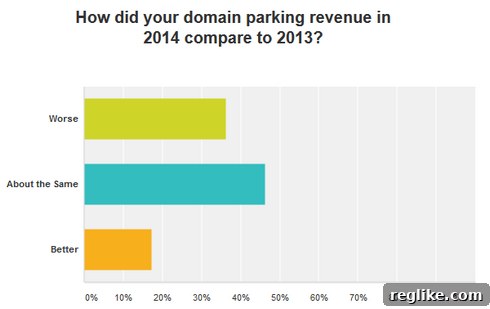
The visual representation of this data, as often depicted in industry reports, serves as a sobering reminder of the challenges at hand. This trend is not merely anecdotal; it is a systemic shift influenced by a myriad of factors impacting the digital advertising ecosystem and user behavior.
The Underlying Causes of the Decline in Domain Parking Revenue
Several critical factors have contributed to the ongoing reduction in domain parking revenue. Understanding these drivers is crucial for any domainer looking to adapt and thrive:
- Search Engine Algorithm Changes: Google, the dominant force in online search and advertising, has consistently refined its algorithms to prioritize high-quality, relevant content. Parked pages, which often offer minimal unique content and primarily serve as ad vehicles, have been increasingly de-prioritized in search results. This means less organic traffic reaching parked domains, directly impacting ad impressions and clicks.
- Shifts in User Behavior and Intent: Internet users are more sophisticated and demanding. They are less likely to click on generic ads on a parked page and increasingly prefer direct navigation to known websites or engaging with rich, informative content. The rise of mobile browsing and app usage further diverts traffic from traditional web-based parked pages.
- Increased Competition and Ad Quality Demands: The online advertising landscape is more competitive than ever. Advertisers are becoming more discerning, demanding higher quality traffic and better return on investment. Parking companies, limited in their ability to generate genuinely engaged traffic, find it harder to command premium ad rates.
- Consolidation of Ad Networks: As noted in the original article, most domain parking companies now operate under similar, if not identical, Google AdSense contracts. This consolidation means fewer “levers to pull” for parking companies to differentiate their monetization strategies or optimize earnings significantly beyond what Google dictates. The lack of diverse ad sources limits competition among platforms, which can suppress overall earnings for domainers.
- Ad Blocking Technologies: The widespread adoption of ad blockers by internet users directly reduces the visibility of advertisements on parked pages, cutting off a primary revenue stream regardless of traffic volume.
Domain Parking Companies: Navigating a New Reality
In response to these challenges, the role of domain parking companies has also evolved significantly. Historically, these companies offered domainers a simple, hands-off way to generate income from undeveloped domains. They would host a simple page filled with ads, leveraging type-in traffic and minimal SEO to generate clicks. However, the current environment demands more sophistication and less reliance on mere redirection.
The fact that “most parking companies are now on the same Google contract” fundamentally alters the playing field. This means the core monetization mechanism is largely standardized, reducing the scope for individual parking providers to offer superior earnings through unique ad partnerships or significantly better optimization techniques for “tier one monetization.” While some may offer slightly different template designs or analytics, the underlying ad revenue generation is largely dictated by a single, powerful entity, leaving parking companies with fewer options to innovate and deliver substantially higher returns.
The Search for New Solutions: Why Domainers Are Exploring Alternatives
Given the revenue stagnation and decline, it’s unsurprising that domainers are actively seeking new avenues. About 40% of survey respondents indicated their intention to try a new parking company in 2015. This statistic highlights a palpable dissatisfaction and a desperate search for a “magic bullet” in a market that offers few easy solutions. While some new parking companies might offer marginal improvements in interface or reporting, the fundamental economic realities of the industry remain largely unchanged. The hope that a different parking provider will significantly boost revenue is often met with the same limitations imposed by the consolidated ad ecosystem.
This trend towards exploring new providers isn’t necessarily a panacea, but rather a symptom of the deeper need for diversification. Domainers are realizing that the old model of passive parking is yielding diminishing returns and that a more proactive approach to domain asset management is imperative.
Strategies for Domainers: Adapting to Survive and Thrive
In this challenging landscape, domainers must pivot from passive parking to active domain management and monetization. The future belongs to those who can extract value from their digital assets beyond simple ad clicks. This requires a multi-faceted approach, moving beyond the traditional understanding of domain parking.
Beyond Passive Parking: Active Domain Monetization Strategies
Instead of merely parking, domainers should explore these alternative strategies:
- Developing Domains: This is arguably the most impactful strategy. Transforming a parked domain into a functional website, a mini-site, a blog, an e-commerce store, or a lead generation portal can unlock significant value. A developed site can generate income through affiliate marketing, direct advertising, product sales, or service provision, far exceeding typical parking revenue.
- Leasing and Lead Generation: High-value domains can be leased to businesses that can benefit from the domain’s branding or type-in traffic. Alternatively, a domain can be developed into a simple lead capture page, generating valuable customer leads for businesses in specific niches.
- Strategic Selling: Recognizing when to sell a domain is crucial. As parking revenues decline, the long-term holding cost of low-performing domains can outweigh potential future sales. Developing a robust sales pipeline and actively marketing domains for sale can be more profitable than continued parking.
- Affiliate Marketing Integration: Even simple domain development can include affiliate links relevant to the domain’s keyword, providing a direct path to monetization through commissions rather than generic ads.
- Information Portals: Building out content around a domain’s keyword theme can attract organic traffic and allow for more sophisticated monetization through targeted advertising, premium content, or directory listings.
Optimizing Existing Parked Domains (If Still Pursued)
For domains that remain parked, some optimization strategies can still be applied, albeit with limited impact on overall revenue:
- Niche Focus: Prioritize parking for domains with very specific, high-value keywords that attract highly targeted, commercially-oriented traffic.
- Testing Templates: Experiment with different parking page layouts and ad placements offered by parking providers to see if any configuration slightly improves click-through rates.
- Understanding Visitor Intent: Analyze traffic patterns to discern user intent. If traffic is consistently low quality or accidental, it might be a sign to either develop or divest the domain.
Effective Portfolio Management
In this dynamic environment, robust portfolio management is non-negotiable:
- Auditing Your Portfolio: Regularly review all domains to assess their performance, potential, and associated costs (renewal fees).
- Divesting Underperforming Assets: Be ruthless in selling or letting go of domains that consistently fail to generate sufficient revenue or show little promise for future development/sale.
- Strategic Acquisitions: If acquiring new domains, focus on premium, keyword-rich names with clear development or branding potential, rather than generic names solely for parking.
- Cost Reduction: Minimize holding costs where possible.
The Future of Domain Ownership in a Changing Digital Economy
The challenges in the domain parking business have inevitably led to significant consolidation within the space in recent years, a trend that is likely to continue. Smaller parking providers or those unable to adapt to the new realities will likely be acquired by larger entities or simply cease operations. This consolidation may lead to fewer choices for domainers but potentially more robust services from the surviving, larger players who can invest in better technology and diversified monetization strategies.
Ultimately, the era of easy, passive income from simply parking domains is largely behind us. The domain industry is maturing, professionalizing, and demanding more active engagement from its participants. Successful domainers of the future will be those who view their domains not just as parked assets, but as valuable digital real estate requiring development, strategic management, and a keen eye for market opportunities. The shift from a “set it and forget it” mentality to a proactive “develop, optimize, and monetize” approach is no longer optional; it is essential for long-term sustainability and profitability in the evolving digital economy.