
Unlocking Value: Why 65% of Domain Owners Prioritize Advertising Income Over Sales
The landscape of domain name investment has seen a fascinating evolution over the past two decades. What began for many as a speculative venture, driven by the hope of significant resale profits, has steadily matured into a more nuanced approach focused on sustainable income generation. This fundamental shift is brilliantly captured by a key insight from the 2006 Domain Name Wire survey, which revealed a striking preference among domain owners: a substantial 65% anticipated earning more revenue from advertising on their domains than from outright domain sales over the subsequent five years. While this data reflects a specific moment in time, it underscores an enduring trend that continues to shape strategies in the digital asset market today.
This article delves into the implications of this finding, exploring the driving forces behind the increasing emphasis on current revenue streams, the challenges and opportunities in domain monetization, and the critical role of quality traffic in determining profitability. We will unpack why many investors, even then, saw their domains not just as potential flip assets, but as burgeoning digital real estate capable of generating consistent, passive income through various advertising models.
The Shifting Paradigm: From Speculation to Sustainable Income Generation
In the early days of the internet, owning premium domain names was often likened to staking a claim in a rapidly expanding digital frontier. The excitement was palpable, fueled by high-profile sales that saw domains change hands for millions of dollars. This speculative fervor led many to acquire domains primarily with an eye toward future appreciation and resale. However, as the market matured, a more pragmatic reality began to set in. The vast majority of domain names, while valuable, would not command multi-million-dollar sales prices. Instead, their true potential lay in their ability to attract visitors and, consequently, generate revenue through advertising and other monetization methods.
The 2006 survey finding—that 65% of domain owners expected greater income from ads than sales—was a clear indicator of this evolving mindset. It signaled a pivot towards a long-term investment strategy, where domains were viewed as income-generating assets rather than mere commodities to be bought and sold quickly. This perspective brought domains closer to traditional real estate, where landlords seek consistent rental income rather than solely relying on property value appreciation. For domain investors, this meant developing a deeper understanding of online advertising, user behavior, and website development, moving beyond simple registration and holding.
This shift wasn’t just about diversification; it was about stability. Resale markets can be unpredictable, subject to economic downturns, technological shifts, and changing trends. Income generation, particularly from established traffic sources, offers a more predictable and often more sustainable return on investment. This focus encourages domain owners to invest in developing their domains, even minimally, to enhance their appeal to advertisers and users alike.
Understanding Diverse Domain Monetization Streams
When the survey mentioned “advertising income,” it encompassed a spectrum of monetization strategies that extended far beyond rudimentary domain parking. While parking was, and to some extent still is, a common entry point for domain owners, the more lucrative opportunities lie in developing the domain into a functional website. Let’s explore the various avenues for generating income from domains:
1. Domain Parking
This is often the simplest form of monetization, where a domain shows a page filled with ads, usually contextually relevant to the domain name. Services like Sedo, Google AdSense (through various parking partners), and others allow domain owners to display ads without building a full website. While easy to set up, revenue from basic parking is often low, as the traffic quality can be inconsistent.
2. Content-Rich Websites
Developing a domain into a full-fledged website with valuable content is where the real potential for advertising income lies. These sites can host display ads (e.g., Google AdSense, Media.net), native advertising, or sponsored content. The key is to create engaging content that attracts and retains a target audience, leading to higher page views and click-through rates, which in turn drive advertising revenue.
3. Affiliate Marketing
Many domain owners build niche websites focused on specific products or services, then monetize them through affiliate links. When visitors click these links and make a purchase, the domain owner earns a commission. This strategy requires good content, strong SEO, and a deep understanding of the target market.
4. Lead Generation
For certain business models, domains can be developed to capture leads for specific industries (e.g., insurance, real estate, home services). The website collects user information (e.g., contact details, project requirements) and then sells these leads to relevant service providers. This can be highly profitable for targeted, high-value domains.
5. E-commerce and Product Sales
Some domains are perfect for direct product sales. This involves setting up an online store, either selling proprietary products or dropshipping. While more intensive to set up and manage, it offers direct control over revenue and branding.
The distinction between simple parking and developed sites is crucial. While parking might generate a few dollars per month, a well-developed site with quality content and targeted traffic can generate hundreds or even thousands, making the investment in development worthwhile for the long term.
The Reality of Domain Parking Revenue: Quality Over Quantity
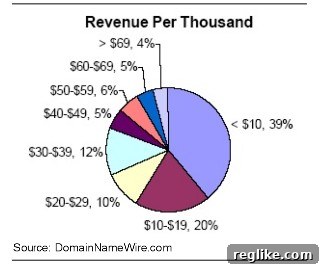
Despite the optimism about advertising income, the survey also painted a candid picture of the challenges faced by domain owners relying solely on parking. “Unfortunately, most domain name owners are not receiving high revenue from parked domains,” the report noted. This stark reality was underscored by the statistic that fully 39% of survey participants were receiving less than $10 per 1,000 views (RPM) from their parked domains. This figure highlights a fundamental issue in domain monetization: not all traffic is created equal.
The primary culprit behind low parking revenue is often the quality of traffic. There’s a significant difference between “type-in traffic” and “residual traffic.”
Type-in Traffic: The Gold Standard
Type-in traffic refers to visitors who directly type a domain name into their browser’s address bar. These users typically have a specific intent: they are looking for information related to that domain name, or they might be attempting to reach a known brand or concept. For example, someone typing “cars.com” or “flowers.org” directly into their browser is likely interested in buying cars or sending flowers. This direct intent makes type-in traffic highly valuable to advertisers, as these visitors are often closer to a purchasing decision. Domains attracting consistent, high-quality type-in traffic can command significantly higher RPMs.
Residual (or Accidental) Traffic: Lower Value
Residual traffic, on the other hand, often comes from misspellings, expired links, or remnants of old search engine results. While it adds to the overall “views,” these visitors usually lack specific intent related to the domain’s core concept. They might have landed on the page by accident, clicked a broken link, or simply mistyped a URL. As a result, they are less likely to engage with the ads, leading to lower click-through rates and, consequently, lower RPMs for the domain owner.
The survey data further illustrates this dichotomy: while 39% earned less than $10 RPM, a more fortunate 15% were receiving greater than $50 per 1,000 views. This substantial difference showcases the immense impact of traffic quality and domain relevance. Those achieving higher RPMs likely owned domains with strong type-in potential or had optimized their parking pages more effectively to convert accidental visitors into engaged users.
The distribution of revenue from parked domains (on a per owner basis) as illustrated in the pie chart below gives a visual representation of this disparity, emphasizing that while some thrive, a significant portion struggles to generate substantial income from basic parking.
Maximizing Your Digital Asset’s Potential: Strategies for Enhanced Revenue
Given the insights into traffic quality and monetization streams, how can domain owners maximize their advertising income? The answer lies in strategic development, optimization, and understanding the evolving demands of the online ecosystem.
1. Focus on Quality Traffic Acquisition
For new domain acquisitions, prioritize names with inherent type-in potential or strong brandability. For existing domains, analyze your traffic sources. If a domain consistently receives low-quality traffic, consider developing it into a simple landing page that provides value, rather than just a parking page, to better engage visitors.
2. Optimize Parking Pages (If Applicable)
Even for parked domains, optimization matters. Choose parking platforms that offer intelligent ad matching, clear layouts, and good user experience. Some platforms allow for custom templates or basic content additions, which can significantly improve engagement and ad performance.
3. Develop Niche Websites
The most effective way to increase advertising revenue is to transform a parked domain into a content-rich, niche-specific website. This involves:
- Keyword Research: Identify keywords relevant to your domain that have search volume and commercial intent.
- Content Creation: Publish high-quality, original content that addresses user queries and provides value. This builds authority and attracts organic search traffic.
- SEO Optimization: Ensure your website is technically sound, mobile-friendly, and optimized for search engines to rank higher and attract more visitors.
- Diversify Ad Placements: Experiment with different ad networks (beyond just one parking provider) and ad formats (display, native, video) to find what works best for your audience.
4. Consider Alternative Monetization
Don’t limit yourself to just display ads. Explore affiliate marketing for relevant products, create a lead generation form for specific services, or even build a small e-commerce store if the domain lends itself to product sales. The more diversified your monetization strategy, the more resilient your income stream will be.
5. Analytics and Iteration
Regularly monitor your domain’s performance using web analytics tools. Understand where your traffic comes from, how users interact with your site, and which monetization methods are most effective. Use these insights to continually refine your strategy, test new approaches, and improve your RPM.
The Enduring Relevance of Strategic Domain Investment
The insights from the 2006 Domain Name Wire survey remain remarkably pertinent today. While the internet has evolved dramatically, the core principle holds true: domains are not just digital addresses; they are valuable digital assets. Their true worth is increasingly measured not just by a one-time sale potential, but by their capacity to generate consistent, ongoing income. This requires a strategic mindset, a willingness to develop and optimize, and a keen understanding of online advertising and user behavior.
As the digital economy continues to expand, the demand for quality domain names and effective monetization strategies will only grow. Domain investors who embrace this paradigm shift—prioritizing the cultivation of their digital assets for sustainable revenue—are best positioned to thrive in the long run. The question is no longer just “What’s my domain worth?”, but “What income can my domain generate?” And for many, the answer to the latter holds far greater appeal.
Understanding which parking services and monetization platforms offer the best tools and highest returns is a continuous journey of research and adaptation. What was popular in 2006 may have changed, but the fundamental need for effective domain management persists. Staying informed and agile in this dynamic environment is key to unlocking the full potential of your domain portfolio.