
Domain Parking Industry Outlook: Cautious Optimism for 2008 Revenue
The domain name industry, a dynamic and often unpredictable sector, is currently buzzing with discussions about the future of domain parking. Despite recent headwinds and evolving advertiser policies, a significant portion of industry professionals remains remarkably bullish on its prospects. A comprehensive survey reveals that three-quarters of domain name professionals anticipate that domain parking revenue in 2008 will remain consistent with or even surpass the figures recorded in 2007, signalling a resilient optimism within the community.
This sentiment is further underscored by specific predictions regarding key performance indicators. A substantial 45% of respondents believe that RPM rates – Revenue Per Thousand views, a crucial metric for evaluating the profitability of parked domains – are set to increase throughout 2008. This expectation suggests a belief in improved optimization, higher advertiser spend, or perhaps a stabilization of the market after a period of adjustment. Understanding these trends is vital for domain investors, developers, and anyone involved in the broader domain monetization ecosystem.
Navigating the Evolving Landscape of Domain Parking
The journey of domain parking has been anything but static. Recent years have seen significant shifts, including heightened scrutiny from advertising platforms and a greater emphasis on quality traffic. The “bad news” alluded to within the industry often refers to policy changes from major advertising networks, notably Google, which in March 2008, began allowing advertisers to opt out of having their ads displayed on domain parking sites. Such developments sparked considerable debate and concern, raising questions about the long-term viability and profitability of traditional parking models.
However, the industry’s collective optimism, as highlighted by these survey results, suggests that many domainers believe they can adapt and thrive amidst these changes. This resilience often stems from a deep understanding of niche markets, effective traffic acquisition strategies, and continuous efforts to optimize parked pages for better user engagement and ad performance. The ability to identify premium domains with organic type-in traffic, or those that attract high-value keywords, remains a cornerstone of successful domain parking. Quality content and relevant advertising continue to be paramount for sustainable revenue generation.
Historical Performance vs. Future Expectations: A Reality Check
While the current outlook for 2008 appears promising according to survey participants, a look back at historical data provides a valuable dose of reality. Industry predictions, while often hopeful, do not always align perfectly with actual outcomes. For instance, in the previous year’s survey (conducted for 2007 performance), a notable 53% of respondents predicted an increase in earnings, with only 19% foreseeing a decrease. Yet, the data gathered from this year’s survey regarding 2007 performance tells a different story: actual earnings were largely on par with, or perhaps slightly less than, those recorded in 2006.
This discrepancy underscores the inherent challenges in forecasting market trends within the fast-paced digital advertising space. Factors such as unforeseen changes in search engine algorithms, shifts in advertiser budgets, increased competition for ad impressions, and global economic conditions can all profoundly impact domain parking revenue. It serves as a crucial reminder for domain investors to temper optimism with pragmatic analysis and to continuously monitor market dynamics rather than relying solely on sentiment. Past performance, while not indicative of future results, offers valuable lessons in market volatility.
Understanding RPM Rates: The Core of Parking Profitability
To truly grasp the economics of domain parking, one must delve into the specifics of RPM rates. Revenue Per Thousand (RPM) is the estimated earnings an advertiser receives for every thousand ad impressions or clicks. It’s a critical benchmark that helps domainers assess the effectiveness of their parking strategies and the overall value of their domain portfolio. The recent survey provides an insightful snapshot of how these earnings were distributed across the industry in 2007, revealing a wide spectrum of profitability among parked domains.
The data indicates that 35% of survey respondents reported earning less than $10 RPM. This significant segment likely includes domains with lower-quality traffic, less optimized parking pages, or those in highly competitive, low-value niches. For these domainers, the challenge lies in improving traffic quality, exploring alternative monetization methods, or considering the development of their domains into full-fledged websites. A consistently low RPM can also indicate a need to switch parking providers or experiment with different ad layouts and keyword targeting to maximize click-through rates and advertiser relevance. Strategic repositioning is key for these underperforming assets.
Conversely, at the higher end of the spectrum, a select 8% of respondents achieved an impressive $70 RPM or better. These high earners typically manage premium domain names that attract highly targeted, valuable traffic from engaged users. Such domains might be short, memorable, highly brandable, or rich in commercial keywords that command high bids from advertisers due to their direct relevance to products or services. Their success often stems from meticulous domain selection, advanced optimization techniques, and a keen eye for market trends. Achieving such high RPMs often requires a sophisticated understanding of keyword relevance, geo-targeting strategies, and conversion psychology on parked pages, transforming simple parking into a fine-tuned monetization machine.
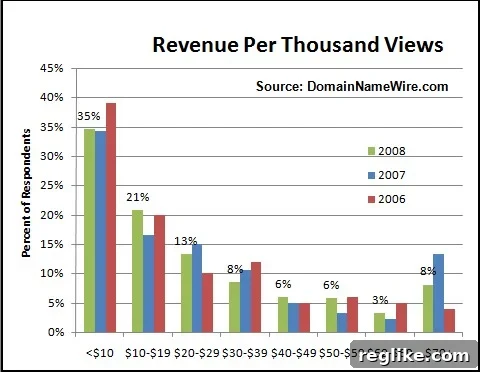
Figure: Distribution of Domain Parking RPMs in 2007, illustrating the wide range of profitability.
Key Factors Influencing Domain Parking Profitability
The wide disparity in RPMs across the industry highlights that numerous factors contribute to the profitability of parked domains. Understanding and optimizing these elements is essential for maximizing returns in the competitive domain market:
- Domain Name Quality: Premium, keyword-rich, and easily typable domains inherently attract better quality traffic and higher advertiser bids. Generic or confusing names typically perform poorly, struggling to capture user intent.
- Traffic Source and Quality: Direct navigation (type-in traffic) and organic search traffic are generally considered high-value because users are actively seeking information or products. Traffic from redirects or less reputable sources may lead to lower RPMs and even penalties from ad networks dueacing a need for vigilance.
- Niche and Advertiser Demand: Domains residing in niches with high commercial intent (e.g., finance, legal services, real estate, health) often yield better returns due to fierce competition among advertisers willing to pay more for qualified leads.
- Parking Provider and Optimization: Different parking platforms offer varying ad inventories, sophisticated optimization tools, and revenue share models. Experimenting with various providers and continuously A/B testing page layouts, ad placements, and keyword targeting can significantly impact performance, improving both CTR and CPC.
- Global Economic Climate: Advertising budgets are often sensitive to broader economic shifts. During periods of economic downturn, advertisers may reduce their spending, directly impacting RPMs across all ad channels.
- Policy Changes by Ad Networks: As seen with Google’s recent policy adjustments regarding advertisers opting out of parked domains, changes from major ad providers can instantly reshape the parking landscape, requiring domainers to adapt their strategies swiftly.
- User Experience (UX): Even on a parked page, a clean design, fast loading speed, and clear ad placement can improve user engagement and thus RPM.
Challenges and Opportunities in a Maturing Market
The domain parking sector, while showing signs of resilience and adaptation, also faces inherent challenges that demand continuous innovation. Increased competition for valuable keywords, the rise of alternative monetization strategies (like developing websites), and the ongoing fight against low-quality traffic sources continually test the ingenuity of domainers. The declining value of many generic domains, coupled with the increasing difficulty in acquiring high-quality type-in traffic in saturated markets, means that success requires a more strategic and data-driven approach than ever before.
However, these challenges also pave the way for new opportunities for discerning domain investors. The heightened focus on quality over quantity has encouraged innovation in domain monetization. Some domainers are moving beyond simple parking to more sophisticated models like lead generation via landing pages, developing niche mini-sites, integrating targeted affiliate marketing programs, or even incubating micro-businesses around their domains. The ability to identify emerging niches, leverage international traffic, and utilize advanced analytics to understand user behavior can unlock significant and previously untapped value, transforming idle assets into active revenue streams.
The Broader Domain Economy: Beyond Parking
It’s important to view domain parking not in isolation, but as a critical component of the larger domain name economy. Many domain investors acquire domains with the ultimate goal of developing them into thriving online businesses or selling them for a substantial profit in the secondary market. Parking often serves as an invaluable interim monetization strategy, helping to offset registration and renewal costs while awaiting full development or a suitable buyer. It’s a low-effort way to maintain a domain’s financial viability.
The insights gained from tracking parking revenue can also profoundly inform future buying and selling decisions within a domain portfolio. A domain that consistently generates a high RPM, even when simply parked, signals strong commercial potential and can therefore fetch a premium price in the aftermarket due to its proven ability to generate income. This inherent interrelationship between parking performance, domain development, and sales strategies will be further explored in upcoming industry analyses. Indeed, the next segment of this comprehensive survey is set to delve into the intricate world of buying and selling domain names online, promising further valuable insights into the full lifecycle and valuation of these digital assets.
Conclusion: Adapting to Thrive in Domain Monetization
The 2008 outlook for the domain parking industry presents a fascinating paradox: widespread optimism tempered by the hard-won lessons of past predictions. While three-quarters of industry professionals foresee stable or increased revenue, and nearly half anticipate higher RPMs, history cautions against overconfidence, reminding us of the market’s inherent unpredictability. The significant segment of domains still struggling with low RPMs highlights the ongoing need for strategic domain acquisition and aggressive optimization efforts to improve performance.
Ultimately, sustained success in domain parking, and indeed in the broader domain economy, hinges on adaptability, continuous learning, and a proactive approach. As ad platforms evolve their policies, user behavior shifts, and competition intensifies, those who can innovate, meticulously analyze market data, and consistently optimize their portfolios will be the ones who not only weather the inevitable changes but truly thrive within them. The domain world remains a vibrant and profitable space for those willing to learn, evolve, and strategically manage their digital assets, and the insights gleaned from these valuable industry surveys provide invaluable guidance for navigating its complexities effectively.
[View the full survey results here for deeper insights into the domain industry.]