
Maximizing Your Advertising Investment: The Critical Role of Digital Presence
In the rapidly evolving landscape of modern marketing, businesses invest substantial resources in advertising campaigns, aiming to capture audience attention and drive engagement. Yet, a fundamental oversight often undermines these efforts: failing to make it effortlessly simple for potential customers to find and connect with them. Why spend a fortune on compelling advertisements if the path to engagement is fraught with obstacles?
The digital age has fundamentally reshaped consumer expectations. When an advertisement piques curiosity, the immediate instinct is to seek more information online. Whether it’s a product, a service, or a brand, people expect to instantly access details, explore offerings, and make contact with ease. This expectation forms the cornerstone of effective advertising in the 21st century. Any advertisement, regardless of its medium – print, broadcast, or digital – must serve as a clear, unobstructed gateway to further interaction. Without a direct and simple means of connection, such as a well-placed domain name or a clear call to action, even the most captivating ad risks becoming a costly missed opportunity.
The Shocking Omission: A Full-Page Ad with No Domain Name
A striking illustration of this disconnect recently came to light when Bret Fausett shared an image of a full-page advertisement featured in the esteemed New York Times. What made this ad particularly noteworthy, and indeed alarming, was its glaring lack of a domain name. Instead of directing potential customers to a professional website where they could learn more, explore products, or engage with the brand, the ad solely provided an @yahoo.com email address. This decision, seemingly a relic from a bygone era, sparked widespread discussion:
Someone took a full page ad in the New York Times, provided no URL and advertised a https://t.co/6QCB0uSrjQ email address. #buyadomainname. pic.twitter.com/z9mON02Lv2
— Bret Fausett (@bretfausett) February 19, 2017
Investing in a full-page advertisement in a publication as prominent as the New York Times represents a significant financial commitment. Such an investment implies a serious intent to reach a broad and influential audience. To then provide only a generic, free email address as the sole point of contact is not only unusual but also profoundly counterproductive. It immediately raises questions about the advertiser’s professionalism, credibility, and overall commitment to their brand. In an age where digital identity is paramount, a custom domain name is a fundamental aspect of establishing a legitimate and trustworthy online presence. Without it, the substantial advertising budget is largely wasted, as interested parties are left with a cumbersome, unprofessional, and unreliable method of follow-up. This example serves as a stark reminder of how easily a potentially impactful advertising strategy can be undermined by a basic omission in digital integration.
The Economist’s Pages: Brand Awareness vs. Direct Engagement
While the New York Times example might be attributed to an individual advertiser perhaps less attuned to modern marketing nuances, the issue extends even to established companies. It was surprising to observe advertisements in a recent issue of The Economist that similarly lacked essential contact information. In some cases, there was no contact detail whatsoever – not even a phone number, let alone a domain name. This trend raises pertinent questions about the evolving goals of print advertising and the perceived value of immediate digital pathways.
Slack: Betting on Brand Recognition Alone?
Consider the advertisement from Slack, the popular team collaboration platform:
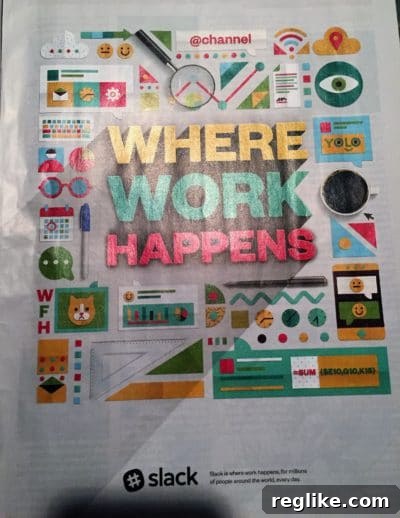
It’s undeniable that Slack enjoys immense popularity and a strong brand presence. This particular ad appears to be primarily focused on brand awareness – reinforcing the name “Slack” in the minds of readers and solidifying its legitimacy. For a company with such widespread recognition, the rationale might be that people already know how to find them, or that the ad’s purpose is simply to keep the brand top-of-mind. While this approach might be justifiable for a ubiquitous brand, it still represents a missed opportunity. Even for branding-focused campaigns, providing a clear URL can subtly reinforce trust, guide curious new users directly to product information, or even offer a specific landing page for a targeted message related to the ad. In an increasingly competitive market, every touchpoint is an opportunity for engagement, and a direct link to the brand’s digital home is an invaluable asset.
Arconic: An Enigma with a $13 Billion Valuation
The case of Arconic, a global leader in advanced engineered products, presents an even more puzzling scenario. Their ad, designed to “bring awareness,” stated: “If you look past wood, stone and concrete, you’ll find us.”

The tagline is intriguing, hinting at a company that operates beyond conventional materials. However, after “looking past” these elements, readers are left with no practical means to “find” Arconic. There was no web address, no phone number, no social media handle, not even a stock symbol for those inclined to research the company’s financial standing. This absence of critical information transforms an otherwise thought-provoking ad into a dead end.
It turns out Arconic is a formidable $13 billion company. Yes, one can eventually find them through a search engine like Google. But why would a major corporation, investing in high-profile advertising, deliberately create such a circuitous path for potential customers or investors? This forces interested parties to take an extra, unnecessary step, introducing friction into the engagement process. Moreover, by directing users to a general search, Arconic inadvertently exposes them to competitors who might feature prominently in search results or even run ads above Arconic’s organic listing. The objective of an advertisement should be to streamline the user journey, not complicate it. Every advertisement should act as a direct conduit, guiding the audience precisely where the advertiser wants them to go – ideally, directly to Arconconic.com, rather than through an indirect and potentially compromised search.
The Undeniable Imperative: Why a Digital Gateway is Non-Negotiable
The examples above underscore a critical deficiency in modern advertising practices. In an era dominated by digital interaction, failing to provide a clear and direct digital pathway in an advertisement is not just an oversight; it’s a strategic misstep that can significantly diminish the effectiveness and return on investment (ROI) of marketing efforts. Here’s why a visible digital gateway, especially a domain name, is absolutely non-negotiable for any serious advertising campaign:
1. Credibility and Professionalism
A dedicated domain name (e.g., CompanyName.com) instantly signals professionalism and legitimacy. It tells potential customers that you are a serious entity with an established online presence. Conversely, relying on generic email addresses or forcing users to search for you can erode trust and make your brand appear less credible or even outdated. In a world saturated with information, establishing immediate trust is paramount.
2. Seamless User Experience (UX)
The core principle of effective advertising is to make it as easy as possible for the consumer to take the next desired action. A direct URL in an ad reduces friction, streamlines the user journey, and respects the audience’s time. Users expect instant gratification; forcing them to navigate through a search engine adds an unnecessary layer of complexity and increases the likelihood of disengagement. A smooth user experience translates directly to higher engagement rates and better conversion prospects.
3. Direct Response and Conversion Optimization
For most advertisements, the ultimate goal is to drive a specific action – whether it’s making a purchase, signing up for a newsletter, requesting a demo, or simply learning more. A prominent domain name, ideally linked to a specific landing page tailored to the ad’s message, is crucial for tracking campaign effectiveness and optimizing conversion rates. Without this direct link, it becomes incredibly challenging to attribute leads, sales, or even interest back to a particular ad, making ROI measurement nearly impossible.
4. Competitive Advantage and Brand Protection
When an advertisement fails to provide a direct digital link, it inadvertently sends potential customers to the open internet – usually via a search engine. This is a hazardous gamble. Competitors might be actively bidding on your brand keywords, placing their ads directly above your organic search results. By sending your audience to Google, you’re essentially giving competitors an opportunity to intercept your hard-earned leads. A direct URL ensures that interested individuals land precisely on your controlled digital property, protecting your brand and guiding them through your curated experience.
5. Bridging the Print-to-Digital Divide
Print advertising still holds significant value for brand building and reaching specific demographics. However, its effectiveness is amplified exponentially when seamlessly integrated with a robust digital strategy. A domain name acts as the crucial bridge, transforming a passive print impression into an active digital interaction. It allows the tangible experience of reading an ad to transition effortlessly into the dynamic world of online exploration, where deeper engagement, information dissemination, and transaction can occur.
Best Practices for Integrated Advertising Success
To truly maximize the impact of every advertising dollar, businesses must embrace an integrated marketing approach that prioritizes clear digital pathways:
- Always Include a Clear URL: This is the most fundamental step. Ensure your website address is prominently displayed, easy to read, and memorable.
- Utilize Specific Landing Pages: For distinct campaigns, create dedicated landing pages that mirror the ad’s message. This enhances relevance, improves user experience, and allows for precise tracking of campaign performance.
- Consider QR Codes: Especially for print ads, QR codes offer a quick, scannable link directly to a specific webpage, providing an instant digital bridge for smartphone users.
- Track Everything: Implement analytics to monitor traffic originating from your ad’s URL. Understanding where your audience comes from and how they interact with your digital assets is crucial for continuous improvement.
- Ensure Mobile Responsiveness: Since many users will access your site via smartphones after seeing an ad, your website must be fully optimized for mobile devices, offering a fluid and intuitive experience.
A Shining Example: Go Boldly
It would be remiss not to acknowledge advertisers who get it right. The Pharmaceutical Research and Manufacturers of America (PhRMA), an advocacy group for pharmaceutical companies, provided an excellent example of effective ad design. They ran a full-page advertisement with the compelling tagline “Go Boldly.” Crucially, they not only owned but also prominently displayed the matching domain name, GoBoldly.com, within the ad.
This approach exemplifies intelligent advertising. The ad creates intrigue with its tagline, and then immediately provides a clear, memorable, and relevant digital destination for anyone wishing to learn more. It eliminates friction, reinforces the brand message, and directs interested parties directly to a controlled environment where PhRMA can further engage them, share their message, and achieve their advocacy goals. This is a testament to understanding how modern audiences interact with advertising and how to effectively bridge the gap between traditional media and digital engagement.
Conclusion: The Future of Advertising is Connected
In conclusion, the efficacy of any advertising strategy hinges on its ability to connect with the audience and facilitate the next step in their journey. While creative messaging and impactful visuals are undeniably important, they become severely limited without a direct and easily accessible digital gateway. The cost of a full-page ad in a prestigious publication or any significant advertising placement demands a commensurate return on investment. This ROI is dramatically enhanced when potential customers can effortlessly transition from being intrigued by an ad to actively engaging with the brand online.
In today’s interconnected world, a robust digital presence, clearly articulated through a professional domain name, is not an optional add-on but an essential component of every advertising campaign. Businesses must recognize that their advertisements are not just messages; they are invitations to engage. By providing clear, actionable digital pathways, companies can ensure that their marketing spend yields maximum results, fosters stronger customer relationships, and builds a truly integrated and resilient brand in the digital age.