
A Landmark Acquisition: Donuts Buys Rightside, Reshaping the Domain Name Landscape
In a significant move that reverberated through the domain name industry, Donuts, a leading registry operator, announced its agreement to acquire Rightside (NASDAQ: NAME) for an impressive $213 million. This strategic consolidation marks a pivotal moment, signaling deeper shifts within the ecosystem of new Top-Level Domains (TLDs) and broader domain management services. Initially, the news sparked immediate discussions, but a closer examination reveals the profound strategic underpinnings and potential ramifications of this substantial transaction.
The Inevitability of Rightside’s Sale
The acquisition of Rightside by Donuts was not merely a market opportunity; it was, for Rightside, a strategic imperative. Following the divestment of its renowned eNom registrar business to Tucows earlier in the year for $83.5 million, Rightside found itself in a precarious position. The company’s operational footprint and financial scale had diminished significantly, rendering its continued existence as an independent publicly traded entity increasingly untenable. Being public demands constant performance, quarterly growth, and robust investor confidence – pressures that became exceedingly difficult to sustain for a company of its reduced size.
Moreover, Rightside faced considerable headwinds that painted a challenging picture for its future as a standalone business. The sale of eNom, while providing a cash injection, also meant Rightside was about to lose its largest customer, eNom, which had been a substantial contributor to its registry revenue. This move placed an even greater spotlight on its portfolio of new TLDs, a segment where revenue growth had begun to flatline. The initial excitement and growth curve associated with the launch of new generic TLDs had started to plateau, challenging the optimistic projections once held by the company.
Consider Rightside’s registry revenue, which encompassed sales from its 40 proprietary TLDs and the technical registry services provided for Donuts’ vast TLD portfolio. As illustrated by the trends, revenue saw initial growth coinciding with the launch of new TLDs. However, this upward trajectory stalled noticeably once the initial wave of new domain introductions subsided and the market began to mature.
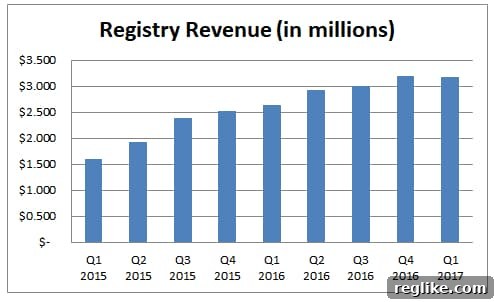
The company had continued to project an ambitious annual registry revenue of $50-$75 million within a few years. However, achieving such targets in a consolidating and increasingly competitive new TLD market was looking increasingly improbable. This financial pressure was compounded by the unpredictable nature of its domain name aftermarket revenue, a segment notorious for its volatility. Consequently, Rightside had forecasted a lower overall revenue for 2017 compared to 2016, a forecast significantly influenced by the anticipated fluctuations in aftermarket performance. These factors collectively made a compelling case for the company to seek an acquirer, rather than attempting to navigate an uncertain future alone as a small public entity.
A Fated Acquisition: The Donuts-Rightside Partnership
The relationship between Donuts and Rightside is deeply interwoven, tracing back to the nascent stages of the new TLD program. Their collaboration began with a strategic partnership to apply for a substantial pool of approximately 100 domain extensions together. This early alliance was so close that it even fueled speculation among industry observers that Donuts might serve as a strategic “backdoor” for Rightside (then part of Demand Media) in the event of any disqualification from directly owning new TLDs due to regulatory or competitive concerns.
Beyond joint applications, Rightside has historically served as the critical technical backbone for Donuts, operating the entire technical registry services for all of Donuts’ extensive portfolio of domain extensions. This deep operational integration meant that the two companies were already inextricably linked at a fundamental level, making an eventual full integration a logical, if not inevitable, progression. Further reinforcing this historical connection is the fact that Paul Stahura, a co-founder of Donuts and its first CEO, was the original founder of eNom. This registrar business eventually became a significant part of Demand Media and subsequently Rightside, creating a unique historical thread between the key players in this acquisition.
However, their long-standing relationship was not without its moments of tension. A notable instance occurred when Donuts made a public, unsolicited offer of $70 million for Rightside’s new TLD registry business. This aggressive move, made public after Rightside had initially rebuffed the offer, underscored Donuts’ persistent interest in Rightside’s assets and its desire for market consolidation. Moreover, Donuts strategically leveraged Google’s open-source registry platform, Nomulus, as a bargaining chip during the renewal of its technical registry contract with Rightside. By openly collaborating with Google on Nomulus, Donuts effectively created leverage, enabling it to negotiate more favorable terms and demonstrating its strategic acumen in managing vendor relationships and securing competitive advantages.
Unpacking the $213 Million Valuation: Hidden Figures and Future Directions
The $213 million acquisition price represents a substantial increase over Donuts’ previous $70 million unsolicited offer. This significant jump is primarily due to the scope of the current deal: Donuts is acquiring Rightside’s entire business, not just its registry segment. While the registry business contributes significantly to Rightside’s strategic value, it was, at the time of the deal, the smallest part of its revenue streams. Last year, the registry segment generated $11.8 million in revenue. However, Donuts also gains ownership of Name.com, Rightside’s popular retail registrar, which generated $29.1 million in revenue last last year. Furthermore, the acquisition includes Rightside’s substantial portfolio of approximately 300,000 domain names, alongside its aftermarket business (which combines portfolio sales and parking revenue), contributing $22.6 million to the company’s annual revenue.
It’s important to acknowledge that while the registry business had lower absolute revenue, it typically operates with significantly higher margins compared to the broader retail registrar and aftermarket operations. This makes the registry a highly attractive asset from a profitability standpoint. Moreover, Rightside’s financial position was bolstered by a significant cash reserve, a direct result of the earlier eNom sale. While the company had begun to use some of this capital for share buybacks, the actual net cost of the $213 million offer to Donuts, once Rightside’s cash reserves are factored in, is likely closer to an estimated $150 million, making the acquisition even more financially attractive.
The Future of Name.com: Registrar Operations Under Donuts
One of the most intriguing aspects of this acquisition is what Donuts will decide to do with Name.com, Rightside’s popular registrar business. Historically, major registry operators have often shied away from owning registrars to avoid potential conflicts of interest, such as favoring their own TLDs over competitors’. However, the industry landscape has evolved, and vertical integration between registries and registrars has become less of a significant concern than once predicted. Rightside, for instance, had effectively leveraged Name.com to boost the adoption of some of its own new TLDs. This precedent suggests that Donuts might consider keeping Name.com as a strategic asset, using it to drive registrations for its extensive TLD portfolio. If Donuts chooses not to retain Name.com, there would undoubtedly be a long list of eager buyers within the competitive registrar market, given its established brand and customer base.
The Aftermarket Business and .Com Portfolio
The aftermarket domain business presents a different set of strategic considerations for Donuts. It would indeed be somewhat ironic for a company whose core mission revolves around the growth and promotion of new TLDs to simultaneously hold a portfolio of hundreds of thousands of traditional .com domains. This segment includes not only direct sales from its portfolio but also parking revenue generated from undeveloped domains. While the specifics of Rightside’s portfolio are not fully public, a logical buyer for the “cleaner,” higher-value segments of this portfolio would be a company like GoDaddy, which possesses extensive experience and infrastructure in managing large domain portfolios and aftermarket sales.
Contrasting Strategies and Future Integration in the New TLD Market
Before the acquisition, Donuts was already the undisputed leader in the new TLD space, managing an expansive portfolio of approximately 200 domain extensions. With the addition of Rightside’s 40 TLDs, Donuts has solidified its dominant position, further consolidating power within this burgeoning market segment. However, the two companies had historically adopted distinct strategies for developing and marketing their TLD portfolios, and it will be fascinating to observe whether Donuts shifts its approach post-acquisition.
Donuts has largely operated on an “economies of scale” model, focusing on acquiring a vast number of TLDs and relying on the sheer breadth of its offerings, coupled with registrar distribution, to drive registrations. Its marketing efforts for individual TLDs have traditionally been minimal, adhering to a strategy that prioritizes operational efficiency over aggressive promotional campaigns. Rightside, conversely, particularly in its later stages as a public company, had no such luxury. Under intense pressure to demonstrate top-line growth and generate immediate revenue, even at the expense of short-term profitability, Rightside actively marketed specific TLDs. For example, it made concerted efforts to cultivate domains like .live, strategically engaging streaming video influencers to drive adoption and build brand recognition.
The central question now is whether Donuts will choose to discontinue these more intensive marketing activities in favor of simply harvesting the fruits of Rightside’s previous efforts, or if it will adopt a hybrid approach. From a purely financial standpoint, especially for a private company not under the scrutiny of quarterly earnings, scaling back on direct marketing for individual TLDs might appear more sensible, as it reduces immediate operational costs. However, for the long-term health and growth of the entire new TLD industry, a more robust marketing investment across the board is crucial. While Donuts, as a private entity, doesn’t face the same short-term pressures as a public company like Rightside did, the industry hopes it will ramp up marketing to ensure sustained adoption and awareness of new TLDs.
Both Donuts and Rightside employed analytical approaches to pricing and managing premium domain names within their TLDs. However, Rightside was often perceived as having taken this approach to an extreme, potentially holding back too many premium names or setting prices too high, thus limiting adoption. It remains to be seen if Donuts will pare down Rightside’s extensive premium inventory, perhaps by making more names available or adjusting pricing strategies to stimulate broader uptake. Additionally, from a trademark protection perspective, it is highly anticipated that the two companies’ similar trademark blocking services, designed to protect brand owners in the new TLD space, will be integrated and potentially offered at a consolidated, premium price, leveraging the combined market power.
Operational Synergies and Industry Impact
Despite recent layoffs, Rightside carried a significant amount of operational overhead as a public company. The acquisition by Donuts will undoubtedly lead to substantial operational efficiencies. Many positions within Rightside’s corporate structure, such as finance, legal, human resources, and certain executive roles, will become redundant as Donuts integrates the acquired business into its existing framework. This consolidation offers a prime opportunity for other companies within the domain industry looking to bolster their ranks with experienced talent, as skilled professionals from Rightside may become available.
This acquisition goes beyond mere financial transactions; it reshapes the competitive landscape of the new TLD market. By acquiring Rightside, Donuts not only eliminates a direct competitor but also gains a substantial portfolio of TLDs, a robust registrar, and valuable aftermarket assets. This move solidifies Donuts’ position as the leading registry operator for new TLDs and provides it with an even greater platform to influence the future direction of the domain name industry. The strategic integration of Rightside’s assets and expertise into Donuts’ operations is poised to create a more streamlined, efficient, and dominant force in the global domain market.
Summing It Up: A Strategic Masterstroke
In conclusion, Rightside’s sale was an unavoidable consequence of its evolving market position and financial pressures. Donuts, with its deep historical ties, existing operational partnership, and dominant role in the new TLD business, emerged as the most logical and ideal buyer. This strategic acquisition extends Donuts’ reach beyond just TLD registries, bringing a significant registrar and aftermarket business under its umbrella. The industry will closely watch two key areas post-acquisition: firstly, how Donuts integrates and manages Rightside’s non-new TLD businesses, particularly Name.com and the aftermarket portfolio; and secondly, whether Donuts will adapt its historically lean marketing approach to incorporate some of Rightside’s more active promotional strategies for new TLD adoption. This acquisition is more than just a merger; it’s a strategic consolidation that promises to redefine the trajectory of the domain name industry for years to come.