
Dynadot’s appraisals aren’t as objectionable as some other services, but they are fairly basic.
This is part of Domain Name Wire’s review of automated domain appraisal tools.
Dynadot, a registrar popular with domain investors, offers a free domain appraisal tool that returns a single numeric estimate and a short rationale. The explanation typically cites factors like length, registration history, and potential use cases. One useful feature is that Dynadot lists comparable domains currently for sale to help justify its estimate.
Overall the tool produces fewer perplexing results than some competitors, but its outputs are still basic and sometimes inconsistent. Below is a breakdown of how the tool performed across several domain categories.
Two-word brandables
We tested MakeMatter.com (sold for $15,000) and PressBridge.com (sold for $5,000). Two-dictionary-word brandable .coms commonly sell in the $3,000–$15,000 range, so a reasonable appraisal system should produce values within or near that band.
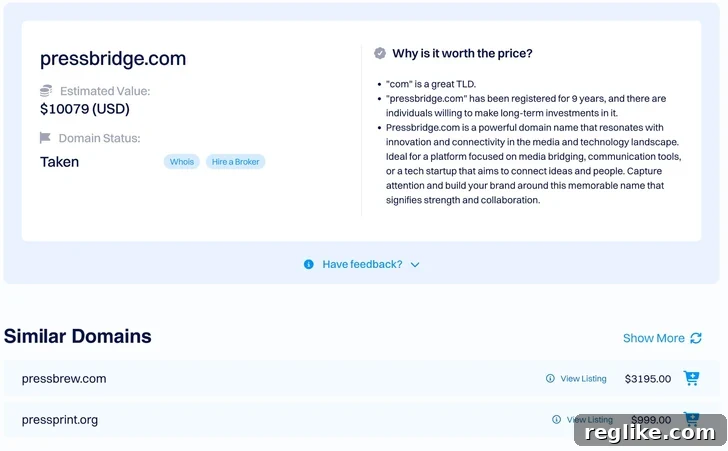
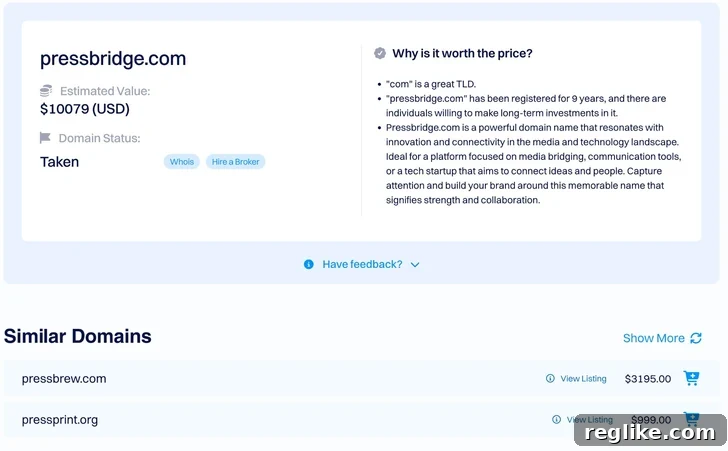
Dynadot appraised MakeMatter.com at $3,292 and PressBridge.com at $10,079. Both results sit inside the expected range, though the gap between them was larger than anticipated. For an unregistered brandable, CloudToaster.com, Dynadot returned $2,000 — a modest valuation that illustrates the tool’s conservative lean for some unregistered names.
One-word, high-value .com
High-end single-word .coms are notoriously difficult to price. Dragonfly.com was appraised by Dynadot at $166,643, which is well below recent sale figures for comparable premium names. Other tests showed similar variance: money.com came back at about $19 million (reasonable if treated as undeveloped), Midnight.com at $237,163 (sold for $1.15 million this year), and Twig.com at $72,429 (sold for $695,000 this year).
These disparities highlight the challenge of valuing top-tier domains. A better approach would be for the tool to present ranges or rounded estimates, or to flag names that exceed a reliable appraisal threshold with a “too high to appraise” or “over $X” message.
Popular ccTLDs (.io, .ai)
Country-code and tech-focused TLDs have different market dynamics. We tested expedite.io (sold for $14,995), which Dynadot appraised at $11,125 — a reasonable estimate. For kickers.ai (sold for $8,000), Dynadot returned $29,852, a notably higher figure. Dynadot has extensive .ai transaction data from previously running expired domain auctions for that registry, which can skew valuations upward in some cases.
Exact-match descriptive domains
Exact-match, category-defining names can command high premiums. WaterFilters.com, listed for $3.5 million, received a Dynadot appraisal of $29,852 — placing it mid-range compared with other automated tools. Given the scarcity and strategic value of true exact-match category domains, automated tools often struggle to capture their full market potential.
Three- and four-letter domains
Short letter combos are among the most liquid assets in the domain market. We tested dujo.com, a pronounceable four-letter .com listed on Afternic for $36,000; Dynadot valued it at $28,802. For a non-pronounceable four-letter example, MOTG.com (listed for $14,888) came back at $23,819. Dynadot correctly ranked the pronounceable dujo.com higher than motg.com.
For the three-letter domain VJN.com (listed at $39,000), Dynadot appraised it at $66,147. That exceeds the asking price and illustrates how appraisal models can produce values higher than current market listings. While surprising, such figures aren’t impossible, since three-letter .coms can command broad ranges depending on buyer demand and perceived letter quality.
New gTLDs
New generic TLDs are challenging to value due to thin sales histories. voicemail.app, which sold for $5,000 last year, was appraised by Dynadot at $8,854. timber.homes, sold for $2,899, received an appraisal of $590. Considering the sparse and volatile data for many new TLDs, these appraisals are not unreasonable — though they vary in direction and magnitude.
Final analysis
In summary, Dynadot’s appraisal tool produces fewer baffling outputs than some automated systems, but it remains a fairly basic option. Its strengths include showing comparable listings and offering clear, single-number estimates. Its shortcomings include inconsistent handling of high-end domains, occasional over- or underestimates for ccTLDs and new gTLDs, and a lack of nuanced output such as ranges or confidence indicators.
Small product improvements would increase usability: adding thousands separators in valuations for readability and offering a bulk appraisal mode so users can rank multiple domains more efficiently. For casual users and investors seeking a quick sanity check, Dynadot’s tool is useful; for serious valuation work, it should be one of several inputs rather than the sole authority.