
The Lingua Franca of Domains: Unpacking Language Dynamics at DOMAINfest Prague
International conferences are vibrant hubs of global exchange, bringing together professionals from diverse linguistic backgrounds to share knowledge, forge connections, and drive innovation. Yet, amidst the excitement of cross-cultural interaction, one challenge consistently looms large: effective communication. How do organizers ensure that every attendee, regardless of their native tongue, can fully engage with the content and the community?
The DOMAINfest Prague conference served as a fascinating case study in this perpetual quest for seamless global communication. While all domain-centric events inherently possess an international flavor, DOMAINfest Prague emphasized this aspect even further. Its organizers, DomainSponsor, embarked on an ambitious endeavor to bridge potential language barriers, providing extensive real-time translation services to cater to its diverse European audience.
DomainSponsor’s Vision: Fostering Inclusivity Through Multilingual Support
The official language designated for the DOMAINfest Prague conference was English, a common choice for many international business and tech gatherings. However, DomainSponsor went above and beyond to ensure maximum comprehension and participation. Their vision was clear: to create an environment where linguistic differences would not hinder anyone’s ability to absorb the valuable insights shared during sessions or participate actively in the domain auction. This commitment to inclusivity manifested in the form of professional, real-time translation services.
Attendees were offered a sophisticated “U.N.-style” setup, allowing them to immerse themselves fully in the conference content in their preferred language. This wasn’t merely a gesture; it represented a significant logistical and financial investment, underscoring DomainSponsor’s dedication to providing an unparalleled experience for every participant. The idea was to eliminate the cognitive load of translating in real-time in one’s head, freeing attendees to focus entirely on the speakers’ messages and the strategic discussions at hand.
The technology deployed was impressive and efficient, mirroring the systems used in high-stakes diplomatic environments. Each attendee had the option to pick up a headset, tune into a specific frequency, and listen to live interpretations of the presentations. This kind of simultaneous translation requires highly skilled interpreters and robust audio equipment, a testament to the effort put forth by the conference organizers.
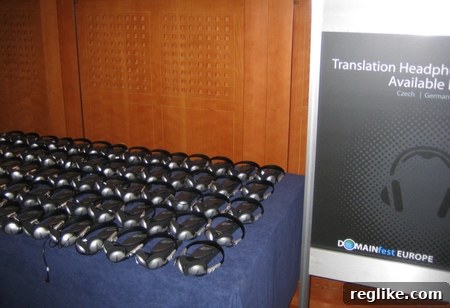
State-of-the-art headphones provided for hearing real-time translations, designed to offer a personalized listening experience to each attendee.
Behind the Scenes: The Dedicated Team of Translators
To facilitate this ambitious multilingual environment, a team of professional translators was on standby, diligently working behind the scenes. These linguistic experts were positioned in a dedicated booth, often at the back of the main conference hall, where they could listen to the speakers through soundproof glass and simultaneously interpret the content into the designated languages. Their role was crucial, demanding not only impeccable language skills but also a deep understanding of the domain industry’s specific terminology and nuances.
Translations were offered in key regional languages, specifically Czech, Polish, and German. This selection reflected the significant presence of domain professionals from Central and Eastern Europe, aiming to directly serve a substantial portion of the conference’s target demographic. The services covered not just the main educational sessions and keynote speeches but also the high-energy domain auction, ensuring that every bid and comment was perfectly understood by all potential buyers and sellers, regardless of their native tongue. This comprehensive coverage demonstrated a thorough approach to ensuring equitable access to information throughout the event.
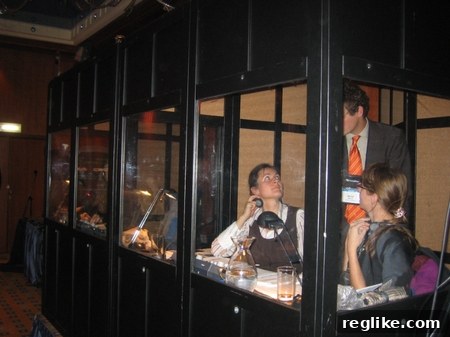
The dedicated team of professional translators, working diligently from their booth at the rear of the conference room to provide real-time language support.
The Unforeseen Reality: A Curious Observation on Usage
Despite the meticulous planning and the significant resources invested in providing these top-tier translation services, an interesting paradox emerged. A casual observation throughout the conference revealed a striking lack of attendees utilizing the provided headphones. The U.N.-style headsets, readily available and prominently displayed, remained largely untouched. This unexpected outcome prompted questions about the actual need for such extensive multilingual support within the domain community.
To delve deeper into this curious phenomenon, conversations were initiated with several German domain investors attending the conference. Their insights shed considerable light on why the translation services, despite their quality and availability, saw minimal engagement. Their consensus was remarkably consistent: for most domain professionals operating within Europe, a functional command of English is not just an advantage, but a fundamental necessity for conducting business in this highly globalized industry.
English as the Unofficial Standard: Why European Domainers Opted Out
The explanation provided by European domainers underscores a critical aspect of the domain industry’s culture and operational dynamics. They articulated that English has firmly established itself as the unofficial lingua franca of the global domain marketplace. This isn’t merely a preference; it’s a pragmatic requirement driven by several factors inherent to the nature of domain investing and development.
Firstly, the internet itself originated predominantly in English-speaking regions, and a significant portion of its foundational infrastructure, documentation, and early content was, and often still is, in English. Secondly, the largest and most influential domain marketplaces, registrars, and industry forums operate primarily in English. To effectively navigate these platforms, negotiate deals, analyze market trends, and participate in global discussions, a solid grasp of English is indispensable.
Furthermore, the very act of identifying valuable domain names often involves understanding English keywords, brand names, and search trends, even for non-English markets. Many premium domains are English words or phrases, and the most robust tools and resources for domain analysis are developed and documented in English. Therefore, proficiency in English isn’t just about communicating at a conference; it’s about the daily mechanics of their profession.
This sentiment resonated broadly, indicating that attendees, especially those actively engaged in the international domain market, likely came prepared with sufficient English skills. For them, opting for a translation service might have felt redundant or even slightly slower than processing the information directly from the speaker. The domain industry, much like other global tech sectors, naturally gravitates towards English as its primary mode of professional communication, facilitating seamless interaction across geographical and cultural divides.
Implications and Lessons for Future International Events
The experience at DOMAINfest Prague offers valuable lessons for organizers of future international conferences, particularly within niche global industries like domaining. While the intent to provide inclusive multilingual support is commendable, understanding the specific linguistic competencies and habits of the target audience is crucial for effective resource allocation.
One key takeaway is the importance of pre-event surveys or market research to gauge the actual demand for translation services. Rather than assuming a broad need, organizers could ascertain the specific languages attendees would genuinely benefit from, or if English proficiency is already high enough to render extensive translation unnecessary. This could lead to more targeted language support, perhaps focusing on specific regional languages that might have a lower baseline of English proficiency among their professionals, or offering interpretation for breakout sessions where more nuanced, informal discussions might occur.
Moreover, the cost-benefit analysis of providing U.N.-style simultaneous translation is a significant consideration. The resources allocated to this service could potentially be rechanneled into other valuable attendee benefits, such as enhanced networking tools, more specialized content, or improved logistical comforts, if the demand for translation is indeed minimal. It highlights a common challenge in event planning: balancing ideal inclusivity with practical resource management and actual attendee needs.
The Evolving Landscape of Conference Communication
Looking ahead, the landscape of conference communication is continuously evolving. With advancements in artificial intelligence and machine learning, real-time translation technologies are becoming more sophisticated and accessible. While human interpreters offer unparalleled nuance and context, AI-powered tools might offer a more cost-effective and scalable solution for basic comprehension in the future, especially for less formal interactions or for supplementing human services.
Furthermore, the rise of hybrid and virtual events has introduced new possibilities for multilingual content delivery. Pre-recorded sessions can be easily subtitled in multiple languages, and virtual platforms often integrate real-time captioning or translation features. This allows attendees to consume content at their own pace and in their preferred format, offering a more flexible and personalized experience than traditional in-person simultaneous translation.
However, the DOMAINfest Prague experience reminds us that even with advanced technology, the human element of linguistic proficiency and cultural adaptation remains paramount. The domain industry’s unique global dynamics have organically fostered a community where English serves as the primary bridge for communication, making traditional translation services less critical than one might initially assume for the majority of its European participants.
Conclusion: The Paradox of Preparedness in a Global Industry
The story of translation services at DOMAINfest Prague is a compelling narrative of preparedness meeting an unexpected reality. DomainSponsor’s foresight and commitment to inclusivity were exemplary, demonstrating a genuine desire to remove barriers for all attendees. They equipped the conference with the best tools to facilitate multilingual exchange, investing in professional interpreters and high-tech listening devices for Czech, Polish, and German speakers.
Yet, the low adoption rate of these services spoke volumes about the self-sufficiency and operational necessities within the European domain community. It underscored a fundamental truth of the global domain industry: English proficiency is not merely a desirable skill but an essential tool for doing business, networking, and staying competitive. European domainers, by and large, arrive at international conferences already equipped with the linguistic capabilities required to fully engage, making the sophisticated translation setup a thoughtful but ultimately underutilized provision.
This paradox offers a powerful insight into the unique communication ecosystem of the domain world. It illustrates how an industry’s inherent global nature can organically cultivate a shared linguistic foundation among its professionals, thereby reshaping the traditional assumptions about multilingual support at international gatherings. As the domain industry continues to expand and evolve globally, this dynamic interplay between diverse linguistic backgrounds and the prevailing influence of English will undoubtedly remain a fascinating aspect of its enduring international character.