
The Unprecedented Shift: Navigating Domain Ownership in the GDPR Era and Beyond
The landscape of domain name ownership, particularly within the European Union, has undergone a seismic shift, making the once-simple task of identifying an individual domain owner remarkably complex. This dramatic change is largely a direct consequence of the European Union’s General Data Protection Regulation (GDPR), which began rigorous enforcement in May of 2018. While its initial focus was on safeguarding personal data across various digital platforms, its profound impact on the long-standing Whois system for domain name registration was both anticipated and far-reaching, fundamentally altering how domain ownership information is accessed and displayed globally.
Before GDPR, the Whois database served as a public directory, offering a wealth of information about domain registrants, including names, postal addresses, email addresses, and phone numbers. This transparency was crucial for various functions, from intellectual property enforcement to combating cybercrime. However, GDPR’s core principle—granting individuals greater control over their personal data—collided directly with the public nature of Whois. The regulation mandated that personal data could only be processed under specific, lawful bases, and that individuals had rights concerning access, rectification, erasure, and restriction of processing. This created an immediate dilemma for registrars and registries: how to comply with GDPR while still maintaining the utility and purpose of the Whois system?
A Glimpse into the Redacted Future: What the New Whois Looks Like
The extent of this impact was perhaps best illustrated by initial mock-ups and real-world examples provided by leading domain registrars. The idea of a heavily redacted Whois record, once considered a distant or even exaggerated possibility, quickly became a reality. Imagine trying to identify a domain owner when presented with something akin to the following:
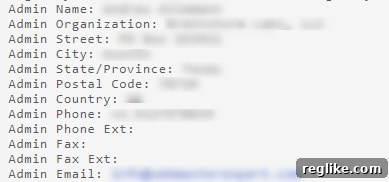
This image, initially a conceptual representation, turned out to be remarkably prescient. Major registrars, grappling with the complexities of GDPR compliance, began implementing changes that mirrored this level of data obfuscation. Consider, for instance, the guidance and proposed formats from industry giants like Tucows/Enom, one of the world’s largest domain registrars. Their suggestions for how a public Whois record for an individual residing in the European Union would appear post-GDPR offered a stark confirmation of the changes:
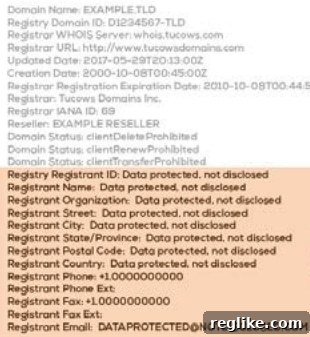
What immediately stands out in these examples is the almost complete absence of identifiable personal data. Crucially, these new Whois records often lack even a forwarding email address, let alone a direct contact email, postal address, or telephone number. This is not merely a minor tweak; it represents a fundamental overhaul of how domain ownership information is publicly displayed. The implications of such extensive redaction are profound and ripple across various sectors of the domain name industry and beyond, affecting everyone from casual domain buyers to legal professionals and law enforcement agencies.
The Ripple Effect: Challenges for Domain Investors, Businesses, and Beyond
The extensive redaction of Whois data under GDPR has created significant hurdles for various stakeholders. For domain name investors and businesses looking to acquire domains, the immediate challenge is verifying ownership and initiating contact. Traditionally, investors would use Whois to identify the registrant, assess the legitimacy of the contact information, and then reach out directly to inquire about a potential sale. With vital contact details like email addresses removed, this process becomes exceedingly difficult, if not impossible, through public channels. How does one perform due diligence on a domain’s owner, gauge its value, or even make an offer when the owner is effectively anonymous?
Furthermore, the difficulties extend to routine administrative tasks. Domain transfers, which often require explicit confirmation from the registrant via email, now face complex new protocols. Even simple Whois updates, where contacts must be emailed to confirm changes, present an operational headache. The very mechanisms designed to ensure the integrity and security of domain ownership are now complicated by the strictures of data privacy regulations. This means increased friction, potential delays, and a more cumbersome process for all parties involved in domain management.
Beyond transactional aspects, the impact on intellectual property (IP) enforcement is particularly acute. Trademark holders and their legal representatives rely heavily on Whois data to identify infringers and initiate dispute resolution processes, such as the Uniform Domain-Name Dispute-Resolution Policy (UDRP). Without access to registrant contact information, the initial steps of identifying a party in breach and serving legal notices become significantly more challenging. This raises serious questions about the balance between individual privacy rights and the legitimate needs of businesses to protect their brands and intellectual assets in the digital realm.
Similarly, law enforcement agencies and cybersecurity researchers face new obstacles in their efforts to combat online crime. Phishing schemes, malware distribution, and other illicit activities often rely on anonymously registered domains. Historically, Whois data provided critical leads for tracking down perpetrators. With public Whois data stripped of personal identifiers, tracing malicious actors becomes a far more arduous and time-consuming process, potentially hindering efforts to protect internet users from cyber threats.
The Emergence of “Gated Whois”: A Conditional Access Model
Recognizing the critical need to balance individual privacy with legitimate operational and legal requirements, the domain name industry began exploring alternative solutions. The most prominent of these is the concept of “gated Whois” or “authenticated access.” This model aims to provide a controlled environment where personal data remains protected from general public view but can be accessed by specific parties who can demonstrate a valid and legitimate reason.
As articulated by major registrars like Enom, the plan involves implementing systems that allow for authenticated access in a “specific and limited manner.” The core idea is that those with a justifiable need for personal data can request and access the necessary information, while the overarching privacy of individuals remains safeguarded. This shifts the paradigm from open public access to a permission-based system, requiring users to prove their eligibility before gaining access to sensitive data.
But who qualifies as having a “legitimate reason”? Enom, among others, provided illustrative examples:
Think about, for example, an intellectual property lawyer who wants to know the owner of a domain in order to submit a trademark dispute, or a law enforcement officer tracking down the people behind a phishing scheme; they should be able to find out who owns the domain name under investigation.
These examples highlight the practical necessities that such a system must address. For an IP lawyer, identifying the registrant is fundamental to initiating legal action or UDRP proceedings. For law enforcement, tracking down individuals responsible for online fraud or criminal activities is a matter of public safety. The challenge, therefore, lies in developing robust, transparent, and fair mechanisms for verifying these “legitimate reasons.” This will involve defining clear criteria, implementing secure authentication protocols, and potentially establishing an independent body or automated system to evaluate access requests. The process of proving legitimacy, ensuring data security, and guaranteeing timely access will be crucial for the success and acceptance of any gated Whois system.
Beyond the EU: The Potential for Global Whois Transformation
While the GDPR initially targets individuals within the European Union, its influence is not confined to its geographical borders. The very nature of the internet, being a global network, means that regulations enacted in one major jurisdiction can have cascading effects worldwide. The precedent set by GDPR regarding data privacy for domain registrants has prompted a broader re-evaluation of public Whois policies across the globe.
Many other countries and regions have either enacted or are in the process of developing their own data privacy and protection regulations. Examples include the California Consumer Privacy Act (CCPA) in the United States, Brazil’s LGPD, and similar frameworks emerging in Asia and other continents. These regulations, while differing in specifics, share a common thread: an emphasis on protecting personal data and granting individuals more control over it. This growing global trend renders a fully public Whois highly problematic, and in some cases, potentially unlawful, regardless of whether the registrant is based in the EU or elsewhere.
As Enom’s blog post insightfully pointed out:
While the GDPR only applies to EU-local individuals, there are data privacy and protection regulations in many other places around the world, which render a public Whois highly problematic, if not unlawful. With this in mind, what we know for sure is that we will no longer be able to publish personal data for any EU-located individual in the public Whois. What remains an open question is if we will continue to publish personal data for registrants based outside of the EU; we don’t yet have a final answer on that, and we’ll work through this issue over the next few months.
This statement underscores a significant point of uncertainty and a potential future direction. If maintaining a distinction between EU and non-EU registrants becomes overly complex or legally untenable in a world of proliferating privacy laws, a globally harmonized, redacted, or gated Whois system could become the default. Such a move would further solidify the shift towards a more privacy-centric internet, requiring all domain registrars and registries to adapt their practices universally. This would transform domain ownership data from a transparent, publicly available resource into a carefully controlled asset, accessible only under specific, justifiable conditions. The implications for international businesses, global cybersecurity, and the overall functioning of the domain name ecosystem would be immense, necessitating a continuous dialogue and adaptation across the entire industry.
Conclusion: A New Era of Domain Data Governance
The enforcement of GDPR marked a definitive turning point for the domain name industry, ushering in an era where individual privacy takes precedence over the historical transparency of the Whois system. The days of easily figuring out what individual in the EU owns a domain name are, for all practical purposes, behind us. The resulting redaction of personal data has introduced significant challenges for domain investors, IP lawyers, law enforcement, and indeed, anyone who previously relied on readily available Whois information. While these challenges are substantial, the industry’s response, particularly through the development of “gated Whois” systems, demonstrates a commitment to finding a workable balance between privacy rights and the legitimate needs for data access.
Looking ahead, the evolution of Whois data governance is far from complete. The initial impact of GDPR, confined primarily to EU individuals, has ignited a global conversation about data privacy that is reshaping internet policy worldwide. As more regions adopt similar data protection regulations, the prospect of a universally redacted or permission-based Whois system becomes increasingly likely. This profound shift requires continuous adaptation from all stakeholders – registrars, registries, legal entities, and individuals alike. It is a new era that demands innovative solutions, clear communication, and a shared understanding of the delicate equilibrium between privacy, transparency, and the secure functioning of the internet.