
Epik’s Explosive Twitter Return: Company Blasts Former CEO Rob Monster Over Debt and Mismanagement, Threatens Legal Action
In a dramatic and highly unusual corporate development, Epik Holdings Inc., a prominent domain registrar and web hosting company, has reactivated its long-dormant Twitter account to launch a scathing public attack on its founder and former CEO, Rob Monster. After remaining conspicuously silent since Monster’s departure in September 2022, the company’s official social media presence has re-emerged with a series of direct accusations, explicit demands for his resignation from the board, and a clear threat of imminent legal action. This unprecedented public display of corporate infighting not only signals deep-seated disagreements within the company’s leadership but also sheds critical light on significant financial distress and the challenges of accountability in the business world.
The decision to air such grave grievances publicly on Twitter is a significant departure from typical corporate communication strategies, which usually favor internal resolution or formal legal channels. Epik’s move underscores the perceived urgency and severity of the issues at hand, presenting a compelling case study in modern corporate governance and the evolving landscape of public relations. By bypassing traditional methods, Epik’s current leadership seems to be actively seeking to pressure its former CEO, while simultaneously signaling to its creditors, customers, and the broader domain industry that it is decisively addressing its challenges and holding individuals accountable for past decisions.
The Digital Confrontation: Epik’s Twitter Account Springs to Life
For over a year, Epik’s official Twitter account had been a digital ghost town, a silent monument to the transition that followed Rob Monster’s exit as CEO in the fall of 2022. Its sudden and forceful resuscitation over the past five days has not been for routine marketing campaigns or customer service updates, but rather to deliver a series of pointed, unvarnished messages directed squarely at its former leader. This digital confrontation marks a significant and public escalation in what appears to be a long-simmering internal conflict that has now boiled over into the public domain.
The language employed in these recent tweets is remarkably unequivocal, painting a stark picture of a company struggling under the oppressive weight of financial burdens, which it attributes directly to Monster’s leadership during his tenure. The strategic choice to take this dispute public, while bold and potentially risky, could be interpreted as an attempt by the current Epik management to draw a clear distinction between past management and present efforts. It highlights a desperate struggle for financial stability and operational integrity, aiming to restore confidence in the company’s future despite the current turmoil.
Unpacking the Accusations: Financial Mismanagement and Mounting Debt
At the very core of Epik’s public accusations is the explicit assertion that Rob Monster bears direct responsibility for the company’s precarious financial state, including its substantial debt and its current inability to fulfill obligations to creditors. The tweets explicitly link these pervasive financial struggles to his management decisions and operational oversight during his time at the helm. One particularly damning tweet offers specific details about operational failures and the resulting financial fallout:
#BeEpik 2.0 Team & CEO shut down Masterbucks Dec ’22 due to serious financial & security risks from Rob Monster’s actions. Now, Epik struggles to manage debt from his company-wide oversights, including Masterbucks.
This statement reveals critical information regarding the “Masterbucks” operation, which was reportedly shut down in December 2022. The reasons cited were “serious financial & security risks” directly attributed to Monster’s actions. Masterbucks, which appears to have been a key internal program or system, is now being presented as a prime example by the company to illustrate broader “company-wide oversights” that have, according to Epik, plunged the organization into significant debt. The implication is undeniable: Monster’s strategic decisions and operational management allegedly created a complex web of problems that the current “Epik 2.0” team is now desperately attempting to unravel and rectify.
The challenges of managing legacy debt are formidable for any enterprise, but when that debt is publicly attributed to the very founder and a current board member, it introduces a layer of profound complexity and potential bitterness to the entire situation. Epik’s current leadership is making a determined effort to draw a sharp distinction between the previous administration and the present, signaling an ongoing and arduous battle for financial recovery and operational integrity in the wake of alleged mismanagement that has left a lasting impact on the company’s viability.
The Call for Resignation: Allegations of Irrational Business Decisions and Board Deadlocks
Beyond the severe financial accusations, Epik’s series of tweets also includes a direct and forceful call for Rob Monster to step down immediately from the company’s board of directors. This demand is deeply rooted in allegations that his continued presence actively hinders effective governance, obstructs sound decision-making, and contributes to corporate paralysis. The company substantiates this claim by quoting “third parties” who have purportedly voiced serious concerns:
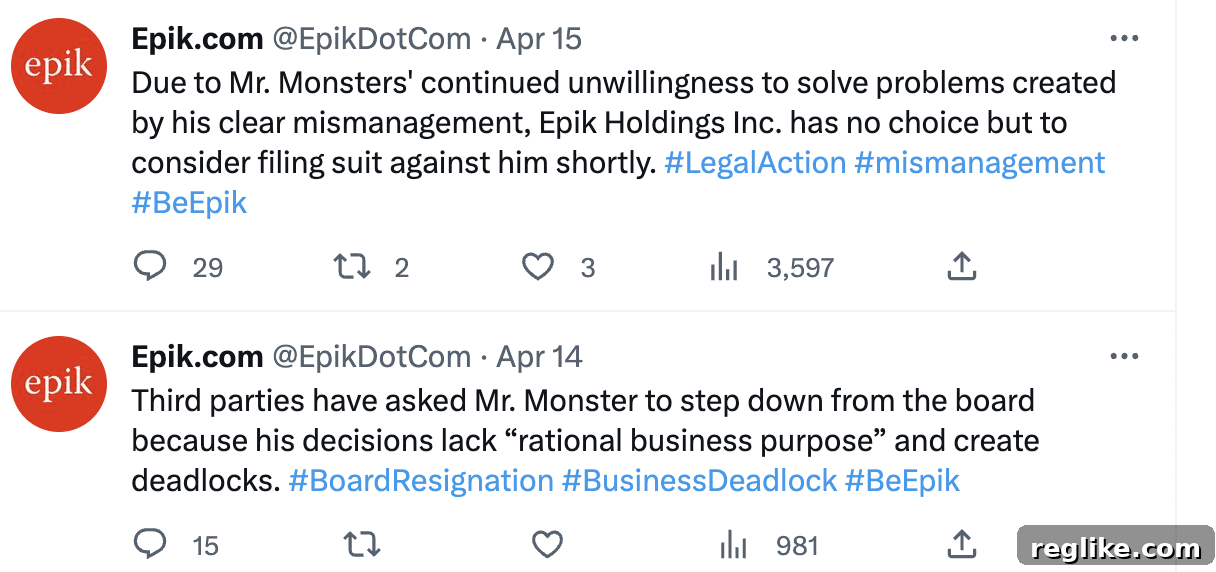
Third parties have asked Mr. Monster to step down from the board because his decisions lack “rational business purpose” and create deadlocks.
This accusation strikes directly at the fundamental principles of corporate governance and fiduciary duty. A board member is inherently expected to act with utmost integrity, exercising sound judgment, demonstrating strategic foresight, and contributing positively to the overall direction of the company. The assertion that Monster’s decisions lack “rational business purpose” suggests a profound and irreconcilable disagreement over strategic vision, operational tactics, or perhaps even the ethical framework guiding his actions. Furthermore, the explicit mention of “deadlocks” implies that his continued involvement is actively obstructing the board’s capacity to make critical decisions, thereby paralyzing progress, delaying essential reforms, and exacerbating the company’s already significant challenges.
The identity of these “third parties” is not explicitly disclosed in the tweets, but they could reasonably encompass a range of stakeholders, including other board members, significant shareholders, or other key partners who genuinely believe that Monster’s continued involvement is detrimental to Epik’s health. A board deadlock is a profoundly serious governance issue, capable of preventing a company from enacting necessary operational changes, securing vital funding, or responding effectively to dynamic market conditions, all of which can ultimately jeopardize its long-term viability and competitiveness. The highly public nature of this demand places immense pressure not only on Monster himself but also on the entire board structure to address these accusations swiftly and decisively.
Escalation to Legal Action: “Clear Mismanagement” Paves the Way for a Lawsuit
Perhaps the most severe and impactful threat issued by Epik’s Twitter account is the unequivocal declaration of intent to pursue formal legal action against Rob Monster. This move represents a significant escalation, transforming the dispute from mere internal corporate disagreements into a potentially costly, reputation-damaging, and protracted courtroom battle. The company’s stance on this matter is unmistakably clear and leaves little room for ambiguity:
Due to Mr. Monsters’ continued unwillingness to solve problems created by his clear mismanagement, Epik Holdings Inc. has no choice but to consider filing suit against him shortly.
This statement strongly suggests that any previous, less public attempts to resolve these pressing issues have utterly failed, leaving the current Epik leadership with what they perceive as no viable alternative but litigation. The phrase “clear mismanagement” is not merely rhetorical; it carries significant legal weight and often forms the foundational basis for claims such as breach of fiduciary duty, corporate negligence, or even fraud. Should a lawsuit indeed be filed, it could seek substantial damages for the financial losses allegedly incurred by the company as a direct consequence of Monster’s actions, or it could aim to legally compel his removal from the board of directors.
Such litigation against a founder and former CEO is, by its very nature, a complex, arduous, and resource-intensive process. It would undoubtedly entail extensive legal discovery, potentially exposing sensitive internal documents, confidential communications, and revealing highly private aspects of corporate operations. For Epik, pursuing this legal path signifies a profound willingness to undertake considerable legal expenses and endure intense public scrutiny, indicating the profound level of conviction the current management holds regarding Monster’s accountability and the perceived severity of the problems he is accused of creating. For Rob Monster, it represents a grave legal challenge that could have significant and far-reaching personal, professional, and financial repercussions, potentially tarnishing his legacy and reputation within the industry.
Visual Evidence: The Tweet Series Unveiled
To further substantiate its claims and provide undeniable transparency regarding the nature and timing of its public accusations, Epik included screenshots of the actual tweets within its announcement. These images serve as direct, irrefutable evidence of the company’s communication strategy and precisely the specific messages conveyed to the public:
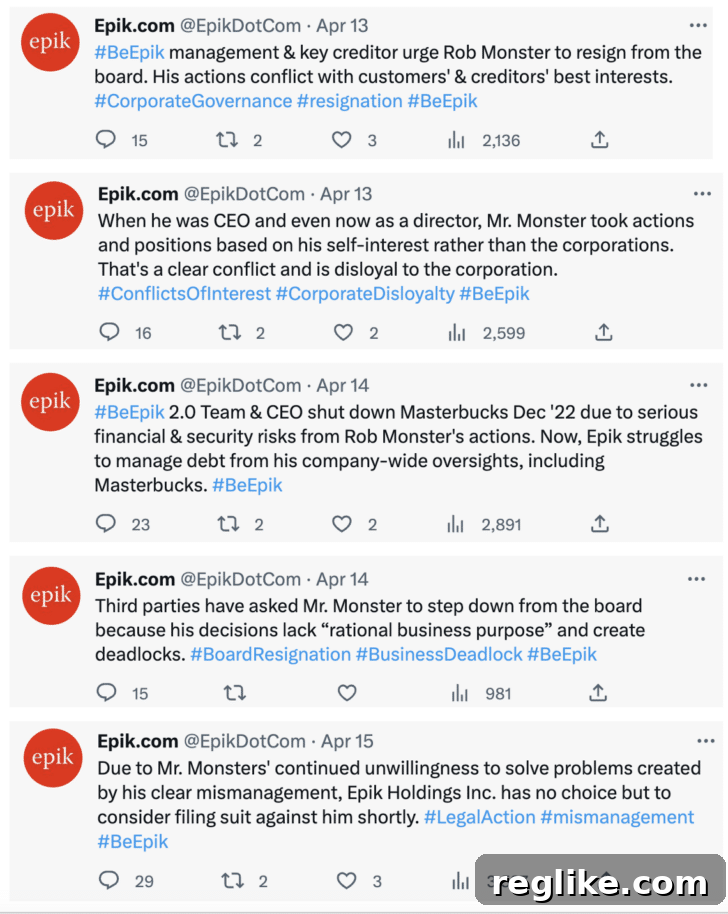
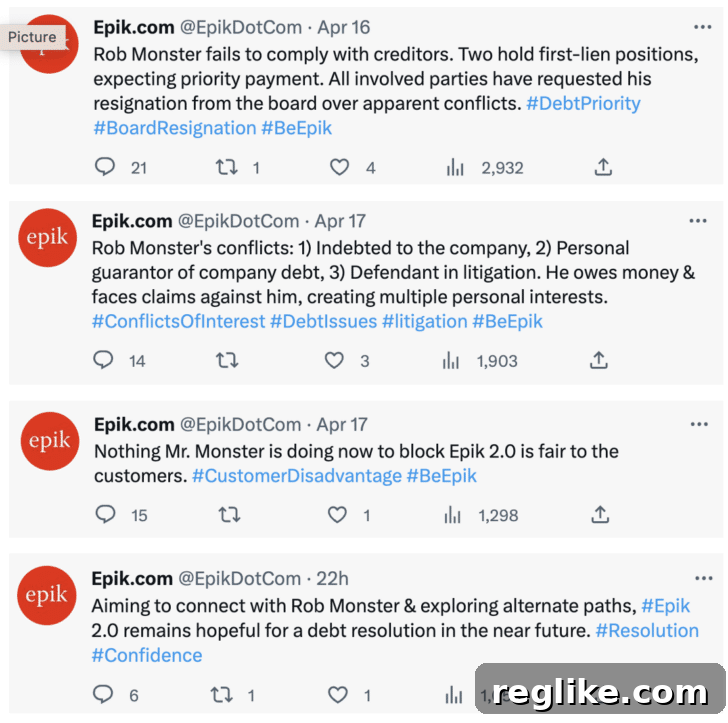
These crucial visuals underscore the direct and unambiguous nature of the company’s accusations, leaving absolutely no room for misinterpretation regarding the severity of the ongoing conflict and the decisive actions Epik is prepared to undertake. The strategic inclusion of these screenshots within the public announcement further solidifies the company’s commitment to making this dispute a matter of unequivocal public record, reinforcing the seriousness with which the current leadership views these allegations.
Profound Implications for Epik’s Future and Corporate Accountability
This highly public and dramatic fallout with its founder carries profoundly significant implications for Epik’s future trajectory. The company is already openly grappling with substantial debt, and this ongoing, high-profile dispute could further strain its critical relationships with essential partners, its loyal customer base, and crucially, potential future investors. Trust and stability are paramount commodities in the highly competitive domain and hosting industry, and such internal turmoil, especially when made public, can severely erode confidence among all stakeholders. However, by adopting such a firm and public stance, the current leadership might also be attempting to project an image of proactive accountability and an unwavering commitment to rectifying past wrongs, potentially attracting new confidence from stakeholders who deeply value transparency, strong ethical governance, and decisive action.
The entire situation vividly highlights the critical importance of implementing and maintaining robust corporate governance structures, a necessity especially pronounced in privately held or closely managed companies. The alleged lack of “rational business purpose” in key decisions and the creation of crippling “deadlocks” serve as a stark and potent cautionary tale for both emerging startups and long-established businesses alike, emphasizing the vital importance of clear board composition, well-defined roles and responsibilities, and effective, pre-established dispute resolution mechanisms. This unfolding saga will undoubtedly be watched closely by industry observers, not just for its dramatic twists and turns, but for the crucial precedents it might set in terms of founder liability, board responsibilities, and the ever-evolving landscape of corporate accountability in our increasingly digital and interconnected world.
As Epik endeavors to navigate this extraordinarily challenging period, the impending legal battles and the necessary internal restructuring will undoubtedly be immense undertakings. The company’s ultimate ability to successfully overcome this turmoil, restore its financial health, and meticulously rebuild its reputation will serve as a true and ultimate test of its resilience, its strategic acumen, and the inherent effectiveness of its new leadership. The coming months will be pivotal, revealing whether this bold and unconventional public strategy will ultimately yield the desired outcomes or if it will inadvertently add yet another layer of complexity to Epik’s already troubled and uncertain journey.
This unfolding corporate drama serves as a powerful and timely reminder that the legacy of a founder, while often celebrated and revered, can also, under specific circumstances, become a profound source of challenge, conflict, and public scrutiny, especially when business decisions, operational integrity, and financial management are called into serious question. The domain industry and the wider global business community will undoubtedly be keenly observing every development as this high-stakes dispute unfolds, eager to witness its ultimate resolution and its lasting impact.