
Mastering the Digital Gateway: An In-Depth Look at Google’s “Domain Name” Search Landscape
In today’s hyper-connected world, a strong online presence is non-negotiable for businesses and individuals alike. At the heart of this digital identity lies the domain name – your unique address on the internet. As such, understanding how search engines like Google interpret and present information for such a fundamental query can offer invaluable insights into SEO, user intent, and the competitive landscape of the digital realm. Recently, during a routine research session, I delved into Google’s search results for the term “domain name,” and the observations were quite revealing, prompting a deeper analysis of the dynamics at play.
Initial Observations: Unpacking the “Domain Name” Search Query
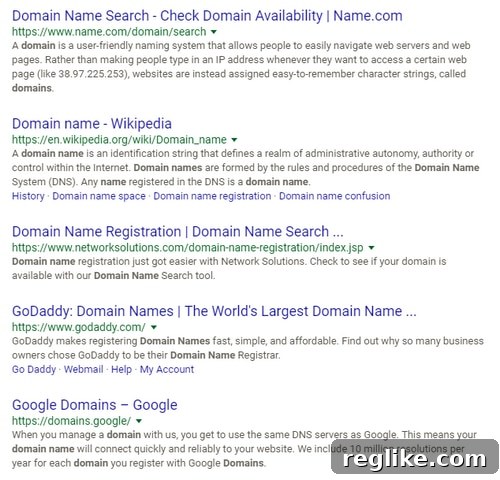
My investigation began with a simple yet powerful search: “domain name” (in quotes for exact match, and later without). To ensure a comprehensive view, I conducted these searches both while logged into my Google account and through a proxy browser, aiming to mitigate personalization biases. The consistency across these different browsing contexts was noteworthy, particularly concerning the top-ranking results.
Across both logged-in and proxy searches, the same five results consistently occupied the coveted top five positions, albeit with some minor fluctuations in their precise order. This stability in the leading contenders underscores their established authority and relevance in Google’s eyes for this highly competitive keyword.
The Reign of Name.com: A Consistent Top Performer
Perhaps the most striking revelation was the unwavering dominance of Name.com, which secured the number one spot for both the singular “domain name” search queries. This top ranking is an extraordinary feat in such a competitive niche and undoubtedly funnels an immense volume of highly targeted traffic to the company, translating directly into substantial business growth. Achieving and maintaining the premier position for a core keyword like “domain name” is the holy grail of SEO for any domain registrar.
Intriguingly, the page that Name.com ranks highest for is not its homepage, but rather a dedicated domain search page (https://www.name.com/domain/search). This strategic choice highlights a deep understanding of user intent. When someone searches for “domain name,” they’re often looking to perform a search or understand what a domain is, rather than just browsing a company’s general offerings. By directing users straight to a functional search tool, Name.com significantly streamlines the user journey, enhancing their experience and likely improving conversion rates.
For the singular “domain name” query, Google opted to pull an answer to one of Name.com’s FAQ questions as the featured snippet description. This informative snippet provides a clear and concise definition, directly addressing a common informational query associated with the term:
A domain is a user-friendly naming system that allows people to easily navigate web servers and web pages. Rather than making people type in an IP address whenever they want to access a certain web page (like 38.97.225.253), websites are instead assigned easy-to-remember character strings, called domains.
This choice by Google further emphasizes the search engine’s focus on providing immediate, relevant answers, especially for foundational terms. Securing a featured snippet, also known as position zero, is a powerful SEO win, as it grants prime visibility and authority.
The Broader Competitive Landscape
Beyond Name.com, the remaining top results, appearing in varying orders, comprised other industry giants and an essential informational resource. These included Network Solutions, GoDaddy, Google Domains, and Wikipedia. This mix of established domain registrars and a universal encyclopedia reflects the dual nature of the “domain name” search query: users are often seeking both transactional services (to register a domain) and educational information (to understand what domains are). Each of these entities brings a different value proposition to the table, contributing to a diverse and competitive search landscape.
Shifting Sands: The “Domain Names” Plural Search
The subtle change from “domain name” to “domain names” (plural) can signify a slight shift in user intent. While the singular might imply a search for a specific domain or a basic definition, the plural could suggest a broader interest in the concept of multiple domains, comparisons between domain types, or general information about domain name registration services. Despite this subtle difference, Name.com impressively retained its top spot for me, across both my local browser and the proxy, underscoring its robust SEO foundation for this keyword family.
However, an interesting alteration occurred in Google’s chosen snippet for Name.com when searching for the plural term. Instead of the descriptive FAQ response, Google displayed Name.com’s meta description:
Find your perfect domain name. From premium domains to cheap domains, search for and register your domain with Name.com and save. SEARCH NOW >>>
This shift from an informational snippet to a more transactional, call-to-action-oriented meta description suggests that Google may interpret the plural query as having a stronger commercial intent. Users searching for “domain names” might be further along in their buying journey, actively looking to compare options or make a purchase. Name.com’s meta description, with its emphasis on searching and registering, perfectly aligns with this potential user need, providing a clear pathway to conversion.
The Intersection of Organic and Paid Search: Google’s Dual Strategy
No discussion of Google search results would be complete without acknowledging the presence of paid advertisements. For terms as commercially valuable as “domain name” and “domain names,” the ad space is predictably crowded. The top spot in the paid results is frequently occupied by Google Domains, showcasing Google’s strategic approach to its own services.
This scenario brings to light a unique dynamic: Google, as both the search engine provider and a domain registrar, leverages its platform to promote its own offerings. The paid search aspect for Google Domains is, as the saying goes, quite nifty; it effectively allows Google to move money from one pocket to another. By bidding on highly competitive keywords, Google Domains secures prime visibility, driving traffic to its platform and undoubtedly contributing significantly to its market share. This raises fascinating questions about the true sources of Google Domains’ growth – how much stems from paid search campaigns, how much from organic search optimization, and how much from internal cross-promotion within the vast Google ecosystem?
For external domain registrars, this means they are not only competing with Google Domains in the organic search results but also directly against Google itself in the paid ad auctions. This creates an even more challenging environment, necessitating highly optimized SEO strategies and shrewd paid ad management to carve out visibility and market share.
Decoding Name.com’s SEO Success: Strategies for Top Rankings
Name.com’s consistent top ranking for such critical keywords is not by accident; it’s a testament to robust SEO strategies. Several factors likely contribute to their success:
- User-Centric Page Design: Ranking a dedicated domain search page over the homepage demonstrates an acute understanding of user intent. This page is optimized for conversion, providing immediate utility to visitors.
- High Domain Authority: Name.com has built significant authority over years through consistent service, strong brand recognition, and a natural accumulation of high-quality backlinks.
- Content Relevance and Quality: Their site likely features comprehensive, high-quality content related to domain names, hosting, and web presence, answering a wide array of user questions and establishing them as an authoritative source.
- Technical SEO Excellence: A fast, mobile-responsive, and technically sound website ensures optimal crawlability and indexability by Google, providing a solid foundation for their content.
- Effective Internal Linking: A well-structured internal linking strategy helps distribute link equity throughout the site and guides users to relevant pages, reinforcing the importance of key landing pages.
- Engagement and User Experience: Positive user signals, such as low bounce rates and high time on page (likely due to the utility of their search tool and clear information), tell Google that users find their site valuable.
The Indispensable Role of Domain Names in the Digital Ecosystem
The observations from these Google searches underscore the fundamental importance of domain names in the modern digital landscape. A domain name is more than just an address; it’s a critical component of a brand’s identity, credibility, and memorability. For businesses, a well-chosen domain name:
- Builds Brand Recognition: It’s often the first point of contact for customers, helping to establish brand recall.
- Enhances Credibility: A professional domain name (e.g., .com, .org, .net) instills trust and legitimacy.
- Improves SEO: While direct keyword matching in a domain name has less impact than it once did, a memorable, relevant domain can indirectly aid SEO through brand searches and easier link building.
- Facilitates Marketing: An easy-to-remember domain name is crucial for all marketing efforts, from business cards to social media campaigns.
- Provides Ownership: It secures your unique space on the internet, preventing competitors from claiming your primary online identity.
Choosing the right domain name is a strategic decision that impacts everything from branding to marketing and long-term digital success. It’s a foundational element that merits careful consideration and strategic investment, which is why searches for “domain name” are so prevalent and competitive.
Navigating the Search Landscape: Key Takeaways for Businesses
For any business or individual looking to establish or enhance their online presence, the insights gleaned from these search results are invaluable:
- Understand User Intent: Google’s algorithm is increasingly sophisticated at discerning the intent behind a search query. Tailoring content and landing pages to match these intents (informational vs. transactional) is crucial for ranking success.
- Invest in Robust SEO: Name.com’s success demonstrates that consistent investment in organic search optimization yields significant, long-term returns, even against industry giants and the search engine itself.
- Optimize for Featured Snippets: By structuring content to directly answer common questions, businesses can aim for featured snippets, gaining unparalleled visibility.
- Consider Both Organic and Paid Strategies: While organic ranking is ideal, a comprehensive digital marketing strategy often requires a blend of both SEO and paid advertising, especially in highly competitive sectors.
- Prioritize User Experience: A seamless, intuitive user journey, from search result click to desired action, is paramount. This includes fast load times, mobile responsiveness, and clear calls to action.
Conclusion: The Evolving World of Domain Names and Search
The humble search for “domain name” reveals a complex and dynamic ecosystem governed by Google’s ever-evolving algorithms and intense market competition. Name.com’s impressive consistency at the top of the search results is a testament to effective SEO strategies, user-centric design, and a deep understanding of customer needs. The interplay between organic results, featured snippets, and paid advertisements paints a vivid picture of how digital visibility is achieved and maintained in the domain registration industry.
As the internet continues to grow, the importance of a strong domain name and the ability to be found for relevant search queries will only intensify. For businesses, continually monitoring and adapting to these search landscape shifts is not merely an option, but a fundamental requirement for sustained growth and online success. The insights from this simple search serve as a powerful reminder of the intricate science and art behind ranking highly in the digital age.