
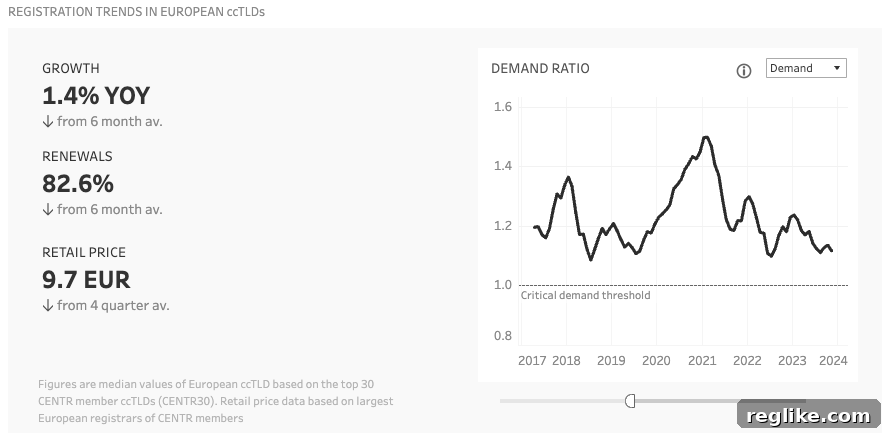
European ccTLDs Demonstrate Resilient Growth Amidst Evolving Global TLD Landscape
In an era where digital footprints are expanding at an unprecedented rate, the domain name industry is a dynamic battleground of innovation, competition, and shifting user preferences. Within this intricate ecosystem, country code top-level domains (ccTLDs) hold a unique and often underestimated position. A recent report from CENTR, the Council of European National Top-Level Domain Registries, offers a compelling glimpse into the health and trajectory of European ccTLDs, revealing a narrative of sustained, albeit moderating, growth.
CENTR, a pivotal organization representing ccTLD operators primarily across Europe, has published its latest Global TLD report, providing invaluable insights into market trends and operator performance. The overarching message is clear: European ccTLDs continue to expand their registrant base, a testament to their enduring relevance and perceived value. However, this growth is now proceeding at a more measured pace compared to the boom experienced during the global pandemic, a period that saw an accelerated push towards digitalization across all sectors.
Understanding the Growth Dynamics of European ccTLDs
The report meticulously details the performance metrics for European ccTLDs throughout 2023. A key takeaway is the 1.4% year-over-year growth observed across these domains. While seemingly modest when compared to the exponential surges seen in the immediate wake of the pandemic, this figure represents a significant achievement in a mature market that faces constant pressure from generic top-level domains (gTLDs) and an increasingly saturated digital space. It underscores a fundamental resilience and consistent demand for localized online presences.
A more granular examination of monthly year-over-year rates reveals an interesting ebb and flow in the market’s momentum. The data suggests that the market for European ccTLDs appeared to bottom out in January 2023, subsequently demonstrating a period of recovery and expansion. This upward trend, however, was not maintained uniformly throughout the year, with a noticeable dip occurring in the latter part of 2023. This fluctuation could be attributed to various macroeconomic factors, evolving consumer confidence, or seasonal patterns in domain registration activity.
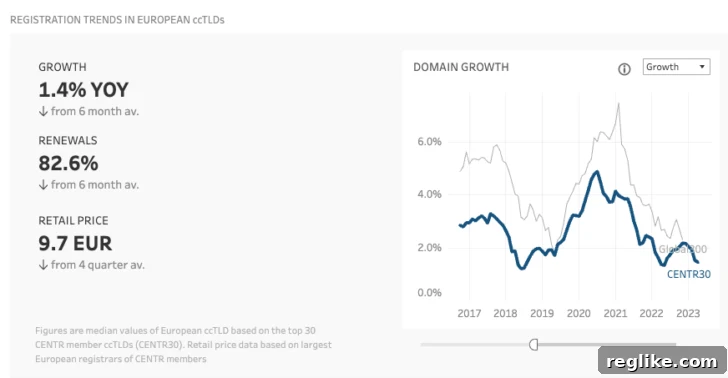
Despite these monthly variations, the overall annual growth figure of 1.4% paints a picture of stability rather than decline. This sustained expansion is particularly noteworthy given the competitive pressures and the general maturation of the domain name industry. For many ccTLDs, which often cater to specific national or regional markets, maintaining any level of positive growth indicates a strong local appeal and a continued commitment from businesses and individuals to establish and maintain an online identity tied to their geographical location.
The Critical Role of Robust Renewal Rates
CENTR’s analysis attributes much of this sustained growth to remarkably strong renewal rates within the existing base of European ccTLDs. This factor is paramount, as it suggests that registered domains are actively being maintained and utilized, rather than merely being registered and subsequently abandoned. High renewal rates are a powerful indicator of the intrinsic value perceived by registrants, who choose to continue their investment in their chosen domain name year after year.
While deletions have increased over 2023, they are still relatively low compared to longer-term averages. This means that while the base of domains in European ccTLDs are often being maintained, new registrations are struggling. Based on analysis of registrations and in particularly average demand ratios, we expect average growth rates to remain similar for 2024. The challenge for ccTLD registries will be to ensure their already high renewal rates are maintained whilst still attracting a sufficient number of new registrations over the year.
The quote highlights a crucial nuance: while the existing domain base is largely stable due to strong renewals, new registrations are facing challenges. This dynamic presents a dual challenge for ccTLD registries. On one hand, they must continue to foster an environment that encourages registrants to maintain their domains, possibly through enhanced services, consistent support, and clear value propositions. On the other hand, they need innovative strategies to attract a fresh influx of new registrations, which are essential for long-term, significant expansion beyond simply maintaining the status quo.
The relationship between new registrations and deletions provides further clarity on these market dynamics. The report illustrates this through a chart that effectively visualizes the ratio of new registrations to deletions:
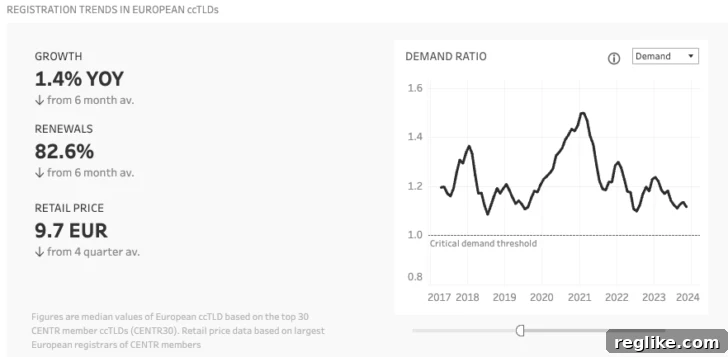
This “demand ratio” is a critical metric. When the number of new registrations significantly outweighs deletions, the domain base grows robustly. When deletions increase or new registrations slow down, this ratio can approach or fall below 1.0, indicating a stagnant or shrinking base. For European ccTLDs, the ability to maintain a positive, albeit fluctuating, ratio suggests that despite challenges in attracting new sign-ups, the retention power remains strong.
The Distinctive Value Proposition of ccTLDs: Development Over Speculation
A significant factor contributing to the higher renewal rates and overall stability of European ccTLDs, as posited by CENTR, is the nature of their usage. The report suggests that European ccTLDs are “more likely to be developed” compared to domains under the venerable .com or other generic top-level domains (gTLDs). What does “developed” truly imply in this context? It refers to domains that are actively used for websites, email services, e-commerce platforms, blogs, or other legitimate online activities that serve a tangible purpose for businesses, organizations, or individuals. These are not merely parked domains, speculative investments, or defensive registrations; they are integral components of an active online presence.
This distinction is crucial. A domain that hosts an active website for a local business, a national charity, or a personal portfolio is inherently more valuable to its owner than a domain held purely for potential future resale. Consequently, the incentive to renew such a domain is much higher. Registrants of developed domains have invested time, effort, and often financial resources into building their online presence, making the domain an indispensable asset. This deeply embedded usage translates directly into the observed higher renewal rates, forming a bedrock of stability for ccTLD registries.
Contrasting with the gTLD Landscape: The .com Benchmark
To fully appreciate the performance of European ccTLDs, it’s beneficial to draw a comparison with the broader gTLD market, particularly with the dominant .com domain. Verisign, the authoritative registry for .com and .net domains, consistently reports on its blended renewal rate for these iconic TLDs. Their data typically shows a renewal rate hovering in the low-to-mid 70% range. While respectable, this figure often sits below the implied higher renewal rates for many actively developed ccTLDs, further underscoring the different usage patterns and value propositions at play.
Moreover, Verisign’s reports have frequently indicated that the “Demand Ratio” for .com domains is currently below 1.0. This metric, similar to CENTR’s new registrations to deletions ratio, signifies that the number of new .com registrations is not sufficiently outpacing the number of deletions. The direct consequence of a demand ratio below 1.0 for .com is a gradual decline in its overall base of registered domains. This trend for the world’s most ubiquitous TLD provides a stark contrast to the continuing, albeit slower, growth witnessed in European ccTLDs. It highlights that even the most established and recognized domain extensions are not immune to market saturation and changing user behaviors.
The reasons behind .com’s declining base are multi-faceted. Market maturity and saturation play a significant role; many desirable .com names have long been taken. Furthermore, the rise of hundreds of new gTLDs, offering more specific and often creative domain choices, has fragmented the market. Coupled with this, a larger proportion of .com domains might historically have been registered for speculative purposes, leading to higher deletion rates when investment returns don’t materialize or market conditions shift. In comparison, the local focus and inherent trust associated with ccTLDs often translate into more purposeful registrations and, thus, greater longevity.
Future Outlook and Strategic Imperatives for ccTLD Registries
Looking ahead to 2024, CENTR anticipates that average growth rates for European ccTLDs are likely to remain similar to those observed in 2023. This prediction suggests a continued period of steady, moderate expansion rather than a return to the explosive growth seen during the pandemic. For ccTLD registries, this outlook underscores the importance of refining their strategies to adapt to a maturing market.
The primary challenge remains dual: maintaining already high renewal rates while simultaneously boosting new registrations. To achieve this, registries might need to explore innovative marketing campaigns that emphasize the unique benefits of local domains – such as enhanced local SEO, trust, and national identity. Offering value-added services bundled with domain registrations, like website builders, email hosting, or cybersecurity solutions, could also incentivize both new registrations and renewals. Engagement with local businesses, entrepreneurs, and digital communities will be crucial to foster a vibrant ecosystem that naturally drives demand for local domain names.
Moreover, as digital economies continue to evolve, ccTLDs are uniquely positioned to serve as anchors for national digital sovereignty and identity. By promoting the development of digital skills, supporting local startups, and advocating for policies that favor national digital infrastructures, ccTLD registries can solidify their indispensable role in the broader digital landscape. Their inherent connection to geographical territories also offers a distinct advantage in a world increasingly focused on localized online experiences and targeted content delivery.
Conclusion: Resilience in a Maturing Market
The latest CENTR report paints a picture of resilience and sustained relevance for European ccTLDs. While the era of rapid, pandemic-fueled expansion has tempered, these domains continue to grow, outperforming some of their gTLD counterparts in key metrics like renewal rates and stability of the domain base. This success is largely attributable to the high proportion of “developed” domains that serve active, tangible purposes, fostering strong registrant loyalty and a higher propensity for renewal.
The insights from CENTR serve as a valuable compass for the entire domain name industry. They highlight that even in a competitive and maturing market, strategic focus on value, utility, and localized identity can yield positive results. For European ccTLD registries, the path forward involves a delicate balance of maintaining existing relationships through exceptional service and innovating to capture new market segments. Their continued growth, however modest, is a powerful indicator of their foundational importance in the global digital infrastructure, proving that slow and steady growth can indeed win the race.