
[Editor’s note: This comprehensive report, initially compiled by Nat Cohen, delves into recent Uniform Domain Name Dispute Resolution Policy (UDRP) decisions, highlighting concerning trends and the potential for misuse.]
Unmasking Cybersquatting: A Deep Dive into Controversial UDRP Decisions
Are you, a diligent domain owner, unknowingly committing “cybersquatting”? The Uniform Domain Name Dispute Resolution Policy (UDRP), often lauded as a streamlined mechanism for resolving domain name disputes, has increasingly become a battleground where legitimate domain registrants find themselves at risk. This report meticulously examines a series of recent UDRP decisions, scrutinizing the rationales provided by panelists for finding domain owners guilty of cybersquatting and ordering the transfer of their valuable domain names. Our analysis aims to shed light on how the UDRP, originally designed to combat clear-cut instances of abusive domain registration, is, in some instances, being misapplied to seize properly registered domain names, causing significant disruption and financial harm to their owners.
Understanding the UDRP: A Brief Overview
The UDRP, established by the Internet Corporation for Assigned Names and Numbers (ICANN), serves as an administrative proceeding to resolve disputes over the registration of domain names. Its primary objective is to provide a swift and cost-effective alternative to traditional litigation for trademark owners facing obvious cases of cybersquatting. To succeed in a UDRP complaint, a complainant must prove three essential elements:
- The domain name is identical or confusingly similar to a trademark or service mark in which the complainant has rights.
- The respondent (domain owner) has no rights or legitimate interests in respect of the domain name.
- The domain name has been registered and is being used in bad faith.
While these criteria appear straightforward, the interpretation and application of these principles by UDRP panelists can vary widely, leading to outcomes that challenge the policy’s original intent. This report will explore specific cases where such interpretations have raised serious questions about fairness, consistency, and the protection of domain owners’ rights.
Examining Recent UDRP Decisions: A Pattern of Concern
HDRamp.com – March 9, 2016
Complainant: Heavy Duty Ramps LLC, sellers of heavy-duty ramps
Respondent: Landsport, sellers of heavy-duty ramps
This case presents a troubling scenario where a business operating on the plural version of a descriptive product domain (hdramps.com) for “heavy-duty ramps” successfully seized the singular version (hdramp.com) from a competitor. The decision was rendered despite the complainant having no registered trademark rights at the time the disputed domain was registered. The panel relied on a design mark registered just a few months before the UDRP filing, which notably included a disclaimer for the wording itself. This raises fundamental questions about the timing of trademark rights and the enforceability of highly descriptive terms.
While Respondent contends that the domain is comprised of common and descriptive terms and as such cannot be found to be identical or confusingly similar to Complainant’s mark, the Panel finds that such a determination is not necessary under Policy ¶ 4(a)(i) as this portion of the Policy considers only whether Complainant has rights in the mark and whether the disputed domain name is identical or confusingly similar to Complainant’s mark.
The panel’s assertion that determining the descriptive nature of the domain is “not necessary” under Policy ¶ 4(a)(i) is particularly concerning. This section primarily focuses on the existence of trademark rights and confusing similarity, but the inherent descriptiveness of a term is crucial when assessing the strength and scope of those rights, especially when the complainant registered a trademark with a disclaimer for the word itself. Granting exclusive rights to a singular, descriptive term like “hdramp” to a later trademark holder, especially over a competitor using the same descriptive term, appears to expand the reach of trademark protection beyond its reasonable boundaries.
Thus, Respondent’s use of the domain disrupts and competes with Complainant’s business because Respondent uses the domain to sell products and services that compete with Complainant’s business.
Respondent has engaged in the tactic of typosquatting by simply removing the letter “s” from Complainant’s HD RAMPS mark, in order to register its domain name of hdramp.com.
Labeling the respondent’s use as “typosquatting” by merely removing an “s” from a descriptive plural term ignores the distinct nature and common usage of singular vs. plural forms in generic terms. Furthermore, the UDRP is not intended to resolve general business competition issues but specifically to address trademark abuse. This decision exemplifies a tendency to interpret “disrupts and competes” in a way that conflates legitimate competition with bad faith cybersquatting, penalizing a competitor for using a highly descriptive domain name in its natural form.

Screenshot of Respondent’s hdramp.com, before the domain was transferred to Complainant.
Euroview.com – September 12, 2016
Complainant: Euroview Enterprises LLC, an Illinois fabricator and installer of shower doors and bath enclosures.
Respondent: Jinsu Kim, a Korean who appears to be a domain investor.
The Euroview.com case illustrates a concerning finding that a domain name combining two generic words, “Euro” and “View,” can be exclusively claimed by a relatively obscure small business making a non-intuitive use of the term, despite operating on a separate continent. This outcome challenges the principle that generic terms, even when combined, typically remain free for general use.
The Respondent contends that “euroview” is a combination of commonly used generic terms. But if “euro” and “view” are separately dictionary terms, it is not clear for what product or service “euroview” is the generic term. Moreover, even assuming arguendo that euroview.com contains a generic term, the “mere registration of a domain name, even one that is comprised of a confirmed dictionary word or phrase … may not of itself confer rights or legitimate interests in the domain name.” WIPO Overview. 2.0,paragraph 2.2.
The panel’s reasoning here suggests a burden on the respondent to prove that “euroview” is a generic term for a specific product or service, effectively shifting the onus from the complainant to demonstrate exclusive trademark rights. This interpretation risks undermining the legitimate use of combined generic terms by domain registrants who see value in such combinations for general commercial or informational purposes.
Adding another layer of complexity, imagine you are a domain investor in Korea, and you register euroview.com, a seemingly generic commercial domain. You might even check USPTO records and find a design mark for “Euroview Frameless Glass Enclosures” that was cancelled years ago. Believing the term is available, you proceed with registration. Years later, the company with the cancelled trademark registers a new trademark for “Euroview.” Under the UDRP, your earlier registration can then be deemed in bad faith, a violation of the policy, and you are publicly branded a cybersquatter.
Simply, “If the complainant owns a trademark, then it generally satisfies the threshold requirement of having trademark rights.” [regardless if the trademark was registered after the domain was acquired]… The Panel agrees with the Complainant that whether the conclusive date is 2006 or 2007, by the time that the Respondent acquired the disputed domain name [in Korea], the Complainant’s [US] rights in the EUROVIEW mark were established. [despite the cancellation of the design mark]
This finding is particularly problematic because it suggests that trademark rights can be retroactively established to predate a domain registration, even when previous rights were cancelled. It imposes an unreasonable burden on domain registrants to foresee future trademark registrations, especially across different continents and after previous marks have been abandoned. The UDRP standard typically requires bad faith registration at the time of registration. Furthermore, it’s ironic that another company held a US trademark for “EUROVIEW” for windows prior to the complainant in this case, yet the panel awarded the domain to the junior rights holder, highlighting a potential oversight in the panel’s review.
Further, the panel’s determination of bad faith was influenced by an alleged malware infection:
[Customer letter entered as evidence:] The second time visiting my computer ended up with a blue screen on it saying to call a number and download a specific program because my computer was now infected. I think I was able to get out of the site and have my computer unharmed”
[Panelist:] Evidence of malware infection is relevant in the Panel’s determination of bad faith under paragraph 4(a)(iii) of the Policy…a respondent’s spreading malware ‘implies abusive conduct of a particularly serious nature,’ conduct that ‘goes well beyond the activities of the typical cybersquatter’.
The panel appears to conflate a zero-click redirect to an advertiser (which may or may not offer legitimate software, but often involves aggressive pop-ups) with actively hosting a malicious malware infection site. While aggressive advertising can be disruptive, categorizing it as “spreading malware” without conclusive technical evidence of a direct infection from the respondent’s site sets a low bar for such a serious accusation, particularly when the user reported their computer was “unharmed.” This broad interpretation can unfairly tarnish a domain owner’s reputation and contribute to a finding of bad faith.
ChicagoSouthland.com – July 26, 2016
Complainant: The Chicago Southland Convention and Visitors Bureau.
Respondent: “purchases expired domains for their link authority. Its market is the adult (porn) industry”.
This case illustrates how a domain owner can lose a geographic domain, such as ChicagoSouthland.com (Wikipedia page), to a Conventions and Visitors Bureau (CVB). The panel incorrectly granted the CVB exclusive trademark rights to that geographic name, based on a state trademark registration, which is generally not entitled to the same deference under the UDRP as federal registrations.
To fully grasp the implications, some background on trademark law is essential. Under UDRP Paragraph 4(a)(i), complainants must demonstrate trademark rights. However, US state trademark registrations, unlike federal ones, are typically automatic or unexamined and thus often not given the same weight in UDRP proceedings. According to WIPO’s overview, “panels have typically found trademark registrations that are automatic or unexamined (such as US state registrations as opposed to US federal registrations) are not owed the same deference under the UDRP as examined registrations.” Furthermore, geographical terms used in their primary geographic sense are generally ineligible for trademark registration. The U.S. Patent and Trademark Office’s Trademark Manual of Examining Procedures states that an application should be refused if “the primary significance of the mark is a generally known geographic location.”
The panel in this case made two fundamental errors: it granted protection to a geographic term used in its geographic meaning and treated a US state registration as establishing common law trademark protection for a term that should not be eligible for protection under the UDRP. This decision effectively grants a monopoly over a descriptive geographic name to a single entity, restricting its fair use by others within that region.
The Respondent argues that the Complainant’s trademark is comprised of common, geographically descriptive words and, as such, cannot be an enforceable trademark. However, the Panel’s jurisdiction does not stretch so far as to comment on the strength of Complainant’s trademark. Complainant has adequately plead (sic) its rights in or to the trademark CHICAGO SOUTHLAND by showing the mark has secondary meaning. For purposes of the Policy, Complainant therefore has cognizable trademark rights.
The panel’s reluctance to assess the strength of a trademark, particularly when it’s geographically descriptive and based on a state registration, is problematic. While “secondary meaning” can, in some cases, grant trademark rights to descriptive terms, proving it typically requires extensive and exclusive use over a significant period. To assume secondary meaning based on a state registration for a geographic term without rigorous evidence undermines established trademark principles and the UDRP’s proper application.
Further, the panel deemed the use for an adult site illegitimate:
The Panel further finds that there has been no bona fide offering of goods or services or any legitimate noncommercial or fair use because Respondent uses the disputed domain to display adult-oriented material.
While UDRP panels often view adult content negatively, blanket declarations that such use can never be legitimate disregard the fact that domain names, especially descriptive ones, can be used for a wide array of content, including adult material, without necessarily targeting a specific trademark in bad faith. The critical factor should be whether the domain was registered with the primary intent to exploit a complainant’s trademark, not merely the nature of the content itself. This approach can unduly restrict a respondent’s rights to use a generic or descriptive domain.
Another point of contention arose from a negotiation:
Respondent has also demanded far more than “market price” for the disputed domain name.
Although Complainant offered to buy the disputed domain name for $4,000, given the totality of the circumstances, Respondent’s offer to sell the disputed domain for $6,000.00 constitutes bad faith.
The determination that a counteroffer of $6,000 for a domain, following an initial offer of $4,000, constitutes “bad faith” is a subjective and dangerous precedent. Domain owners have every right to negotiate prices they deem fair for their assets. Labeling a reasonable counteroffer as “bad faith” can discourage legitimate sales and unfairly penalize domain owners for simply trying to achieve a better price, rather than focusing on whether the domain was registered primarily to sell to the trademark holder at an exorbitant price.
Finally, the panel linked the adult content to harm to the complainant’s reputation:
In addition, and more importantly, Respondent uses the disputed domain name to tarnish the reputation of Complainant… Registering and subsequently using the disputed domain in a manner that misleads Internet users into believing the Complainant is somehow related to a pornographic web site is what offends the Policy…Similar to the Harley-Davidson case, Respondent’s use of the disputed domain name tarnishes the reputation of the CHICAGO SOUTHLAND mark.
The claim of “tarnishment” relies on the faulty premise that the CVB has exclusive rights to the geographic name. If “Chicago Southland” is a generic geographic identifier, then its use for an adult site, while potentially undesirable to a CVB, does not inherently “tarnish” a trademark that should not have been granted exclusive rights in the first place. This argument incorrectly attributes a unique association between the geographic term and the complainant, overlooking the term’s public domain nature.
CafeDelMar.com – September 21, 2016
Complainants: are the founders of a bar in Spain, called “Café del Mar”, which then began publishing music albums under the title “Café del Mar”.
Respondent: Hubert Seiwert of Germany, who registered several generic word and phrase domains in the late 1990s.
This case highlights an alarming overreach by a panelist, who, contrary to the UDRP requirement for complainants to establish their right to relief, undertook independent research. This research was then allegedly misinterpreted and used to determine the case’s outcome without offering the domain owner an opportunity to review or respond to the supposed evidence. This practice undermines due process and fairness within the UDRP framework.
The core of the dispute revolved around a domain registered seventeen years prior. If you registered “CafedelMar.com” in the late 1990s, based on a generic commercial phrase used by over 100 businesses globally, and one of those businesses (the Complainant) later registers a design mark, you could still be found in bad faith. The panel found that briefly joining an eBay affiliate program eight years after your registration, through which the Complainant’s products could be purchased, was conclusive evidence that you initially registered cafedelmar.com in bad faith to target the Complainant, thus branding you a cybersquatter.
The respondent argued that “Café Del Mar” is a generic name consisting of the three common Spanish dictionary words “café,” “del,” and “mar,” meaning “Café By The Sea” or “Café Of The Sea.” Indeed, the respondent pointed out that significantly more than 100 unaffiliated businesses worldwide use the name “café del mar” independently. The respondent also highlighted having received many unsolicited offers for the domain over 17 years but chose not to accept them, indicating a lack of intent to profit specifically from the complainant.
The Respondent contends that “Café Del Mar” is a generic name consisting of the three common Spanish dictionary words “café”, “del” and “mar”, which have a combined meaning of “Café By The Sea” or “Café Of The Sea”…
Respondent concludes that significantly more than 100 unaffiliated, separate businesses exist worldwide which have no relation to the Complainants and who chose the name “café del mar” independently, without seeking to copy or profit from the Complainants’ name or reputation…
The Respondent also indicates to have received many inquiries and unsolicited offers up to USD 8,000 from parties unrelated to the Complainants over the 17 years it has owned the domain, but chose not to accept these offers…
In the case at hand, the disputed domain name cafedelmar.com was registered on February 28, 1999 while the Complainants’ earliest European Union trademark registration for CAFÉ DEL MAR (figurative mark) was filed in January 21, 2000 and registered on April 21, 2004…
Despite the domain being registered *before* the complainant’s trademark, the panel’s independent research through historical screenshots played a pivotal role:
However, the Panel verified that historical screenshots for the disputed domain name are publicly available on “www.screenshots.com”. [footnote] 1 A review of these screenshots shows that the disputed domain name was pointed, on May 3, 2005, to a web page where the disputed domain name was offered for sale and, on June 20, 2007, to a web site promoting the sale of CAFÉ DEL MAR music compilations, including the first editions released on 1995 and 1996.
[footnote] 1 A panel may undertake limited factual research into matters of public record if it deems this necessary to reach the right decision. WIPO Overview 2.0, paragraph 4.5.
The Panel infers from the Respondent’s previous use of the disputed domain name to promote the resale of the first CAFÉ DEL MAR music compilations released by the Complainants that the Respondent was therefore aware of the Complainants and very likely registered the disputed domain name with the intention to target the Complainants and their business.
This inference is a significant leap. Using an affiliate program that happened to feature a complainant’s products eight years after registration, for a generic domain, does not automatically equate to initial bad faith targeting. The UDRP requires bad faith at the time of registration. The panel’s interpretation extends “bad faith” far beyond the registration date, applying it to subsequent, incidental use. This sets a dangerous precedent, making it nearly impossible for owners of generic domains to defend against claims from later trademark holders who might be picked up by general affiliate programs.
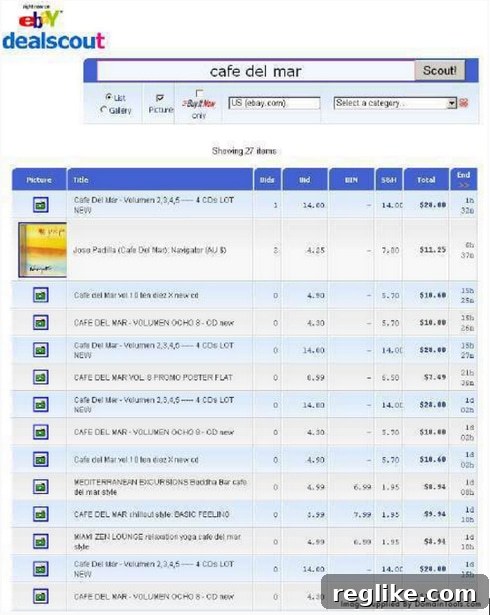
Screenshot from June 20, 2007 viewed by the Panelist showing cafedelmar.com’s participation in an eBay affiliate program and the Complainant’s albums appearing in the results.
Sihi.com – July 12, 2016
Majority Decision with dissent
Complainant: Flowserve Corp, a $5 billion market cap maker of valves and pumps
Respondent: Ashantiplc Limited, a domain investment company
The Sihi.com case presents a contentious decision where a majority panel found it constituted bad faith to win a four-letter dot-com domain at auction after the trademark holder allowed the domain to expire. This ruling fundamentally misunderstands the inherent value of short, generic, or pronounceable domain names and the legitimate process of acquiring expired domains.
Complainant owned sihi.com since 1995 and failed to renew it. Respondent acquired the Disputed Domain Name in an auction shortly after the expiration of the domain registration.
This Panel finds that the purchase shortly after the lapse of the domain rights in Complainant is evidence of bad faith.
The act of letting a domain expire signifies a lapse in the prior registrant’s interest or vigilance. Acquiring an expired domain through a public auction is a legitimate practice in the domain aftermarket. To label such an acquisition as “bad faith” without clear evidence of targeting the former registrant’s trademark sets an unreasonable standard. It implies that once a domain has been used by a company with a trademark, it should forever be off-limits to others, even if that company abandons it.
Furthermore, the panel attempted to determine whether the respondent paid over ‘reseller’ pricing for the domain, concluding that a high price indicated targeting the trademark holder:
The Panel finds, therefore, that other than to identify Complainant’s goods and services, ‘sihi’ is not an acronym distinctive enough for a potential purchaser to be willing to pay a high amount of money, certainly not distinctive enough that such limited alternate uses would support Respondent’s decision to spend $5,000 for the Disputed Domain Name.
It is not convincing the prize (sic) paid by Respondent for the domain name with respect to the chances of selling it [to anyone other than the trademark owner].
This aspect of the decision demonstrates a profound misunderstanding of the domain market. Short, four-letter dot-com domains (known as “LLLL.com” domains) possess inherent value due to their scarcity, memorability, and potential for branding across various industries, irrespective of any specific existing trademark. A price of $5,000 for a pronounceable four-letter .com domain is not necessarily “excessive” in the broader domain aftermarket. The panel’s attempt to quantify the “distinctiveness” of “sihi” for non-trademark uses and to second-guess the respondent’s investment decision based on this flawed premise is highly subjective and inappropriate for UDRP proceedings.
In stark contrast to the majority finding, the dissenting panelist rightly recognized the inherent value of four-letter dot-com domains and the lack of proven bad faith targeting:
based upon the present record I think it is at least as likely that Respondent chose to acquire the Disputed Domain Name because of its non-trademark value (most likely, as a pronounceable four-letter “.com” domain name containing four common letters) as that the decision was targeted at Complainant or its mark. I would therefore find that Complainant has not met its burden of proving bad faith.
The dissenting opinion correctly emphasizes that a domain’s value can stem from factors beyond a specific trademark, a crucial point often overlooked in UDRP cases involving short, desirable domains.
NutrihealthSystems.com – August 23, 2016
Complainant: Nutrisystem, an $800+ million market cap US weight loss company
Respondent: Dr. Shikha’s Nutri Health Systems, a 12-year-old Indian company offering weight loss services.
This UDRP decision highlights the alarming possibility of a panel confiscating a domain name that a business has legitimately used as its primary website for over a decade. The panel found that such long-term, established use was insufficient to confer a legitimate interest in the domain name, which is a severe departure from common law principles of trademark and business rights.
Respondent argues that on 14th October, 2003 it incorporated the company in the name of Dr. Shikha’s Nutri Health Systems Private Limited in India. Respondent states that it has been promoting the disputed domain name through various channels and that it has advertised extensively through print media publishing, various advertisements in leading newspapers and magazines of India.
the Panel notes that there is no evidence that … Respondent provides a bona fide offering of goods or services, nor that there is legitimate noncommercial or fair use of the disputed domain name.
To conclude that a 12-year-old company, incorporated and actively promoting its services through extensive advertising under the disputed domain name, provides “no evidence” of a bona fide offering of goods or services, or legitimate use, is profoundly disturbing. This suggests an incredibly high and possibly unattainable bar for establishing legitimate interest, effectively dismissing years of legitimate business activity.

Screenshot of NutriHealthSystems.com showing Dr. Shikha Sharma
Adding to the concern, the panel asserted that a business cannot adopt a name, even one based on common, descriptive commercial terms, if it significantly differs from the name of a business on another continent that holds no trademark rights in the respondent’s country. This ruling ignores the principle of territoriality in trademark law.
Respondent alleges that it was unaware of the Complainant’s marks or domain name at the time of registration of the disputed domain name… Moreover, Respondent argues that the Complainant’s trademark is not registered in India.
The disputed domain name [nutrihealthsystems.com] is confusingly similar to the Complainant’s NUTRISYSTEM registered trademark
In terms of the Policy, the Panel finds that Respondent has registered and is currently using the disputed domain names to intentionally attract, for commercial gain, Internet users to its websites by creating a likelihood of confusion with Complainant’s trademark.
The finding of “confusingly similar” between “Nutrihealthsystems.com” and “NUTRISYSTEM” is stretched, particularly when considering the descriptive nature of “nutri” (nutrition) and “health systems.” Furthermore, the lack of trademark registration in India by the complainant should be a strong mitigating factor. To find bad faith where a local business, unaware of a foreign competitor, uses a descriptive name for a related service, undermines the very essence of legitimate business naming and geographic boundaries of trademark protection.
Finally, the panel even critiqued the respondent’s marketing strategy:
the Panel notes that Respondent uses the same marketing strategy used by Complainant, which is to show testimonials of persons who had lost weight.
To use common marketing strategies, such as customer testimonials – a ubiquitous practice in the weight loss industry – as evidence of bad faith or targeting is an extraordinary overreach. This blurs the line between legitimate competitive practices and abusive cybersquatting, penalizing businesses for effective and widely accepted marketing techniques.
Buttonmakers.com – March 10, 2016
Complainant: Rockstar Industries, operators of Buttonmakers.net, sellers of machines that make buttons
Respondent: Buttonmakers.com, operator of BuyButtonParts.com, sellers of machines that make buttons
The Buttonmakers.com decision illustrates how a business operating on a generic product .net domain (Buttonmakers.net) can seize the .com version from a competitor. The panelist found bad faith in using the .com domain in its generic meaning, even though Buttonmakers.net had no trademark until years after the .com domain was registered. In fact, the complainant’s own trademark application acknowledged “buttonmakers” as a generic and unprotectable term at the time the .com domain was registered. This decision represents a profound misapplication of trademark principles, particularly concerning generic terms and “acquired distinctiveness.”
The Panel finds that the submitted evidence is sufficient to show Respondent is a competitor of Complainant, accordingly the Panel finds that Respondent uses the buttonmakers.com domain name in disruptive bad faith under Policy ¶ 4(b)(iii).
To fully appreciate the gravity of this decision, understanding “acquired distinctiveness” is key. A descriptive term can gain trademark protection if it acquires secondary meaning, typically through extensive and exclusive use, leading consumers to associate the term solely with a particular brand. In the US, a presumption of acquired distinctiveness can arise after five years of exclusive use. Here, buttonmakers.com was registered three years *after* buttonmakers.net, but *before* the complainant could claim acquired distinctiveness. Moreover, the complainant was not making *exclusive* use of “buttonmakers” during the required five years, precisely because the respondent began using Buttonmakers.com in its descriptive meaning during that period. The fact that Buttonmakers.net eventually acquired a trademark in 2014 based on acquired distinctiveness does not retroactively change the descriptive and unprotectable nature of “buttonmakers” when buttonmakers.com was registered in 2007. The panel’s finding of “disruptive bad faith” fundamentally ignores these chronological and legal nuances, effectively penalizing a legitimate competitor for using a descriptive term.
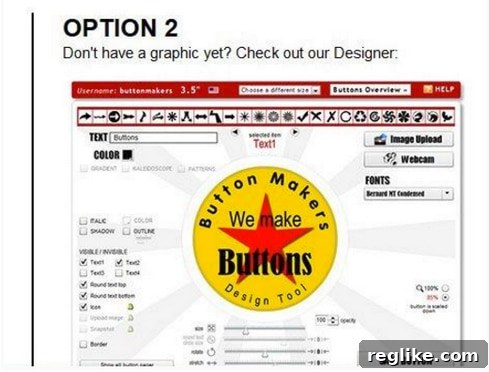
From Buttonmakers.net’s Specimen of Use for its trademark application. Buttonmakers.net needs to show that its use isn’t descriptive. So what is the non-descriptive trademark use that Buttonmakers.net makes of ‘Buttonmakers’? The answer is apparently that “We make buttons”.
Decisions Where the Domain Owner Failed to Respond
In cases where the respondent fails to submit a response, panels hear only one side of the dispute, which often leads to one-sided decisions. While this is understandable to some extent, even in these “no response” cases, some of the reasoning deployed by panels raises troubling questions regarding the consistent and fair application of the UDRP.
EquipmentTrader.com – August 16, 2016
This decision states that running a business selling equipment on equipmenttrader.com violates the Policy if another business holds a trademark on “Heavy Equipment Trader.”
Based on the evidence of record here, the Panel finds that no basis exists which would appear to legitimize a claim of rights or legitimate interests by the Respondent to the disputed domain name under paragraph 4(c) of the Policy.
This finding is problematic because “equipment trader” is a highly descriptive phrase. Granting a trademark holder of “Heavy Equipment Trader” the ability to seize “equipmenttrader.com” implies that descriptive variations of generic terms are also protected, even for legitimate businesses operating under those descriptive names. This effectively grants undue protection to generic terms, hindering fair competition and the use of natural language domains.
Wonderforest.com – October 7, 2016
In this case, a panel ruled that if a blogger registers a generic combination domain name (thewonderforest.com), then another party cannot register a similar domain (wonderforest.com) less than two years later. This is because the blogger was deemed to have exclusive rights to that term, despite not having a registered trademark at the time the disputed domain was registered. The blogger’s domain ‘thewonderforest.com’ was registered in 2011, the disputed domain ‘wonderforest.com’ in 2012, and the complainant’s trademark was applied for in 2014 and registered in 2016.
Complainant has not provided direct evidence of the secondary meaning it has achieved in the WONDER FOREST mark, other than allegation of “continuous and extensive” use dating back to 2011…The Panel has examined the website to which that domain name resolves and finds that it shows Complainant established its business under the name “the Wonder Forest tm blog” in 2011…As such the Panel finds that Complainant has established common law rights in the WONDER FOREST mark dating back to 2011.
The standard for establishing “secondary meaning” is quite high, requiring consumers to primarily associate a descriptive term like “WonderForest” with a specific source, like “that blog about home decoration.” To assert that a niche blog established common law rights and secondary meaning “dating back to 2011” after less than two years of operation is nonsensical under established trademark law. This rapid conferral of common law rights to a descriptive term, especially against an earlier-registered, similar domain, significantly lowers the bar for trademark protection and deviates from the rigorous standards typically required by the UDRP for common law marks.
Furthermore, the panel also considered the respondent’s attempt to sell the domain as evidence of bad faith:
Complainant also has provided evidence that Respondent is attempting to sell the domain name to the general public for an excessive cost. SeeCompl., at Attached Annex 3. Panels have also found this to violate Policy ¶ 4(b)(iv)
Selling a domain for profit is a legitimate activity for domain registrants and investors. Labeling an attempt to sell a domain for what a panel considers “excessive cost” as evidence of bad faith is a misapplication of the UDRP. Bad faith under Policy ¶ 4(b)(iv) typically requires a pattern of registering domains primarily for the purpose of selling them to trademark holders for valuable consideration in excess of out-of-pocket costs. Simply listing a domain for sale, even at a high price, without a clear pattern of targeting a specific trademark, should not automatically equate to bad faith.
Conclusion: The Imperative for UDRP Reform and Oversight
The cases detailed in this report, in my view, represent clear examples of the misapplication of the Uniform Domain Name Dispute Resolution Policy. The UDRP was carefully crafted to provide a remedy for unambiguous cybersquatting cases, where a domain owner registers and uses a domain with the explicit intention of targeting a trademark owner. However, as demonstrated, numerous decisions deviate significantly from this foundational intent.
A disturbing trend emerges where panels order the transfer of disputed domains to complainants who did not possess enforceable trademark rights at the time the domain was originally registered. In none of these highlighted cases is there compelling, objective evidence that the domain owner was intentionally targeting a valid trademark of the complainant when they registered and used these domain names. Instead, panels often rely on speculative rationales, retrospectively inferring bad faith or overstating the scope of trademark protection for descriptive and generic terms.
While I am not an attorney, my analyses presented here have been independently reviewed by two experienced IP attorneys, whose corrections and improvements I am grateful for. The dismayed reactions from several experienced UDRP attorneys to a couple of these decisions prior to this article’s inception further affirmed that I was not alone in perceiving these decisions as wrongly decided, reinforcing the importance of bringing these issues to light.
These flawed decisions underscore a critical lack of quality control within UDRP providers such as WIPO and the Forum. The system becomes fundamentally broken when accredited panelists, who demonstrably make fundamental errors in applying trademark law or significantly overreach in their interpretations, are empowered to arbitrarily seize domains from legitimate owners without any form of compensation. As these cases illustrate, some panelists appear to harbor no qualms about harming the livelihoods of small business owners by straying from the Policy’s clear guidelines and inventing highly speculative justifications to seize descriptive domains integral to these businesses’ operations.
Moreover, such inconsistent decisions erode the credibility of the UDRP and undermine the diligent work of panelists who conscientiously apply the Policy, demanding concrete evidence of bad faith targeting as intended. A policy interpreted by hundreds of panelists globally, across various UDRP providers, necessitates a degree of humility and adherence to established principles to maintain consistency in its administration. Panelists who disregard this uniformity by unilaterally altering evidentiary standards or adopting inconsistent interpretations do a profound disservice to all stakeholders who rely on the UDRP for fairness and predictability.
A significant systemic weakness is the apparent absence of self-correction procedures among UDRP providers and a lack of oversight by an independent organization to ensure compliance with the Policy. WIPO and the Forum, under whose authority these questionable decisions were issued, currently operate with considerable autonomy, as neither is under direct contract with ICANN regarding the policy’s implementation. This lack of external accountability creates a concerning incentive structure. The complainant typically chooses the most favorable forum for their case, and (except in rare cases of three-member panels) pays all fees. This arrangement inherently incentivizes providers to foster “happy customers” by delivering desired domains, even if it means approving overreaching decisions that conflict with the Policy and unjustly seize domains from prior owners. While WIPO has previously de-accredited a panelist – ironically, a recognized expert in IP law – the panelists responsible for the decisions highlighted in this report remain accredited, raising serious questions about the criteria and process for panelist oversight.
The integrity of the domain name system and the rights of legitimate domain owners depend on a UDRP that is applied consistently, fairly, and strictly according to its intended purpose. Without greater scrutiny, robust quality control, and effective oversight mechanisms, the UDRP risks becoming a tool for opportunistic trademark enforcement rather than a balanced arbiter of genuine cybersquatting disputes.