
Google vs. Francotel: A High-Stakes Battle Over AdWords Trademark and Domain Name
In a compelling case that underscores the complexities of international trademark law and domain name disputes, a French company, Francotel, LLC, finds itself embroiled in a legal skirmish with tech giant Google. The dispute centers on the coveted “AdWords” trademark and the seemingly innocuous domain name, ad-words.mobi. This multifaceted conflict highlights the challenges businesses face in protecting their intellectual property in an increasingly digital and globalized marketplace, where a simple domain registration can escalate into a full-blown legal battle.
The saga began with Francotel, LLC filing an action to cancel one of Google’s European Union trademarks for “AdWords.” This assertive move was swiftly met with a counter-action from Google, which initiated a Uniform Domain-Name Dispute-Resolution Policy (UDRP) complaint against Francotel over its ownership of the ad-words.mobi domain name. This article delves into the intricate details of this dispute, exploring the legal frameworks involved, the motivations of each party, and the broader implications for brand protection in the digital age.
The Pervasive Influence of Google AdWords
Before delving deeper into the dispute, it’s crucial to understand the significance of Google AdWords. Launched in 2000, Google AdWords (now rebranded as Google Ads) quickly became the cornerstone of Google’s immense advertising empire. It allows businesses worldwide to display concise advertisements on Google’s search results pages and across its vast network of partner websites. AdWords revolutionized online advertising, offering advertisers an efficient, measurable, and highly targeted platform to reach potential customers. For many businesses, Google AdWords is synonymous with digital marketing success, driving traffic, leads, and sales.
The “AdWords” brand itself has accrued enormous goodwill, recognition, and financial value over two decades. It represents not just a product but an entire ecosystem of online advertising. Consequently, any attempt to use, register, or claim ownership over a similar mark or domain name, especially one that directly references its core functionality, is viewed by Google as a significant threat to its brand identity and market position. This deep association and market dominance are central to Google’s aggressive defense of its trademark.
Francotel’s Contention: A Claim to “AdWords”
At the heart of Francotel’s position is its claim to a French trademark for “adwords.” While Google undoubtedly holds numerous trademarks for “AdWords” globally, the existence of a local, national trademark held by another entity can introduce considerable legal complexities. Francotel’s decision to file for the cancellation of Google’s European Union trademark for “AdWords” suggests a strategic and determined effort to assert its rights over the term within the EU jurisdiction. This move is not merely a defensive tactic but an offensive play, aiming to weaken Google’s hold on the mark in a key economic bloc.
It’s important to note that trademark rights are often territorial. A company can hold a trademark in one country, while another entity holds a similar mark in a different country, or even within a specific region if proper distinctions or prior use can be established. Francotel’s actions imply a belief in the legitimacy of its own “adwords” mark, potentially based on prior use, distinctiveness within a specific market, or a different interpretation of trademark law. The French company’s subsequent filing of a newer application for the mark indicates a persistent and evolving strategy to solidify its claim, suggesting a long-term commitment to owning and utilizing the “adwords” designation.
Google’s Retaliation: The UDRP Complaint
Google’s response to Francotel’s trademark cancellation attempt was swift and direct: a UDRP complaint against the ad-words.mobi domain name. The UDRP is an administrative procedure established by the Internet Corporation for Assigned Names and Numbers (ICANN) to resolve disputes over the registration of domain names that allegedly infringe on trademark rights. It provides a faster and more cost-effective alternative to traditional litigation, though its scope is limited to specific criteria.
To succeed in a UDRP complaint, Google must typically demonstrate three key elements:
- The domain name (ad-words.mobi) is identical or confusingly similar to a trademark in which Google has rights (e.g., “AdWords”).
- Francotel, the domain name registrant, has no rights or legitimate interests in respect of the domain name.
- The domain name has been registered and is being used in bad faith.
The “confusingly similar” aspect is particularly relevant here. Even with a hyphen and the “.mobi” top-level domain (TLD), the similarity to “AdWords” is undeniable, making it a strong point for Google. The subsequent criteria – legitimate interest and bad faith – will likely be the primary battlegrounds in this UDRP proceeding, where Francotel’s French trademark could play a pivotal role.
Analyzing the ad-words.mobi Website Content
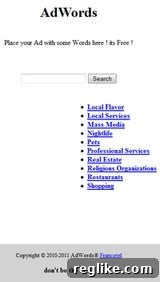
The content hosted on the ad-words.mobi domain name offers intriguing clues regarding Francotel’s intentions and could significantly influence the UDRP panel’s decision. The page conspicuously displays the phrase “Place your Ad with some Words here.” This statement, while seemingly generic, directly mirrors the core functionality and branding of Google AdWords. It could be interpreted by Google as an attempt to leverage the renowned “AdWords” brand to attract users seeking online advertising services, thereby creating confusion and diverting traffic.
Even more pointed is the phrase at the bottom of the page: “don’t be the devil.” This appears to be a direct and provocative jab at Google’s long-standing, albeit recently retired, corporate motto: “Don’t be evil.” Such a direct reference, particularly in the context of a domain name dispute, could be construed as evidence of bad faith. It suggests a deliberate attempt not only to associate with Google’s brand but also to do so in a way that is critical or subversive, indicating knowledge of Google’s trademarks and a calculated intent to exploit them for commercial gain or to cause disruption.
The Significance of the .mobi TLD
The choice of the “.mobi” top-level domain (TLD) for ad-words.mobi adds another layer of intrigue to the dispute. The .mobi TLD was specifically created for websites and services optimized for mobile devices. In the current digital landscape, where mobile access dominates internet usage, a domain name leveraging “.mobi” suggests an intention to target users specifically on their mobile devices. Given that Google’s advertising platforms are heavily integrated with mobile searches and applications, a confusingly similar domain under the “.mobi” TLD could amplify the potential for user confusion and brand dilution.
This particular TLD might also be viewed by Google as a strategic choice by Francotel to exploit an area where Google has a strong presence, thus strengthening the argument for bad faith registration and use. It implies an understanding of the mobile advertising market and an attempt to position ad-words.mobi as a relevant player, even if its primary purpose is to challenge Google’s trademark.
Potential Outcomes and Broader Implications
The resolution of this UDRP case presents several fascinating possibilities. The UDRP panel has a few options:
- Transfer the Domain Name: If Google successfully proves all three elements (similarity, lack of legitimate interest, and bad faith), the panel will order the transfer of ad-words.mobi to Google.
- Cancel the Domain Name: In some rare instances, if transfer isn’t appropriate, the domain might be canceled.
- Deny the Complaint: If Google fails to prove any of the three elements, especially if Francotel can convincingly demonstrate a legitimate interest in its French “adwords” trademark, the complaint would be denied, allowing Francotel to retain the domain.
- Punt to the Courts: As the original article astutely points out, the panel might decide to “punt to the courts.” This typically occurs when the dispute involves complex trademark validity issues that are beyond the scope and expertise of a UDRP panel. The existence of conflicting national and EU trademarks, as well as the pending cancellation action, might lead the panel to conclude that a court of law is better equipped to resolve these intertwined legal questions.
Regardless of the immediate outcome of the UDRP, this case holds significant implications for businesses and intellectual property law:
- Global Trademark Strategy: It underscores the critical need for companies, especially large international ones like Google, to maintain a robust and globally comprehensive trademark registration strategy.
- Domain Name Vigilance: It highlights the importance of proactive domain name monitoring and enforcement to prevent cybersquatting and trademark infringement.
- Interplay of Legal Systems: The dispute vividly illustrates the complexities arising when national trademark laws, regional trademark systems (like the EUIPO), and international domain name policies intersect.
- Bad Faith Considerations: The specific content on ad-words.mobi provides a textbook example of how a website’s messaging can be used as evidence of bad faith in UDRP proceedings.
Conclusion: A Precedent-Setting Battle for Brand Supremacy
The ongoing legal battle between Google and Francotel over the “AdWords” trademark and the ad-words.mobi domain name is more than just a localized dispute; it is a high-stakes struggle for brand supremacy in the digital realm. It brings to light the intricate dance between national trademark rights and global domain name governance, challenging established norms and potentially setting new precedents.
Whether the UDRP panel will issue a definitive ruling or defer the matter to the courts remains to be seen. What is clear, however, is that this case serves as a powerful reminder to all businesses: in an interconnected world, protecting one’s brand requires not only diligent trademark registration across multiple jurisdictions but also constant vigilance against potential infringements in the vast landscape of domain names. The outcome will undoubtedly be watched closely by intellectual property lawyers and brand managers worldwide, offering valuable lessons on navigating the complex intersection of law, technology, and global commerce.