
Navigating the New gTLD Landscape: The Challenges Faced by .CEO and .Best
The dawn of new generic Top-Level Domains (gTLDs) promised a revolution in the digital landscape, offering businesses and individuals unprecedented opportunities for unique online identities. Yet, for every success story, there are numerous challenges. This article delves into the intriguing case of PeopleBrowsr’s ambitious entries, .CEO and .Best, two gTLDs that have struggled to gain traction despite the registrar’s creative marketing spin.
The Promise and Reality of New gTLDs
The Internet Corporation for Assigned Names and Numbers (ICANN) launched its new gTLD program with the vision of expanding the internet’s naming system beyond traditional domains like .com and .org. The goal was to foster innovation, provide more choice, and enable more descriptive and relevant domain names. Hundreds of new gTLDs have since been introduced, ranging from industry-specific options like .tech and .app to geographic identifiers like .nyc and brand domains. While some have flourished, demonstrating strong adoption and commercial viability, others have faced an uphill battle in carving out their niche and achieving widespread acceptance.
The Underperformance of .CEO and .Best
By most objective measures, PeopleBrowsr’s foray into the new gTLD market with .CEO and .Best has yielded disappointing results. A look at the zone files reveals a stark reality:
- .CEO: Registers a modest 1,244 domains.
- .Best: Trails even further with just 434 domains.
These numbers stand in sharp contrast to the initial hype and investment typically associated with launching a new gTLD. The low adoption rates raise pertinent questions about the strategies employed, the market demand for such niche offerings, and the overall execution of their rollout.
Marketing Missteps and Brand Perception
One of the most critical factors influencing a new gTLD’s success is its marketing and how it resonates with the target audience. For .CEO, the launch was marred by what many observed as significant missteps, particularly concerning its promotional content.
- Questionable Promotional Videos: The initial marketing efforts for .CEO included videos widely criticized for being “silly and sexist.” In today’s highly aware and diverse digital environment, such content can alienate potential registrants and damage brand reputation from the outset. Effective marketing should be inclusive, professional, and clearly communicate value, not detract from it.
- Poor Execution of Marketing Strategy: Beyond specific content issues, the broader marketing strategy for .CEO reportedly lacked a clear vision and effective execution. A strong marketing plan for a new gTLD needs to define its target audience precisely, articulate unique selling propositions, and deploy a multi-channel approach to build awareness and drive adoption. Without this, even a potentially good concept can falter.
Furthermore, the very concept of .CEO as a top-level domain has been questioned. While it aims to appeal to a specific executive demographic, its narrow scope and potential for misinterpretation or limited broad appeal might inherently restrict its growth. Domain names that are overly niche or carry connotations that aren’t universally positive can struggle to find a wide audience, regardless of marketing efforts.
The Barrier of Premium Pricing
Another significant hurdle for both .CEO and .Best has been their retail pricing, hovering around the $100 mark. In a market where many new gTLDs and established domains can be registered for significantly less, this price point presents a considerable barrier to entry, especially for domains that have yet to prove their value or utility.
- Value Proposition vs. Cost: For a domain name to command a premium price, it typically needs to offer clear, undeniable value. This could be in terms of strong branding, high search engine optimization (SEO) benefits, immediate recognition, or inherent scarcity. For .CEO and .Best, which lack widespread recognition and have unproven track records, justifying a $100 price tag becomes challenging.
- Market Competition: The new gTLD space is fiercely competitive. Registrants have a plethora of choices, and often, price is a deciding factor. When comparable or more established options are available at a fraction of the cost, consumers are less likely to opt for a higher-priced, less familiar alternative.
Registrar Reluctance: A Crucial Bottleneck
The success of any new gTLD heavily relies on the willingness of domain registrars to offer it to their customers. Registrars act as the primary distribution channel, and their adoption is crucial for visibility and sales. Unfortunately for PeopleBrowsr, many major registrars have not rushed to carry .CEO or .Best.
- Low Demand and Inventory Risk: Registrars are businesses that prioritize profit and efficiency. If they perceive low demand for a particular gTLD, they are less likely to invest resources in integrating it into their platforms, marketing it, and managing the associated inventory risk. The high wholesale price of these domains likely exacerbates this reluctance, as it increases the financial commitment for registrars.
- Impact on Discoverability: Without broad registrar support, these domains remain largely invisible to the average consumer. Most individuals and businesses discover and register domain names through their preferred registrars. A limited presence means limited discoverability, further stifling adoption rates. This creates a vicious cycle where low demand leads to low registrar interest, which in turn perpetuates low demand.
The “Limited Release” Narrative: A Marketing Pivot
Faced with languishing sales and limited registrar interest, PeopleBrowsr has adopted an intriguing marketing strategy: labeling .CEO and .Best as “Limited Release” domains. This pivot attempts to reframe their scarcity not as a sign of poor performance, but as an indicator of rarity and exclusivity.
The company recently distributed a promotional email with the headline: “Two domains your registrar doesn’t want you to know about.” This messaging aims to create a sense of intrigue and urgency, positioning these domains as hidden gems that the “establishment” (i.e., other registrars) is deliberately keeping from consumers. This tactic plays on psychological principles, suggesting that something exclusive or difficult to obtain is inherently more valuable.
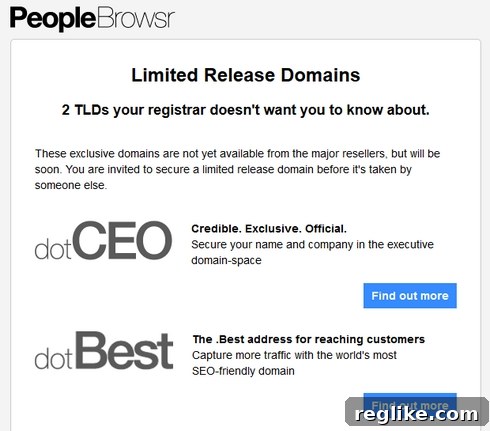
While creative, the effectiveness of this “glass half full” approach remains to be seen. Can merely calling a domain “rare” transform its market perception and drive significant sales, especially when its scarcity stems from low demand rather than deliberate, controlled release? For a “limited release” strategy to truly succeed, there often needs to be an underlying desire or established value that drives demand despite scarcity. If the initial market research and marketing failed to establish that inherent value, then claiming rarity might be a challenging path to widespread success.
Broader Implications for the TLD Market
The struggles of .CEO and .Best offer valuable lessons for the broader new gTLD market and prospective registry operators:
- Importance of Market Research: Thorough market research is paramount. Understanding genuine demand, target audience needs, and competitive landscape before launch is crucial.
- Strategic Pricing: Pricing must align with the perceived value and market conditions. Overpricing an unproven product, especially in a competitive market, can be a fatal error.
- Effective and Ethical Marketing: Marketing campaigns must be well-executed, inclusive, and accurately communicate the value proposition. Misleading or controversial marketing can do more harm than good.
- Registrar Engagement: Building strong relationships with registrars and demonstrating a clear path to profitability for them is vital for broad distribution and visibility.
- Long-Term Vision: The new gTLD space is a marathon, not a sprint. A sustainable business model, adaptability, and a commitment to building a strong ecosystem around the TLD are essential for long-term success.
Conclusion
The journey of .CEO and .Best illustrates the complex challenges inherent in launching and growing new top-level domains. While PeopleBrowsr’s attempt to rebrand their low adoption as “Limited Release” demonstrates a creative approach to marketing, it underscores the difficulty of overcoming initial hurdles related to concept, pricing, and execution. In the dynamic world of digital identities, authenticity, demonstrable value, and effective market engagement often prove to be more powerful drivers of success than clever spin. The future will tell if the “limited release” narrative can truly transform the fortunes of these intriguing, yet underperforming, gTLDs.