
Navigating the Digital Battleground: The Boise Garage Door Domain Name Saga
In the fast-paced world of digital commerce, a domain name is more than just an address; it’s a vital piece of a business’s identity, reputation, and online presence. For local service providers, securing the right domain can be the key to attracting customers and dominating search engine results. However, the path to domain ownership can sometimes be fraught with disputes, legal complexities, and even allegations of misconduct. This article delves into a fascinating case from Boise, Idaho, involving two garage door companies, a contentious Uniform Domain-Name Dispute-Resolution Policy (UDRP) decision, and a subsequent lawsuit that highlights the intricate challenges of online branding and legal recourse.
The Genesis of a Dispute: BoiseGarageDoor.com and the UDRP
The saga began with a UDRP proceeding concerning the domain name BoiseGarageDoor.com. The UDRP, established by the Internet Corporation for Assigned Names and Numbers (ICANN), is designed to provide an efficient and cost-effective mechanism for resolving disputes over domain names that are alleged to have been registered in bad faith, particularly when they infringe on trademark rights. In this specific instance, a panelist, whose expertise in internet marketing was later questioned, ruled in favor of Boise Garage Door, LLC, ordering the transfer of the domain to the complainant. This decision sparked significant debate within the domain name community, underscoring the critical importance of a panelist’s understanding of digital marketing nuances, local SEO, and the broader landscape of domain acquisition strategies.
For many, the awarding of a generic, geographically descriptive domain like “Boise Garage Door” raised eyebrows. While UDRP is a powerful tool against cybersquatting (the bad-faith registration of another’s trademark as a domain name), its application to highly descriptive terms often presents a grey area. Such domains are inherently valuable for local businesses aiming to capture traffic from search queries like “garage door services Boise” or “Boise garage door repair.” The outcome suggested that, at times, UDRP panelists might overlook the legitimate interests of domain holders who have invested in developing such domains, especially when the complainant might not possess clear, prior trademark rights over a purely descriptive term. This particular decision served as a potent reminder that not all disputes are straightforward, and the line between legitimate domain speculation and cybersquatting can be blurry, leading to outcomes that can profoundly impact business operations and online visibility.
From UDRP to the Courtroom: A Lawsuit Unfolds
The respondent in the initial UDRP case, clearly dissatisfied with the WIPO panel’s decision, escalated the matter by filing a lawsuit. This legal action served a dual purpose: first, to block the transfer of the BoiseGarageDoor.com domain name, and second, to address more serious allegations against the UDRP complainant, Boise Garage Door, LLC. The lawsuit specifically claimed that Boise Garage Door, LLC was engaging in slander and libel against the respondent. Such allegations elevate the dispute from a mere domain ownership battle to a complex legal fight involving reputational harm, a much more severe charge with potentially significant financial ramifications.
According to the detailed filing, a particularly damaging incident occurred on October 5th, following the UDRP decision. The lawsuit alleges that the defendant, or their legal counsel, posted a negative review on an advertisement for boisegaragedoor.net on Yahoo! Local. This review accused the respondent of “stealing business from Boise Garage Door through “deceit”.” This specific claim of public defamation adds a contentious layer to the legal proceedings, moving beyond mere domain ownership to encompass online conduct and its impact on a business’s livelihood. The inclusion of this alleged libelous content highlights how domain disputes can quickly spill over into broader accusations of unfair business practices and reputational attacks in the highly competitive online marketplace.
The Disputed Advertisement and Its Controversial Review
The lawsuit brought to light the specific advertisement on Yahoo! Local, which was the target of the alleged negative review:
Upon information and belief, on October 5, Defendant or his counsel left a negative review on the advertisement for boisegaragedoor.net on Yahoo! Local alleging that Boise Garage Door (sic) is stealing business from Boise Garage Door through “deceit”.
The advertisement itself was for a different domain, BoiseGarageDoor.net, which, according to the suit, was registered by an internet marketing group tasked with generating leads for the plaintiff. This distinction is crucial; it suggests that the plaintiff was actively investing in digital marketing and lead generation through another relevant domain, indicating a legitimate business operation rather than simple cybersquatting. The negative review, with its direct accusation of “deceit,” was not only damaging but also contained an interesting factual error that speaks to a broader misunderstanding of domain ownership and privacy.
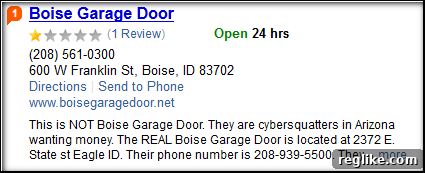
One particular claim within the negative review, stating that the domain (BoiseGarageDoor.net) was owned by a “cybersquatter in Arizona,” became a point of contention and amusement. This assertion, as highlighted in the original reporting, was a misinterpretation of Go Daddy’s Whois proxy service. Many domain owners opt for Whois privacy services to protect their personal information from public view, and Go Daddy, a major domain registrar, frequently lists its Arizona address for these proxy services. This detail reveals a lack of understanding from the reviewer about standard domain privacy practices, inadvertently turning a presumed “gotcha” moment into an easily debunked claim. This misstep not only undermines the credibility of the review but also illustrates how a simple misunderstanding of internet mechanics can lead to false accusations, further complicating legal battles.
The Immediate and Long-Term Repercussions of the Lawsuit
The filing of this lawsuit had several immediate and significant consequences. The most pressing was that WIPO (World Intellectual Property Organization), the administering body for UDRP cases, was compelled to stay the transfer of the BoiseGarageDoor.com domain name. This temporary halt underscores a fundamental principle: while UDRP is an administrative process, national court systems retain ultimate jurisdiction over domain disputes. A pending court case can supersede an administrative panel’s decision, demonstrating the complex interplay between different legal mechanisms for resolving domain ownership. For the plaintiff, this meant a reprieve, allowing them to continue operating under the disputed domain while the lawsuit unfolds, a critical factor for business continuity.
Looking beyond the immediate halt, the lawsuit carries substantial long-term implications. Should the plaintiff succeed in proving the claims of slander and libel, Boise Garage Door, LLC could face significant damages. These damages could encompass not only financial losses incurred by the plaintiff due to the negative publicity but also punitive damages aimed at deterring similar conduct in the future. Legal battles, especially those involving defamation, are inherently costly, time-consuming, and can inflict severe damage on both parties’ reputations, irrespective of the final judgment. The very existence of such a lawsuit can disrupt business operations, drain resources, and divert attention from core business activities. It also sets a precedent regarding the acceptable boundaries of online commentary during ongoing legal or administrative disputes, particularly for competitors.
The Importance of Specialized Legal Representation
Navigating the complex waters of domain name law, online defamation, and business disputes requires specialized legal expertise. In this case, the plaintiff is represented by both local counsel and internet attorney Brett Lewis. The involvement of an attorney like Brett Lewis, who possesses deep knowledge of internet law, intellectual property, and digital marketing landscapes, is crucial. These cases often involve nuanced interpretations of internet protocols, domain registration policies, and evolving legal standards for online conduct. Local counsel provides on-the-ground legal support and familiarity with state-specific laws, while an internet attorney brings a broader perspective on federal laws, international agreements, and technological specifics that are often overlooked in traditional legal practices.
Their combined expertise is vital for effectively arguing the intricacies of UDRP decisions, dissecting the implications of Whois privacy, and presenting compelling evidence regarding online libel and slander. Without such specialized representation, parties involved in these disputes might struggle to articulate their positions effectively, potentially leading to unfavorable outcomes. This case serves as a powerful testament to the necessity of engaging legal professionals who are well-versed in the unique challenges and opportunities presented by the digital environment, especially when core business assets like domain names and online reputations are at stake.
Domain Names, SEO, and Online Reputation in Local Business
This “Boise Garage Door wars” saga provides a compelling illustration of several critical aspects pertinent to modern businesses, particularly those operating in local markets. Firstly, it underscores the immense value of domain names, especially geographically descriptive ones, for local SEO. A domain like BoiseGarageDoor.com or BoiseGarageDoor.net immediately tells search engines and potential customers exactly what the business offers and where it operates. Such domains are powerful tools for capturing organic search traffic from highly targeted local queries, making them highly coveted assets.
Secondly, the case highlights the fragility of online reputation. A single negative review, especially one posted during a heated legal battle and containing serious accusations like “deceit,” can significantly damage a business’s standing. For local businesses, word-of-mouth and online reviews are paramount. Managing online reputation, monitoring review platforms, and having strategies to address negative feedback are no longer optional but essential components of digital marketing. The alleged timing of the review, during the WIPO case, suggests an intent to influence public perception or exert pressure, demonstrating how online platforms can be weaponized in disputes.
Finally, the interplay between UDRP, national courts, and online conduct reveals the multi-faceted nature of digital business disputes. While UDRP offers a streamlined path for certain domain issues, it doesn’t always provide the final word, especially when broader legal claims like defamation are involved. Businesses must be prepared for the possibility that domain disputes can escalate into full-blown litigation, requiring comprehensive legal and digital strategies. Understanding the nuances of these legal frameworks, coupled with robust online reputation management, is crucial for any business seeking to thrive and protect its assets in the increasingly complex digital landscape.
Conclusion: The Enduring Battle for Digital Identity
The ongoing legal battle surrounding the Boise Garage Door domains serves as a potent reminder of the multifaceted challenges businesses face in the digital age. What began as an administrative dispute over a domain name quickly evolved into a complex lawsuit involving allegations of slander and libel. This case vividly illustrates the critical importance of domain names for local businesses, their direct link to SEO and online visibility, and the profound impact of online reviews on reputation. It also highlights the intricate legal landscape that governs digital assets, where UDRP decisions can be challenged in court, and where specialized legal counsel is indispensable.
As the digital frontier continues to expand, businesses must remain vigilant, not only in securing their online identities but also in protecting their reputations from potentially damaging online attacks. The Boise Garage Door saga is more than just a legal skirmish; it’s a testament to the enduring battle for digital identity and fair play in the competitive online marketplace.