
Navigating the Post-GDPR Landscape: How European ccTLD Managers are Redefining WHOIS Transparency
The digital world has been fundamentally reshaped by the European Union’s General Data Protection Regulation (GDPR), a landmark piece of legislation designed to give individuals greater control over their personal data. Within the expansive ecosystem of the internet, few areas have felt the direct impact of GDPR as acutely as the domain name industry, particularly concerning the display and accessibility of domain ownership information traditionally found in WHOIS databases. While GDPR’s “long arm” statutes necessitate compliance from registries and registrars globally when processing data of EU residents, European country code Top-Level Domain (ccTLD) managers face an even more stringent obligation, operating directly within the regulatory spotlight.
In an effort to provide clarity and document the evolving practices within this critical sector, the Council of European National Top-Level Domain Registries (CENTR) — a prominent association representing ccTLD managers across Europe — recently published crucial survey results. This comprehensive report sheds light on the diverse strategies and approaches ccTLD managers are employing to navigate the complex intersection of data privacy laws and the historical demands for domain registrant transparency.
Understanding the implications of GDPR on WHOIS requires a brief look into the regulation’s core tenets. GDPR is built upon principles such as lawfulness, fairness, and transparency; purpose limitation; data minimization; accuracy; storage limitation; integrity and confidentiality; and accountability. For WHOIS, the principle of data minimization, which dictates that only data absolutely necessary for a specified purpose should be collected and processed, is particularly pertinent. Historically, WHOIS databases were designed for technical troubleshooting and abuse contact, often publishing a wide array of personal details including names, addresses, phone numbers, and email addresses. GDPR challenges this historical model by mandating a lawful basis for processing such personal data, pushing domain registries to re-evaluate what information is truly essential for public disclosure.
CENTR’s survey offers invaluable insights into the practical application of these principles. The findings illustrate a dynamic landscape where ccTLDs are adapting their data collection and publication policies to align with GDPR mandates. This chart, for instance, visually represents some of the key trends and divergences in how these critical domain assets are managed:
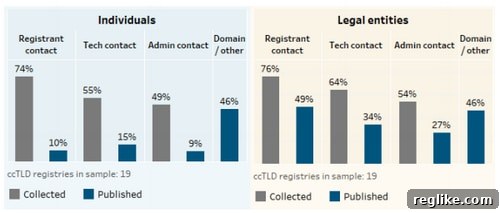
The disparities highlighted by the survey are significant, particularly concerning the types of contact information made publicly available. A striking revelation from the report indicates a substantial difference in the publication of email addresses based on registrant type. Specifically, a mere 11% of registries currently publish an individual registrant’s email address in their public WHOIS. This stark figure underscores the prevailing concern for individual privacy, aiming to protect registrants from unsolicited communications, spam, and potential identity theft. This cautious approach aligns directly with GDPR’s core directive to minimize the exposure of personal data, especially sensitive contact information that could be easily exploited.
In contrast, the publication rate for email addresses associated with corporate registrants stands at 47%. This considerable difference reflects a nuanced interpretation of GDPR, acknowledging that while individuals have strong privacy rights, corporate entities often operate with a greater expectation of transparency and public accountability. For businesses, an accessible contact email can be crucial for legitimate purposes such as intellectual property enforcement, business communication, and legal correspondence. This dual approach signifies a careful balancing act between privacy protection for natural persons and the need for accountability and transparency in commercial operations, demonstrating a pragmatic adaptation by ccTLD managers to differentiate between personal and organizational data.
The journey towards GDPR compliance for many European ccTLD managers was not an entirely new path. It is crucial to acknowledge that a considerable number of EU ccTLD managers had already implemented restricted WHOIS information practices well before GDPR came into effect in May 2018. This proactive stance was often driven by existing national data protection laws, which in some European countries (such as Germany with its robust privacy framework) were already quite stringent and privacy-centric. These pre-GDPR restrictions provided a foundational understanding and established processes that, to some extent, eased their transition into full GDPR compliance. However, GDPR’s broader scope, unified application across the EU, and the potential for significant penalties still presented new challenges, requiring a comprehensive re-evaluation of legal bases for processing personal data and refining access policies for non-public information.
The ramifications of these evolving WHOIS policies extend far beyond simple data display; they impact various stakeholders across the internet ecosystem in profound ways. Law enforcement agencies, for instance, traditionally rely heavily on accurate and accessible WHOIS data for investigating cybercrime, fraud, and other illicit online activities. Intellectual property rights holders, similarly, depend on this information to identify and pursue those infringing on trademarks, copyrights, and other brand assets. Cybersecurity researchers and abuse mitigation teams also leverage WHOIS data to track down sources of malicious activity, such as phishing scams, malware distribution, and botnet operations, which pose significant threats to global internet security. The redaction of key contact information, while protecting individual privacy, can inadvertently complicate these legitimate investigative efforts, leading to a critical debate on “gated access” models and standardized request procedures for accessing non-public WHOIS data based on a demonstrated legitimate interest.
CENTR’s ongoing work, exemplified by this survey, plays a vital role in fostering best practices and facilitating a collective understanding among its members. As an organization dedicated to the operational stability and strategic development of ccTLDs, CENTR provides a crucial platform for dialogue, experience sharing, and policy development among European domain registries. Their reports not only highlight the current state of affairs but also contribute significantly to the ongoing global discussion about the future of WHOIS, striving towards a model that effectively respects privacy while upholding the internet’s security, stability, and resilience needs. This collaborative approach is essential in a fragmented regulatory environment.
The challenge for ccTLD managers remains multifaceted: maintaining strict compliance with GDPR and relevant local laws, effectively addressing the legitimate needs of various stakeholders for access to specific data, and adapting to a constantly evolving digital threat landscape. The survey findings unequivocally demonstrate that there is no single “one size fits all” solution to WHOIS compliance; instead, a spectrum of tailored approaches is being adopted, reflecting the unique legal and operational contexts of each ccTLD. This adaptability, combined with a commitment to continuous improvement and inter-organizational communication, will be key to ensuring a resilient, trustworthy, and privacy-respecting internet infrastructure for all users.
As the digital regulatory environment continues to mature and new challenges emerge, further adjustments and refinements to WHOIS policies are inevitable. The dialogue initiated and sustained by authoritative organizations like CENTR is indispensable for navigating these complexities, ensuring that the critical balance between privacy, transparency, and accountability is thoughtfully maintained. The journey of transforming WHOIS from a largely public directory to a more nuanced, privacy-respecting, and purpose-driven information service is still very much underway, and the data from CENTR provides a crucial, timely snapshot of this significant and ongoing transition, guiding the way forward for the European domain name space.
For a detailed analysis of these findings and to delve deeper into the methodologies and specific data points gathered by CENTR, the full report is available for download.
The report can be downloaded here.