
GoDaddy Deplatforms Gab.com: The Escalating Battle Against Hate Speech Online
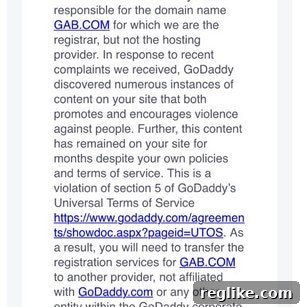
In a significant development that underscores the increasing pressure on tech companies to address online extremism, domain name registrar GoDaddy (NYSE:GDDY) has formally notified Gab.com, the controversial social network, that it must relocate its domain name to a different provider. This directive, confirmed by Gab.com itself through a tweet featuring the official email notice from GoDaddy, marks a crucial turning point in the ongoing debate surrounding content moderation and the responsibility of digital infrastructure providers.
The Ultimatum: GoDaddy’s Stance Against Incitement
GoDaddy’s decision to sever ties with Gab.com comes amid intense public scrutiny following revelations that the alleged perpetrator of the horrific Pittsburgh synagogue shooting was an active user of the platform. Gab.com has long been criticized for its lax content policies, which have allowed it to become a haven for racists, white supremacists, and purveyors of hate speech, often promoting conspiracy theories and inciting violence. While GoDaddy generally attempts to maintain a neutral stance regarding content hosted on domains registered through its service, the company has, in certain extreme circumstances, made exceptions when content clearly violates its terms of service, particularly concerning incitement to violence.
The notice from GoDaddy effectively compels Gab.com to find a new domain registrar within a specified timeframe, or risk losing control of its web address. This action is a powerful statement from one of the internet’s largest infrastructure providers, signaling that even foundational services like domain registration are not immune to ethical considerations regarding the content they facilitate.
Gab.com: A Platform Under Intense Scrutiny
Launched in 2016, Gab.com positioned itself as a “free speech” alternative to mainstream social media platforms like Twitter and Facebook, which it accused of censorship. This self-proclaimed commitment to unmoderated speech quickly attracted individuals and groups who had been banned or restricted from other sites due to violations of community guidelines, including those promoting racism, antisemitism, and extreme political views. Over time, Gab cultivated a reputation as a gathering place for the alt-right and various hate groups, a perception that intensified dramatically in the wake of the Pittsburgh tragedy.
The aftermath of the synagogue shooting placed an unprecedented spotlight on Gab’s role in potentially fostering environments where extremist ideologies thrive. This incident served as a critical inflection point, prompting a cascade of service providers to re-evaluate their relationships with the platform. The withdrawal of services by integral components of Gab’s digital infrastructure made GoDaddy’s move almost inevitable, as public pressure mounted and the reputational risks became too significant to ignore.
A Broader Crackdown: The Ripple Effect of Deplatforming
GoDaddy is not the first, nor the only, company to pull the plug on Gab.com. In the immediate aftermath of the Pittsburgh shooting, the platform faced a widespread “deplatforming” effort across multiple layers of its operational infrastructure. Payment processors such as PayPal and Stripe quickly announced their decision to discontinue services, cutting off Gab’s ability to receive donations or process payments—a critical blow to any online enterprise. Furthermore, several web hosting providers also withdrew their support, making it exceedingly difficult for Gab to maintain a stable online presence. This coordinated withdrawal of services demonstrates a growing trend among technology companies to take proactive measures against platforms perceived to be actively promoting hate speech and inciting real-world violence.
The act of deplatforming, which involves denying essential digital services, has become a potent tool in the fight against online extremism. It highlights the intricate web of dependencies that even a seemingly independent social network relies upon, from domain registration and hosting to payment processing and content delivery networks. When these fundamental services are withdrawn, a platform like Gab faces immense technical and logistical challenges that threaten its very existence online. This collective action by various providers sends a clear message about the shared responsibility within the digital ecosystem to uphold certain ethical standards.
GoDaddy’s Precedent: The Daily Stormer Case
This is not the first time GoDaddy has taken decisive action against a controversial website. The registrar made headlines in 2017 when it informed the operator of the white supremacist site Daily Stormer to find a new registrar following the violent Charlottesville rally. In that instance, GoDaddy explicitly stated that Daily Stormer had violated its terms of service by inciting violence. This prior incident set a clear precedent for GoDaddy’s policy on content that crosses the line from objectionable speech into direct incitement.
Interestingly, the operators of both Daily Stormer and Gab.com might consider themselves fortunate that GoDaddy merely requested them to switch providers. In the case of DailyStormer.com, after GoDaddy’s action, the site attempted to move its registration to Google Domains. However, Google went a step further, not only denying the transfer but also suspending and locking the domain, effectively taking it offline entirely. This more severe response from Google underscored the differing approaches and internal policies among various infrastructure providers regarding how they handle egregious violations of their terms and community standards. While GoDaddy’s move gives Gab a chance to relocate, it still signifies a firm rejection of the content facilitated by the platform.
The Economics of Controversial Domains: Gab.com’s Acquisition
The domain name Gab.com itself represents a significant investment for the social network. Records indicate that Gab.com was purchased for over $200,000, with public information suggesting an acquisition through Flippa for approximately $220,000 in the month prior to this controversy. Before securing this premium .com address, the social network operated under the domain Gab.ai. The transition to Gab.com was likely an effort to enhance its brand legitimacy, improve search engine visibility, and establish a more professional online identity.
The financial outlay for such a high-value domain underscores the importance of a strong, memorable web address in the digital landscape. However, GoDaddy’s decision highlights a crucial vulnerability: even a substantial investment in a domain name offers no immunity if the associated content violates the terms of service of essential infrastructure providers. This situation poses a severe challenge for Gab, as finding another reputable domain registrar willing to host such a controversial site, especially after widespread deplatforming, will be an arduous task, potentially forcing it to rely on less established or less reliable alternatives.
The Free Speech Debate in the Digital Age
The deplatforming of Gab.com by GoDaddy and other service providers intensifies the already heated global debate surrounding free speech online, content moderation, and the responsibility of technology companies. Proponents of deplatforming argue that companies have a moral and ethical obligation to prevent their services from being used to spread hate, incite violence, and facilitate harm. They emphasize that “free speech” does not equate to “consequence-free speech,” especially when that speech directly threatens public safety or democratic values.
Conversely, critics of deplatforming often raise concerns about censorship, arguing that such actions by private companies create a dangerous precedent, giving them undue power to arbitrarily silence voices, even controversial ones. They contend that infrastructure providers should remain neutral conduits for information, without becoming arbiters of acceptable speech. This perspective often warns of a slippery slope where legitimate, albeit unpopular, discourse could be suppressed, leading to a fragmented internet where dissenting voices are pushed to the fringes. The Gab.com case exemplifies this complex tension, where the desire to combat hate speech directly clashes with deeply held principles of open internet access and freedom of expression.
The ongoing saga of Gab.com and its struggle to maintain its online presence serves as a potent reminder that the digital infrastructure, once largely seen as neutral, is increasingly becoming an active participant in shaping the boundaries of permissible online content. As governments, tech companies, and civil society grapple with these profound questions, the future of platforms that champion unrestricted speech, regardless of its content, remains uncertain.