
GoDaddy’s appraisal tool often returns low figures, but it remains a useful way to screen large lists of domains.
This article is part of a review of automated domain appraisal tools.
GoDaddy’s domain appraisal tool is frequently criticized within the domain community. That reaction is understandable: many buyers refer to GoDaddy’s estimates during negotiations and wonder why certain domains sell for far more than the tool’s valuation. In practice, even GoDaddy does not strictly follow its own appraisal numbers when pricing domains it owns.
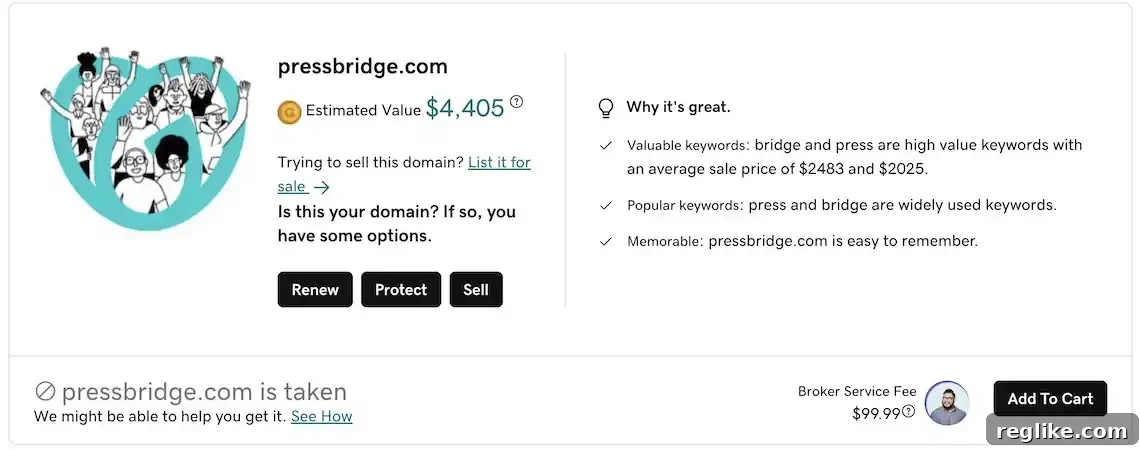
The current appraisal model appears to be dated and uses stale data. The domain market moves rapidly, and GoDaddy’s tool has not kept pace. Results are simple: a suggested price with short, generic reasons such as “Memorable: makematter.com is easy to remember.” The tool once displayed comparable sales, but those comps are no longer provided.
Subscribers to Domain Discount Club Pro gain access to additional appraiser functionality in Domain Academy, which offers tiered pricing probabilities. Unfortunately, those tiers can be less reliable than the primary appraisal — for example, one output suggested an 82.5% chance that Dragonfly.com would sell within a year if priced at $1,000, which is clearly inconsistent with market expectations for a premium one-word .com.
Domain Academy also includes a bulk valuation tool that is worth exploring. In addition to baseline GoDaddy estimates, it shows supporting signals such as TLD registration counts, matching companies on Crunchbase, and related Github repositories. Those extra data points can help users triage large portfolios even when the headline values are off.
Two-word brandable domains
We tested two two-word brandable .com domains: MakeMatter.com, which sold for $15,000, and PressBridge.com, which sold for $5,000. These examples fall within the common range for two-word dictionary brandables, roughly $3,000–$15,000, depending on buyer demand and timing. While individual high-profile sales can push averages upward, this band is a reasonable expectation for many such names.
GoDaddy appraised MakeMatter.com at $2,615 and PressBridge.com at $4,405. Those figures are lower than the recorded sale prices, reflecting the tool’s compression toward a modest mid-range. For many domains, GoDaddy’s valuations cluster between $2,000 and $5,000, so the appraisals are directionally useful for sellers operating in that band — even if they underestimate top-end outcomes.
For an unregistered test name, CloudToaster.com, GoDaddy returned $1,410. That low valuation illustrates the model’s conservative bias for creative but non-dictionary combinations.
One-word premium .coms
Historically, GoDaddy has grouped extremely valuable one-word .coms under a threshold of $25,000 or more. That labeling has been criticized as vague, because premium names like Dragonfly.com typically command prices well above that mark. Recently GoDaddy changed the wording to “too high to estimate,” which avoids suggesting a specific floor but still doesn’t convey the true scale of some six- or seven-figure names.
Even some names listed on GoDaddy’s premium marketplace for six figures receive modest appraisal figures, demonstrating the tool’s limitations at the highest tiers. For example, willow.com shows a valuation that is far below what expected premium-market transactions might indicate.
Popular country and new TLDs
GoDaddy’s model struggles with many ccTLDs and newer generic TLDs. We tested a high-quality one-word .io and a plural .ai example. Expedite.io, which sold for $14,995, received a GoDaddy value of $5,316. Kickers.ai, sold for $8,000, was appraised at $171. Even strong .ai names like money.ai were undervalued by the tool, reinforcing that it does not accurately reflect current pricing dynamics in these extensions.
Exact-match descriptive domains
Category-defining exact match domains remain valuable for businesses selling specific products or services. WaterFilters.com, listed at $3.5 million, is an example of a name with clear commercial utility and substantial potential revenue behind it. GoDaddy appraised this domain at $18,332 — the lowest among several valuation services tested — which highlights the gap between simple algorithmic estimates and the strategic value of exact-match assets for online retailers and large businesses.
Three- and four-letter domains
Short letter combinations, especially pronounceable ones, are among the most liquid and consistently traded assets. We evaluated dujo.com, a pronounceable four-letter .com listed on Afternic for $36,000. GoDaddy valued it at $11,903, toward the lower end of surveyed tools. A non-pronounceable four-letter example, MOTG.com, which sold for $14,888, received a $7,177 appraisal.
Although the numerical values are lower than market listings or sales, GoDaddy’s tool did correctly rank value between these examples: pronounceable brandables tend to score higher than random-letter strings. For a three-letter example, VJN.com — listed for $39,000 — was appraised at $22,670. That estimate sits at roughly two-thirds of the asking price, which is not an unreasonable gap for a conservative algorithmic model.
New generic TLDs
New gTLDs are particularly challenging to price algorithmically because their markets are still maturing. Voicemail.app, sold in early access for $5,000, was appraised at about $1,071. Hidden.app, which more recently sold for $3,995, received a $2,261 valuation from GoDaddy. Timber.homes, sold for $2,899, was appraised at $2,600 — a closer match. These mixed results suggest GoDaddy’s dataset does not fully capture evolving demand in newer extensions.
Final analysis
Overall, GoDaddy’s appraisal tool has notable shortcomings: its numeric outputs are often conservative or outdated, and the model struggles with certain TLDs and high-end one-word .com valuations. However, the service still provides practical value when used as a screening mechanism. It generally orders a list in a useful way — better domains tend to appear higher when sorting by GoDaddy’s valuations — making it a convenient first pass for triaging large portfolios and expired domain searches.
Given GoDaddy’s dominant position in the registrar market and its frequent role as a first stop for buyers researching a name, improving the appraisal algorithm and updating its data sources would better serve customers and the aftermarket. More accurate valuations would reduce confusion in negotiations and better reflect the true worth of domains across a diverse and changing market.