
Unveiling the Opaque: Decoding Google’s Ad Pricing and Its Impact on Domain Parking Partners
The intricate world of digital advertising often operates behind a veil of proprietary algorithms and confidential agreements. For domain owners participating in monetization programs, particularly those relying on Google’s advertising network, this opacity can be a source of significant concern. Google’s ad pricing mechanism, often referred to as a ‘black box,’ makes it exceptionally challenging for its partners to ascertain whether they are receiving a fair and equitable share of the advertising revenue generated.
Historically, a pivotal moment arrived when Google (NASDAQ: GOOG) introduced a “direct to consumer” domain parking option. This initiative was met with a mixed reception. Many within the domain industry initially hailed it as a breakthrough, envisioning a future where intermediaries could be circumvented, and domain owners could directly engage with the tech giant. The prospect of cutting out the “middleman” – the domain parking companies – promised greater control and potentially higher returns. However, this initial enthusiasm soon gave way to a more cautious outlook. Domain owners quickly recognized a critical imbalance: their individual bargaining power with Google was negligible compared to that of large domain parking companies, which aggregated substantial traffic volumes and thus commanded a stronger negotiating position.
Understanding Google’s Domain Parking Agreements
To fully grasp the potential for Google to exert pressure on its partners, it’s essential to delve into the foundational agreements Google establishes with prominent domain parking entities like DomainSponsor, NameMedia, and Sedo. These contracts, by their very nature, are highly confidential, safeguarding competitive strategies and financial terms from public scrutiny. This secrecy itself contributes significantly to the ‘black box’ phenomenon, limiting partners’ understanding of the broader ecosystem.
Nevertheless, rare glimpses into these confidential arrangements can occasionally surface. Thanks to NameMedia’s (subsequently aborted) attempt to go public, a detailed SEC filing offered a unique opportunity to examine the inner workings of a Google AdSense contract. This invaluable insight revealed several key aspects:
1. Diverse AdSense Feed Types for Varied Monetization
The contract illuminated the existence of three distinct types of advertising feeds: AdSense for Content, AdSense for Domains, and AdSense for Search. Each feed serves a specific purpose in monetizing web traffic:
- AdSense for Search: This feed primarily delivers search-based advertisements, directly stemming from Google’s core search engine. It is typically invoked when a user inputs a search query into a designated search box on a parked page or clicks on a link labeled “Related Searches.” Search ads are often considered more valuable due to higher user intent.
- AdSense for Content & AdSense for Domains: While the precise distinctions in ad types displayed on Content versus Domains feeds can sometimes be subtle, these feeds are primarily responsible for delivering contextually relevant advertisements directly on the landing page of a parked domain or on subsequent pages. In a “one-click lander” setup with Google, all advertisements displayed on the homepage generally originate from either the Content or Domains feed, providing immediate monetization upon user arrival.
Understanding these feed types is crucial because their performance and associated revenue per click can vary significantly, directly impacting a domain owner’s earnings.
2. Tiered Revenue Share Based on Contributed Revenue
A significant revelation from the NameMedia agreement was the structure of revenue sharing: parking companies typically receive a higher percentage of the ad revenue if they generate greater overall revenue for Google. The NameMedia contract, for instance, detailed a three-tiered system. This mechanism incentivizes partners to drive not just high volumes of traffic, but specifically traffic that converts into substantial advertising revenue for Google. It’s important to note that the tiers are based on the *revenue amount* delivered to Google, not merely the *volume of traffic* sent. This distinction underscores Google’s focus on profitability rather than just impressions.
Upon learning this, one might assume a sense of security: “Great! The parking companies have negotiated fixed revenue share percentages with Google that are immutable during the contract term. We’re locked into these rates.” However, this assumption overlooks a critical nuance. While the percentage payout to the larger parking companies might indeed remain constant throughout the contract period, this stability does not inherently guarantee the *actual amount paid out* per click. This is a subtle yet powerful distinction, which we will explore further, revealing how Google can influence partner earnings even with seemingly fixed percentage agreements.
Furthermore, this dynamic highlights a key concern for individual domain owners who opt for direct partnerships with Google, bypassing the established parking companies. Without the collective bargaining power and aggregated revenue of a large partner, individual owners often lack a guaranteed percentage, leaving them vulnerable to potential adjustments by Google whenever the company needs to bolster its own earnings or manage ad inventory efficiently.
The Elusive Revenue Share: A Deep Dive into Google’s Profit Prioritization
To truly comprehend why revenue share percentages can be misleading in these agreements, and how Google might have a strategic incentive to collect less per click on AdSense parking pages (even if it implies Google itself earns less per click on those specific pages), we must examine the interplay between Google Adwords and AdSense.
Google AdWords is the primary platform where advertisers bid for ad placements across Google’s vast network. Advertisers typically set a maximum bid per keyword and, critically, establish an overall daily or monthly budget. For instance, an advertiser might specify, “I’m willing to bid $1 per click for these specific keywords, but my total spending should not exceed $1,000 per day.” This budget constraint is central to Google’s ability to manage ad distribution.
At first glance, it appears logical that Google would aim to maximize the price of every click across all its properties – whether on Google.com or within the AdSense network. Maximizing click prices would seemingly lead to higher revenue. However, a crucial difference lies in Google’s profit margins. Google’s margin on traffic generated through its own properties (Google.com, YouTube, etc.) is significantly higher because it doesn’t incur the expense of paying partners a share of that revenue. This fundamental difference creates a powerful incentive for Google to direct a larger portion of an advertiser’s budget toward its own properties, even if it means adjusting click values elsewhere.
Let’s illustrate this with a hypothetical, yet revealing, scenario:
Imagine an advertiser with a daily budget of $1,000, which they consistently max out. Initially, Google could distribute this budget by sending half the traffic from Google.com and the other half from its AdSense network, with an average click price of $1:
- 500 clicks on AdSense properties x $1/click x 25% (Google’s share, assuming a 75% partner payout) = $125 profit for Google.
- 500 clicks on Google.com x $1/click = $500 profit for Google.
- Total Profit for Google = $625.
Now, consider an alternative strategy. What if Google strategically discounts the value of clicks on AdSense properties by 50%, perhaps rationalizing that these clicks are inherently less valuable or convert at a lower rate than those on Google.com? The advertiser’s $1,000 budget remains unchanged, and they still aim to exhaust it. With the AdSense clicks now cheaper, more of the remaining budget will automatically be allocated to Google’s own higher-margin properties to fulfill the advertiser’s spending goal:
- 500 clicks on AdSense properties x $0.50/click x 25% = $62.50 profit for Google.
- To reach the $1,000 budget, the remaining $750 (from $1,000 – $250 spent on AdSense clicks) would be spent on Google.com. This equates to 750 clicks on Google.com x $1/click = $750 profit for Google.
- Total Profit for Google = $812.50.
As this example vividly demonstrates, Google doesn’t necessarily need to alter the percentage it pays to parking companies. By simply reducing the per-click value for AdSense traffic, it can strategically shift advertiser budgets towards its own direct properties, thereby increasing its overall profit significantly. Simultaneously, advertisers might even receive a higher volume of clicks (1250 total in the second scenario vs. 1000 in the first), which could be perceived as a benefit to them.
This tactic raises questions about Google’s stated objective of offering advertisers the “best deal.” If both Google.com and AdSense traffic convert at comparable rates, the second option, while generating more conversions for the advertiser, isn’t necessarily the most efficient use of their budget if AdSense clicks were artificially devalued. Ironically, a third hypothetical option, where *all* traffic was directed to AdSense properties at the higher original rate, might be optimal for the advertiser (more conversions per dollar if AdSense performed well) but would result in the lowest profit for Google ($250 in the first scenario, assuming all 1000 clicks were AdSense).
Are Partners Already Feeling the Squeeze? The Misleading Nature of Traffic Acquisition Costs (TAC)
Many industry observers often cite Google’s Traffic Acquisition Costs (TAC) metric as evidence that advertisers are receiving less value, or that partners are being paid less. However, this metric, while important for investors, offers very little genuine insight into the specifics of partner payouts. TAC represents the percentage of advertising revenue that Google pays to its network partners and direct traffic acquisition efforts.
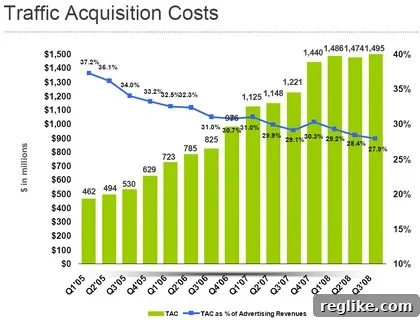
Above: A graphic illustrating Google’s Traffic Acquisition Costs, a key metric for investors but often misinterpreted by partners.
In the provided graphic, the blue line illustrates Google’s expense for traffic acquisition as a percentage of its overall advertising revenue. The green bars primarily depict the actual amounts disbursed to traffic partners. A common argument stems from observing a falling percentage in TAC – for instance, a decline from 37.2% in Q1’05 to 27.9% in Q3’08. This trend is often interpreted as Google paying its partners less.
However, this interpretation can be highly misleading. The TAC percentage, in isolation, tells us very little about the actual per-click or per-impression payments to partners. This is because we lack crucial information: the precise breakdown of traffic volume generated on Google.com versus that generated on AdSense partner sites. If Google’s own properties are growing faster and capturing a larger share of the overall ad spend, the *percentage* of revenue paid out to partners (TAC) might decrease, even if the absolute dollar amount paid to partners remains the same or even increases. In fact, the raw data sometimes suggests that Google might be paying *more* to partners in absolute terms, even as the TAC percentage declines. Without knowing the exact traffic volumes and conversion rates across both Google’s own sites and partner sites, analyzing TAC provides limited insight into whether partners are genuinely receiving more or less per unit of traffic. It remains a financial ‘black box’ where only Google possesses the complete picture.
Indeed, revenue generated on Google.com and other Google-owned properties demonstrated robust growth, increasing by 34% in Q3’08 compared to the previous year. In contrast, revenue from the AdSense network grew at a slower pace of 15% during the same period. While this indicates a stronger performance on Google’s direct properties, it still represents revenue figures, not traffic volumes. Therefore, the essential question of whether Google is paying its partners more or less per click or impression remains obscured. The inherent lack of transparency ensures that partners must largely operate on trust, without the data to independently verify the fairness of their earnings.
A Ticking Time Bomb: The Threat of Feed Elimination
Beyond the gradual “squeeze” of revenue share adjustments, there exists another, more immediate threat that could drastically reduce domain parking partners’ revenue overnight: Google’s contractual right to eliminate the search ad feed. As revealed in the NameMedia agreement (and reportedly consistent across other partner contracts), Google retains the unilateral power to discontinue this crucial feed. Search ads, generally characterized by higher user intent, typically command superior pay-per-click rates compared to contextual or content-based advertisements. The sudden removal of this high-value feed could result in an immediate and massive drop in revenue for domain owners.
While Google is contractually obligated to provide a replacement feed to partners like NameMedia if the search feed is removed, the efficacy of this replacement is a major concern. If the substitute feed fails to perform within a pre-defined percentage (e.g., within x% of the original search feed’s performance), the partner’s sole recourse is a drastic one: terminate their agreement with Google. Considering the extensive reliance of most domain parking operations on Google’s advertising infrastructure, unilaterally canceling such a foundational agreement is hardly a viable or desirable alternative. This clause underscores the extreme power imbalance, leaving partners highly vulnerable to changes in Google’s ad serving strategy.
The Ethical Quandary: Biting the Hand That Feeds Us?
Amidst the growing concerns and complaints regarding Google’s market power and opaque practices, it’s crucial to acknowledge an undeniable truth: without Google, the domain industry, particularly the parking sector, would likely be a mere shadow of its current self. Google’s ubiquitous advertising network has been the primary engine driving the domain parking industry’s growth and monetization capabilities to its present state. This symbiotic relationship presents a complex ethical dilemma: should partners, despite their grievances, refrain from questioning Google’s immense market power? Should gratitude for its contributions override the need for accountability and transparency?
This is undeniably a challenging question. Domain owners routinely observe declining parking revenue, prompting the crucial query: is this decline a natural market trend, or is it a direct consequence of Google’s strategic “squeezing” of partner payouts? The persistent ‘black box’ nature of Google’s ad pricing means that partner relationships are fundamentally built on a foundation of trust. However, recent actions by Google have, in many instances, eroded this trust. For example, notifying parking partners of significant changes in competitive strategy, such as shifts in domain parking decisions, with only a day or two’s advance notice, does little to foster an environment of confidence and mutual respect.
It is always beneficial and necessary to question authority, especially when that authority holds such dominant market power. This critical perspective is why the initial widespread cheer for Google cutting out the “middleman” must be tempered with careful scrutiny. While direct access may seem appealing, it often means confronting the full force of Google’s strategic priorities without the protective buffer or collective bargaining strength that aggregated partners once provided. Transparency, fairness, and mutual trust are not just buzzwords; they are essential pillars for sustainable partnerships in the digital economy.