
This marketplace’s domain appraisal tool doesn’t give a strong reason to rely on it.
This review is part of Domain Name Wire’s series evaluating automated domain appraisal tools. Update: After we published this review, Graen went dark; we removed the site link from this article.
Graen positions itself as a confidential marketplace for high-value domain sales and provides an instant appraisal tool that outputs both short-term and long-term price suggestions. Although the service labels these outputs as pricing suggestions, it calls the feature an appraisal, so this review treats it as such.
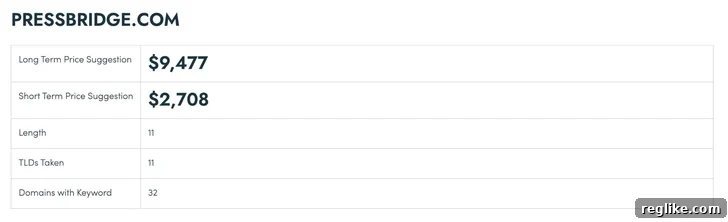
The appraisal reports include the suggested price, the domain’s length, how many top-level domains the second-level name is registered under, and the total number of domains containing the keyword. For testing, I focused on Graen’s long-term price suggestions.
Two-word brandables
I tested two representative two-word brandable .coms: MakeMatter.com, which sold for $15,000, and PressBridge.com, which sold for $5,000. Both fall within the typical market range for two-dictionary-word brandables—roughly $3,000–$15,000—though individual sales can fetch much higher prices.
Graen valued MakeMatter.com at $3,615 and PressBridge.com at $9,477. Those estimates land inside the reasonable range for this domain type and aren’t objectionable. When I tried an unregistered test domain, CloudToaster.com, the tool returned an error, likely because it could not retrieve registration counts across TLDs.
One-word, high-value .coms
The tool struggles at the very high end. Graen appraised Dragonfly.com at $180,000, which is markedly below comparable market sales. Midnight.com, which sold this year for $1.15 million, received a Graen valuation of $176,233. Even Money.com was appraised at under $700,000. These examples show the tool does not reliably capture top-tier one-word .com values.
Popular ccTLDs
I tested a strong one-word .io and a plural .ai of lesser quality. expedite.io, which sold for $14,995, was appraised at $8,258 long term. kickers.ai, which sold for $8,000, received a Graen valuation of $8,235. Many .io and .ai values clustered within a narrow band; for instance, chat.ai was appraised at under $100,000, demonstrating conservative estimates in this sector.
Exact-match descriptive domains
Graen appraised WaterFilters.com at $41,340, a value consistent with several other appraisal tools. Although a seller might list that domain for $3.5 million, asking prices often diverge from realistic market expectations. Exact-match descriptive domains still hold value for large e-commerce markets, but their valuations vary widely depending on buyer demand.
Three- and four-letter domains
Short, brandable letter combinations are highly liquid and often command premium prices. I tested a pronounceable CVCV four-letter .com, dujo.com, listed on Afternic for $36,000; Graen returned $54,038, a relatively high estimate. For a less pronounceable four-letter .com, MOTG.com—sold for $14,888—was appraised at $30,207, again on the high side.
For the three-letter test VJN.com, listed at $39,000 on Afternic, Graen produced a long-term valuation of $90,965 and suggested a short-term listing price near $26,000, which seems more realistic for a lower-tier three-letter combination where letter quality reduces value.
New gTLDs
New top-level domains generally lack robust sales history, making automated appraisal difficult. voicemail.app, sold for $5,000, was appraised at $7,217. timber.homes, sold for $2,899, received a Graen valuation of $17,142—an unexpectedly high number for a .homes domain. NameBio records only a small sample of .homes sales with much lower top values, so Graen’s estimate in this case appears speculative.
Final analysis
Overall, Graen’s appraisal tool produces a mix of reasonable and inconsistent results. It performs acceptably on mid-market two-word brandables and some ccTLDs, but it struggles with top-tier one-word .coms, certain short letter domains, and many new gTLDs where sales data are sparse. Graen does not offer clear advantages over other appraisal services, and its inconsistent top-end estimates make it difficult to recommend the tool as a definitive valuation source for high-value domain decisions.