
The Alarming Reality: Why Domain Sellers Are Facing Payout Delays and Financial Stress
The Growing Crisis: Domain Sale Payouts Hanging in Limbo
In the dynamic world of domain investing and digital asset sales, trust is paramount. Sellers entrust their valuable digital real estate to platforms, expecting efficient transactions and timely payouts. However, a concerning trend has emerged, casting a shadow of uncertainty over the industry. Numerous domain owners are reporting significant delays and outright non-payment of funds due from prominent platforms, leading to immense financial and emotional distress.
One company frequently mentioned in these discussions is Epik, a well-known name in the domain registration and marketplace sphere. Stories have surfaced from multiple individuals who have completed domain sales through Epik but are now facing agonizing waits for their promised proceeds. These aren’t just minor delays; for many, these funds represent crucial financial milestones, retirement savings, or essential income. The emotional toll is palpable, with many expressing deep anxiety and fear that their hard-earned money may never materialize.
The core issue revolves around the integrity of payment processing within these platforms. When a seller successfully closes a deal, the expectation is a swift and transparent transfer of funds. Any deviation from this fundamental principle erodes trust, not only in the specific platform but potentially across the entire domain aftermarket industry. This article delves into a specific case that highlights these growing concerns, offering a closer look at the mechanisms and implications of such payout delays.
Kathleen Kalaf’s Ordeal: A Retirement Dream Deferred
Among the distressed voices, the story of Kathleen Kalaf stands out as a stark illustration of the current predicament. In a recent video shared on YouTube, a visibly shaken Kalaf bravely detailed her harrowing experience, revealing the profound impact these delays have had on her well-being. She spoke of feeling “sick to her stomach” and struggling with sleepless nights, symptoms of the intense stress brought on by financial uncertainty and the fear of losing her rightful funds.
Kathleen’s situation is particularly poignant: she successfully sold a valuable domain through Epik for a substantial sum of $100,000 on September 27. After deducting standard platform fees, she was expecting to receive $91,000. For Kathleen, this significant amount was earmarked for her retirement – a culmination of years of hard work and strategic investment in digital assets. Her retirement plans, which should have been secured by this sale, are now in an indefinite holding pattern, leaving her future in jeopardy and causing immense personal hardship.
The anticipation of receiving such a significant sum, especially for something as critical as retirement, can be a source of immense relief and excitement. To have that expectation shattered by prolonged delays, without clear communication or resolution, transforms that relief into crushing anxiety. Kathleen’s experience is not just about a delayed payment; it’s about the disruption of a carefully planned future and the emotional burden of fighting for what is rightfully hers.
Driven by frustration and a desperate need for resolution, Kalaf also posted a detailed review on TrustPilot, a widely recognized platform for customer feedback. Her review aimed to alert others to the payment issues she was experiencing and to seek a transparent and actionable response from Epik regarding her outstanding funds.
Epik’s Controversial Response: Shifting Blame or Revealing a Flaw?
Epik’s response to Kathleen Kalaf’s TrustPilot review has only added fuel to the fire of customer dissatisfaction and raised significant questions about accountability. Instead of directly addressing the delay in her payment, Epik suggested that Kathleen’s review was misdirected:
Hello Kathleen – Masterbucks is who you are reviewing here, not Epik. Please remove and place your review on the appropriate TrustPilot account. https://www.trustpilot.com/review/masterbucks.com You have been paid out to your Masterbucks by Epik which is where the transaction took place. Epik is not holding your funds, you were paid out. You are currently waiting on Masterbucks to process your cashout. Masterbucks is working on processing cashouts daily. Thank you.
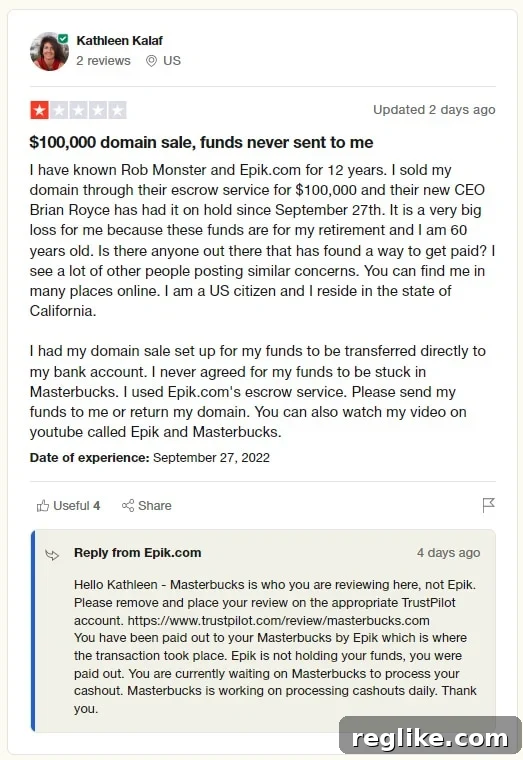
This response from Epik attempts to absolve itself of direct responsibility by redirecting the blame to “Masterbucks.” The implication is that Epik has fulfilled its obligation by transferring funds to Masterbucks, and any subsequent delay lies with this separate entity. However, for a seller like Kathleen, who conducted her transaction directly with Epik and through Epik’s platform, this explanation feels like a deflection. When a customer uses a platform like Epik to sell a domain, they expect the platform to handle the entire payment process seamlessly, regardless of any internal or external payment processors involved. The distinction between Epik and Masterbucks, if Masterbucks is presented as a payment gateway for Epik’s services, is often blurred from a user’s perspective, especially if it’s implicitly part of the Epik ecosystem or a wholly-owned subsidiary.
The suggestion that Kathleen should remove her review from Epik’s page and repost it on Masterbucks’ page further complicates matters. It creates an impression of avoiding negative feedback on their primary platform rather than transparently addressing the core issue of a delayed payout. This approach can erode customer trust, as it implies a lack of direct accountability for the end-to-end transaction experience that a seller expects from the platform they engaged with. For a customer, Epik is the vendor, and they are responsible for ensuring the full transaction, including payout, is completed as promised.
The Masterbucks Mystery: A System “Down for Maintenance”
The narrative surrounding Masterbucks becomes even more problematic when considering the critical timeline of events. It’s crucial to note that Kathleen Kalaf initiated and completed her domain transaction with Epik *after* Masterbucks had reportedly gone “down for maintenance.” This detail is critical because it suggests that Epik was fully aware of the operational issues with its primary payment processing channel (Masterbucks) at the time it accepted Kalaf’s domain sale and the buyer’s funds.
The decision to proceed with transactions and accept substantial funds while knowing that the payout mechanism was compromised “strains credulity,” as was noted in a recent podcast discussion concerning this situation. How could a reputable company accept a significant payment for a customer’s asset, promise a payout, and then later claim the delay is due to a system that was already acknowledged as being non-operational or experiencing severe issues? This raises serious ethical questions about business practices, transparency, and the duty of care owed to customers.
One plausible, albeit deeply concerning, interpretation is that by accepting Kalaf’s transaction and the buyer’s cash under these circumstances, Epik might have been using newly acquired funds to manage existing liabilities or to pay off other creditors. In essence, this could mean placing new sellers like Kathleen Kalaf at the back of an already long line, effectively using her funds to temporarily prop up a struggling payout system. Such a practice would not only be deeply unfair and potentially exploitative but could also indicate severe underlying financial instability, jeopardizing the funds of countless domain investors who trust the platform with their assets and proceeds.
The core expectation of any marketplace or registrar is to act as a trustworthy intermediary, safeguarding both the seller’s asset and the buyer’s payment. When a company accepts funds knowing it cannot promptly disburse them to the rightful owner due to internal system failures, it fundamentally breaches this trust. This situation forces sellers into an involuntary loan scenario, where their retirement funds or critical investments are held hostage without consent or compensation for the delay, adding insult to injury for those relying on these payouts.
Protecting Your Assets: Navigating the Domain Investment Landscape
The incidents surrounding Epik and Masterbucks serve as a stark reminder of the inherent risks in the digital asset market, particularly when dealing with large transactions. For domain investors and sellers, protecting investments goes beyond simply finding valuable domains; it extends to rigorously vetting the platforms used for transactions and understanding the potential pitfalls.
Essential Due Diligence for Domain Sellers:
- Research Reputation Thoroughly: Before engaging with any registrar or marketplace, conduct extensive research into their track record. Look for independent reviews on platforms like TrustPilot, but also search community forums, industry news, and social media for any red flags concerning payouts, customer service, or financial stability.
- Understand Payment Terms and Conditions: Scrutinize the fine print related to payouts. Understand the exact timelines for disbursements, available payment methods, and any potential fees, holding periods, or conditions that might delay your access to funds. Be particularly wary of overly complex, vague, or frequently changing payout policies.
- Diversify Your Platform Usage: While challenging for very large, singular domain sales, where possible, avoid relying solely on one platform for all your transactions. Diversifying your holdings and sales channels can mitigate risk if one platform encounters issues.
- Maintain Comprehensive Communication Records: Document every piece of correspondence, all transaction details, and any promises or guarantees made by the platform. This robust evidence can be absolutely crucial in case of disputes or legal challenges.
- Engage with the Community: Stay connected with the broader domain investor and developer community. Alerts and shared experiences from peers can provide invaluable early warnings about potential issues with specific platforms or emerging industry trends.
The digital economy thrives on trust and efficiency. When payment systems fail, and companies appear to deflect responsibility rather than resolve issues, the entire ecosystem suffers. For individuals like Kathleen Kalaf, the consequences are immediate and devastating, impacting their financial security, mental well-being, and future plans. The domain industry, often lauded for its innovative spirit and potential for wealth creation, must uphold the highest standards of transparency and accountability to protect its participants and foster a healthy, trustworthy environment.
Ultimately, a seller’s fundamental right to receive their earned funds promptly and without undue stress is non-negotiable. Companies facilitating these transactions bear a profound responsibility to ensure the integrity of the payout process, especially when those funds are critical to their customers’ futures, such as retirement savings or essential investments. The domain community must continue to advocate for stronger protections and greater transparency from the platforms they rely upon.