
Navigating the Labyrinth: The Complex .Car/.Cars TLD Contention and ICANN’s Uncharted Waters
The dawn of new generic Top-Level Domains (gTLDs) promised a more diverse and competitive internet landscape. However, alongside innovation, the program has inevitably brought forth complex disputes, particularly concerning string similarity and contention sets. One of the most intricate and closely watched cases involves the applications for .car and .cars, a scenario that has thrust ICANN into uncharted territory regarding its contention resolution mechanisms. At the heart of this intricate web is DERcars, an applicant for the .cars TLD, whose recent reconsideration request to ICANN’s board has highlighted the profound ambiguities in resolving highly entangled contention sets.

This particular dispute, which has unfolded over several weeks, underscores the challenges inherent in a program designed to manage thousands of new domain applications. The core issue revolves around Google’s successful string confusion objection against DERcars’ .cars application, a victory that has inadvertently created a multi-faceted contention set demanding a meticulously designed, yet currently undefined, resolution pathway from ICANN. While some observers initially believed ICANN would be immediately compelled to intervene, the reality might allow for a “wait-and-see” approach. Nevertheless, the situation remains undeniably sticky, casting a long shadow of uncertainty over all involved parties and potentially setting precedents for future gTLD disputes.
The Genesis of Contention: Understanding the .Car/.Cars Applications
The saga began with multiple applications for domain names related to the automotive industry. Specifically, Google submitted an application for the singular .car TLD. Simultaneously, three other significant players – DERcars, Donuts, and Uniregistry – each applied for the plural .cars TLD. This immediate overlap, though seemingly minor, laid the groundwork for a substantial conflict, as string similarity became a central point of contention in ICANN’s evaluation process. The potential for user confusion between a singular and plural version of a highly similar and intuitive gTLD was a key concern that ICANN’s objection processes were designed to address.
Google, asserting potential string confusion, subsequently filed objections against each of the .cars applications. These objections were designed to protect Google’s potential investment in .car by preventing highly similar strings from operating in a way that might dilute its brand or confuse internet users. The outcomes of these objections, however, were not uniform, leading to the current state of complexity.
Uneven Outcomes: The String Confusion Objections
The results of Google’s string confusion objections played out in a mixed fashion, creating a lopsided scenario that is now vexing ICANN. Google’s objections against Donuts and Uniregistry for their respective .cars applications were ultimately unsuccessful. This meant that Donuts and Uniregistry were cleared to proceed with their .cars applications, subject to standard contention resolution processes amongst themselves and any other remaining .cars applicants.
However, the outcome was different for DERcars. Fortuitously for Google, or perhaps due to the specific interpretation of the appointed panelist, Google succeeded in its string confusion objection against DERcars’ .cars application. This crucial distinction effectively placed DERcars’ .cars application in a direct contention set with Google’s .car application. The success of Google’s objection against DERcars, while simultaneously failing against Donuts and Uniregistry, is the pivot around which this entire complex contention set revolves. It introduces a unique layer of interdependency that challenges the standard frameworks for resolving multiple applications for similar domain names.
Deconstructing the Contention Set: Direct vs. Indirect Rivalries
The immediate consequence of these objection outcomes is the formation of an exceptionally convoluted contention set involving all four applicants: Google (.car), DERcars (.cars), Donuts (.cars), and Uniregistry (.cars). This is not a simple direct competition between two parties; rather, it’s a multi-layered dispute with both direct and indirect contention elements. Understanding these relationships is critical to grasping the full scope of the challenge.
As a result of the successful string confusion objection, DERcars’ .cars application is now directly linked with Google’s .car application. This means that, according to ICANN’s established rulebook for new gTLDs, these two must somehow resolve their contention. Simultaneously, DERcars is also in direct contention with both Donuts and Uniregistry, as all three applied for the identical .cars string. The intertwining nature of these disputes means that Donuts and Uniregistry, while not directly opposed to Google’s .car application, are now indirectly in contention with it through DERcars. This triangular relationship effectively pulls all four applications into a single, overarching contention set.
To visualize this intricate network of relationships, consider the following graphic:
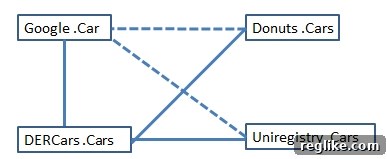
In this diagram, the solid lines depict direct contention, where applicants are vying for the exact same or directly objected-to string. The dashed lines, conversely, illustrate indirect contention, showing how the fate of one application (DERcars’ .cars) impacts the others, even without a direct dispute between them. This graphic clearly illustrates that the resolution of DERcars’ application is paramount, as it serves as the linchpin holding this entire, multi-party contention set together. Until DERcars’ position is definitively resolved, all four applications are effectively stalled within this shared contention pool, unable to proceed independently.
The Central Conundrum: How Will Resolution Work?
The primary challenge stemming from this unique contention set is the question of how it will be resolved. ICANN’s existing rulebook, while robust in many aspects, appears to have not fully anticipated or detailed mechanisms for a scenario of this specific complexity. Numerous applicants and industry participants, engaged in discussions and seeking clarity, hold diverse opinions on potential resolution pathways, highlighting the widespread uncertainty. As DERcars aptly points out in its reconsideration request, the current interpretation of the rules suggests that DERcars might be compelled to compete in not one, but two separate contention set auctions—a prospect that is both unprecedented and logistically daunting.
This situation casts significant doubt and potential complications for all parties involved in the .car/.cars applications. Consider the position of Donuts and Uniregistry: Should they proceed with resolving their direct contention for .cars now, only to potentially face another round of contention resolution with DERcars if DERcars manages to overcome Google’s objection? This scenario introduces layers of strategic risk and financial uncertainty that are not typically present in more straightforward contention sets. The lack of a clear framework makes it nearly impossible for applicants to plan their next steps, invest resources, or even estimate the ultimate cost of acquiring these highly desirable TLDs.
Unpacking Auction Scenarios: A Web of Unanswered Questions
The standard method for resolving contention sets when applicants cannot reach a private agreement is through an auction of last resort, administered by ICANN. However, in this convoluted .car/.cars scenario, the mechanics of such an auction are anything but clear. The specific questions raised by DERcars and echoed by the wider industry underscore the novelty and complexity of this situation:
- Dual Auctions for DERcars? If DERcars must resolve its contention with Google separately from its contention with Donuts and Uniregistry, which auction would take precedence? Could it be forced into two distinct, potentially costly, and emotionally draining auction processes?
- Sequential or Simultaneous? Would one auction precede the other? If so, which one, and on what basis would that decision be made? The outcome of one auction could significantly alter the strategic landscape for the other, raising questions of fairness and strategic disadvantage. Alternatively, could some form of simultaneous auction be devised to handle all four parties at once? The practicalities of such an event, especially with differing strings (.car vs .cars), are immense.
- Fairness and Precedent: How would an auction of last resort truly work to ensure fairness for all applicants, given the indirect contention and the differing objection outcomes? The decisions made here could set critical precedents for future gTLD rounds and other complex contention sets, making ICANN’s approach highly scrutinized.
It’s clear that this situation is far from simple. ICANN, while having a general framework for auctions, has not yet spelled out the granular details for such an intricately linked scenario. Informal inquiries within the industry suggest that the full ramifications of this exact configuration were likely not thoroughly considered during the initial design of the new gTLD program’s contention resolution policies. This gap in the rulebook places a significant burden on ICANN to innovate a fair and transparent solution.
Potential Paths Forward: Speculation and ICANN’s Dilemma
Given the complexities, various speculative solutions and considerations for ICANN’s next steps have emerged:
Simplification through Withdrawal or Private Agreement
One way the problem might simplify itself is if one or more parties decide to withdraw their application. Perhaps DERcars, facing the daunting prospect of multiple auctions and significant uncertainty, might decide that the battle is too costly or too risky to continue against a formidable opponent like Google. Alternatively, a private settlement could emerge. Donuts and Uniregistry, keen to resolve their own contention for .cars, might enter into a private auction where a portion of the proceeds is offered to DERcars to incentivize its exit from the race. Such private agreements are a common and often preferred method for resolving contention, as they bypass the public auction process and allow parties to control their own destiny.
ICANN’s “Wait and See” Approach
Another strong possibility is that ICANN adopts a “wait and see” strategy. Given the unprecedented nature of this specific contention set, ICANN might defer making a definitive ruling on the auction mechanism, hoping that the parties involved can reach a private settlement. If the situation resolves itself through applicant-driven negotiations or withdrawals, ICANN’s task of designing a bespoke auction process would be considerably eased, or even rendered unnecessary. However, this approach carries its own risks, primarily extending the period of uncertainty for all applicants and potentially delaying the launch of these highly anticipated gTLDs.
The Broader Implications for gTLD Program Integrity
The resolution of the .car/.cars contention is not just a matter for the involved applicants; it carries significant implications for the credibility and future of ICANN’s new gTLD program. A fair, transparent, and timely resolution process is crucial to maintain confidence among potential applicants for future gTLD rounds. If the process is perceived as arbitrary, excessively complex, or unfair, it could deter participation and undermine the program’s objectives of fostering innovation and competition in the domain name space.
Moreover, the case highlights the need for ICANN to continually refine its policies and procedures. As the new gTLD program matures, unique challenges like the .car/.cars contention will inevitably arise. Learning from these complex cases is essential for ICANN to strengthen its rulebook and prepare for similar scenarios in the future, ensuring that the next rounds of gTLD applications can navigate the contention resolution process with greater clarity and predictability.
Conclusion: A Precedent-Setting Challenge
The .car/.cars contention set stands as a testament to the intricate challenges inherent in expanding the internet’s naming system. What began as seemingly straightforward applications for automotive-related Top-Level Domains has evolved into a multi-layered dispute, primarily due to the nuanced outcomes of string confusion objections. DERcars’ predicament, caught between direct contention with Google and simultaneous rivalry with Donuts and Uniregistry, illuminates a gap in ICANN’s existing resolution mechanisms.
For now, the situation remains rather messy. The industry, and certainly the applicants, are keenly awaiting ICANN’s guidance on how this unprecedented contention set will ultimately be resolved. Whether through innovative auction designs, strategic private settlements, or a patient “wait and see” approach, the solution to the .car/.cars dilemma will undoubtedly set a significant precedent for the future of new gTLDs and ICANN’s role as the arbiter of the internet’s naming architecture.