
AI-powered domain appraisal system claims to be based on 20 years of auction data, but doesn’t show its work.
This review is part of a series comparing automated domain appraisal tools.
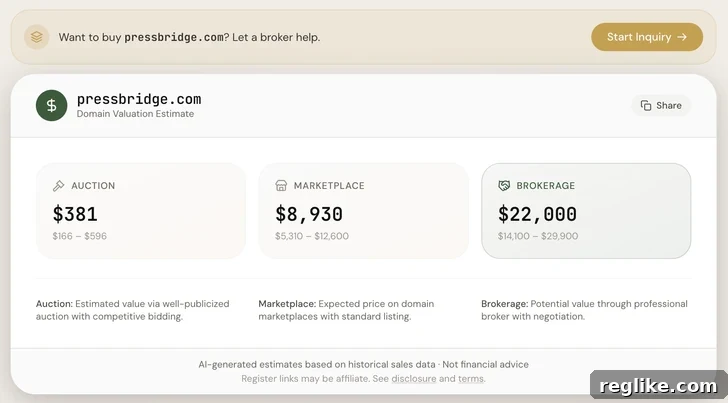
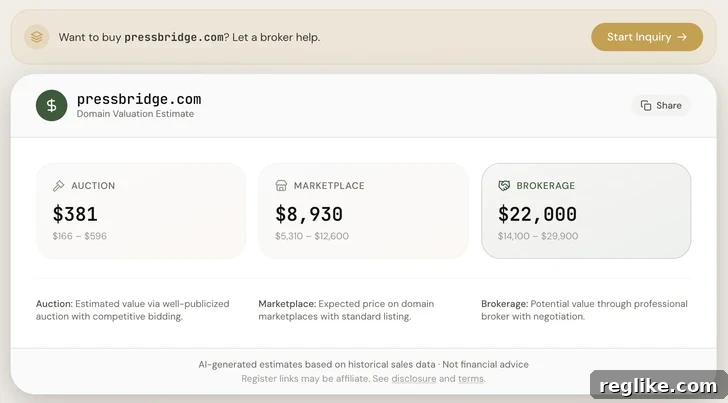
Humbleworth is a lesser-known appraisal service that uses AI to produce three separate valuations for each domain: an auction price, a marketplace price, and a brokerage price. Each price is presented with a range. The service claims its values are derived from more than 20 years of auction sales data, but it provides no visible supporting comparables or methodology. For this review, I focused on the mid-range “marketplace” valuation to gauge how Humbleworth compares to real-world sales and other appraisal tools.
Two-word brandables
Two dictionary-word brandable .coms typically fall in a broad sweet spot. For this category I tested MakeMatter.com, which sold for $15,000, and PressBridge.com, which sold for $5,000. Across the market, similar two-word brandables often trade between roughly $3,000 and $15,000 depending on buyer fit and timing, so appraisals in that band are generally reasonable.
Humbleworth valued MakeMatter.com at $2,260 and PressBridge.com at $8,930. Those estimates are within a plausible range for this class of domains, although MakeMatter’s valuation is on the low side compared with other appraisal platforms. Curiously, Humbleworth’s auction estimate for MakeMatter.com was just $55, despite a recorded GoDaddy auction purchase at $847. On a related check, Humbleworth correctly gave an unregistered domain like CloudToaster.com a low value of $141, so the tool did not overly inflate unregistered names in this test.
One-word, high-value .com
Valuing premium one-word .coms is notoriously difficult and appraisal systems often diverge widely. Humbleworth’s estimates reflected that volatility. It put Dragonfly.com at a marketplace price of $77,200, a figure well below what many market participants would consider the wholesale value. At the same time, it valued Firefly.com at $138,000, which is closer in range but still inconsistent relative to comparable market activity. For Midnight.com, which sold this year for $1.15 million, Humbleworth returned $3.25 million—an aggressive outlier on the high side. These results show that Humbleworth can swing significantly on higher-end domains; appraisal tools should be cautious about asserting precise values for such assets.
Popular ccTLDs (.io, .ai)
Country-code and newer ccTLDs like .io and .ai present different valuation dynamics and limited comparable sales. I tested expedite.io (sold for $14,995) and Humbleworth appraised it at $692. I also tested kickers.ai (sold for $8,000) and Humbleworth returned $394. In another check, a .io domain bought in a SAV auction for $548 was appraised at $988. Overall, Humbleworth’s valuations for .io and .ai domains were far below known sale prices in some cases, so I would not rely on Humbleworth as a primary valuation source for these extensions.
Exact-match descriptive domains
Exact-match, category-defining names tend to command higher, more predictable values when they match buyer intent. WaterFilters.com, listed publicly for $3.5 million, was appraised by most tools in the review for far less than that asking price. Humbleworth’s marketplace estimate for WaterFilters.com was $263,000, which was the second-highest appraisal among the systems tested. That figure is significantly lower than the listed asking price but aligns more closely with many appraisal outputs that avoid echoing optimistic seller expectations.
Three- and four-letter domains
Short letter domains are among the most liquid assets in the domain market. I tested a pronounceable four-letter CVCV .com, dujo.com, listed on Afternic for $36,000. Humbleworth valued it at $27,200, recognizing its pronounceability and brand potential. For a four-letter non-pronounceable example, MOTG.com, which sold for $14,888, Humbleworth appraised it at $22,360. Humbleworth ranked dujo.com higher than MOTG.com, which is appropriate given pronounceability and branding advantages.
For a three-letter .com, VJN.com (listed at $39,000) was appraised at $46,400—again reasonably close to asking prices given letter quality and market expectations. These results suggest Humbleworth can produce sensible relative valuations in the short-letter segment, though absolute numbers can vary.
New gTLDs
New top-level domains lack robust sales histories, which makes automated valuation challenging. Examples here were voicemail.app, sold for $5,000 and appraised at $1,110 by Humbleworth, and timber.homes, sold for $2,899 and appraised at $3,240. These mixed results reflect the inherent uncertainty around new TLD pricing: comparables are sparse and buyer demand can be niche-specific.
Final analysis
Humbleworth produces a range of outputs and can provide quick bulk appraisals—up to 2,000 domains at a time—which can be useful for portfolio overviews or as a second opinion. However, the service suffers from a crucial shortcoming: it claims its valuations are based on historical auction data yet provides no supporting comparables or explanations for individual estimates. For a platform that publishes three different price tiers (auction, marketplace, brokerage), showing sample comps or the auction trades that inform the auction estimate would materially improve credibility.
Without visible comps or methodological transparency, users must take Humbleworth’s figures on trust. That lack of backup is especially important for a standalone tool not backed by a major marketplace or registrar. In summary, Humbleworth can produce plausible ranges in many cases, and it handles short-letter and some brandable names reasonably well, but its opaque methodology and weak performance on some ccTLDs and high-end .coms limit its reliability as a single authoritative valuation source.