

The Unseen Potential: Why Hyphenated Domain Names Deserve Your Attention
In the vast and ever-evolving landscape of the internet, domain names serve as the digital storefronts and identities for businesses and individuals alike. While the prevailing wisdom often champions short, memorable, and non-hyphenated .com domains, a closer look reveals a strategic niche where hyphenated domain names not only make sense but can offer significant advantages. This article delves into the often-misunderstood world of domains with hyphens, exploring their utility, market dynamics, and potential for astute investors and businesses.
It’s important to preface this discussion by acknowledging the consensus: for most general purposes, particularly for branding and ease of recall, non-hyphenated .com domains remain the gold standard. They are simpler to communicate, easier to remember, and generally perform better on the “radio test”—the ability to be understood when heard aloud. My personal portfolio, like many others, overwhelmingly favors these pristine, hyphen-free assets. However, dismissing hyphenated domains entirely would mean overlooking a valuable segment of the domain market, one ripe with opportunities in specific circumstances.
Rethinking Domain Name Conventions: When Hyphens Make Sense
Approximately one percent of my domain portfolio judiciously includes domains with hyphens. The majority of these are geo-service .com domains, following a clear “City-Service” format (e.g., Austin-Foreclosures.com). This specific application highlights one of the key strengths of hyphenated domains: clarity and descriptiveness. When the desired non-hyphenated version is unavailable, a hyphen can bridge the gap, making a domain name instantly understandable and relevant to its target audience.
The inspiration for this deep dive into hyphenated domains stemmed from a real-world encounter. While perusing the latest print edition of the Austin Chronicle, I noticed an advertisement for an Austin-based blade company prominently featuring their domain name: Austin-Blades.com. This example perfectly illustrates a pragmatic and effective use of a hyphenated domain. In such cases, where the exact, non-hyphenated match is likely taken or prohibitively expensive, a hyphenated alternative provides a clear, concise, and geographically relevant online identity.
While Austin-Blades.com might not flawlessly pass the traditional radio test, its context in a print ad, particularly a local publication, mitigates this concern. In situations where a domain is visually presented—on a billboard, in a magazine, or a business card—hyphens can actually enhance legibility. Imagine seeing a long, compounded word on a highway billboard at 70 mph; a hyphen can act as a visual separator, breaking down the domain into easily digestible components and improving comprehension in fleeting moments.
Protecting Your Brand: A Strategic Approach to Hyphenated Domains
For businesses utilizing a hyphenated domain, a comprehensive brand protection strategy is paramount. Just as a company would secure various spellings or related phrases, it’s wise to consider securing variations of a hyphenated domain. For the aforementioned Austin-Blades.com, I would strongly recommend owning the following domains to safeguard their brand identity and prevent potential cybersquatting or user confusion:
- Austin-Blade.com (singular form)
- ATXBlade.com (common local abbreviation, non-hyphenated)
- ATXBlades.com (common local abbreviation, non-hyphenated)
- ATX-Blade.com (common local abbreviation, hyphenated, singular)
- ATX-Blades.com (common local abbreviation, hyphenated, plural)
This multi-faceted approach ensures that all reasonable avenues a customer might use to find the business are covered, channeling traffic directly to the intended destination and protecting the brand from competitors or malicious actors.
A Global Perspective: Hyphenated Domains Beyond .com
Beyond the practicalities of brand protection and legibility, hyphenated domains also present an intriguing opportunity in terms of affordability and availability. While premium, non-hyphenated .com domains are often scarce and command high prices, their hyphenated counterparts frequently offer a more accessible entry point into the domain market. This affordability is particularly appealing to startups and small businesses operating on tighter budgets, allowing them to establish a descriptive online presence without significant upfront investment.
It’s true that many US-based businesses and domain investors tend to shy away from hyphens. However, this perspective is not universally shared. A growing segment of businesses and investors, both domestically and internationally, are strategically building their digital presence by focusing on hyphenated domains. This is especially true in niche markets where precise keyword matching and clarity are prioritized over brevity.
Internationally, the landscape shifts further. Coveted, non-hyphenated domains are often readily available for hand registration, particularly within country code Top-Level Domains (ccTLDs). These domains, ending in two-character country codes (e.g., Grapes-Goose.de, where “de” signifies Germany), often reflect different naming conventions and preferences. Germans, for instance, have a notable affinity for hyphenated domains, which can be attributed to linguistic structures and a cultural emphasis on precision. This makes ccTLDs a fertile ground for exploring hyphenated domain opportunities that might not exist in the crowded .com space.
Unearthing Value: Market Insights from Hyphenated Domain Sales
To quantify the market for hyphenated domains, a search was conducted on NameBio, a prominent domain sales database. Out of approximately 1.4 million recorded domain sales, a significant 17,746 hyphenated domains were reported as selling for $100 or more. This substantial dataset provides compelling evidence that a viable market exists for these often-underestimated assets.
The overall statistics for hyphenated domains reported to NameBio paint an interesting picture:
- Total Sales: 17.8k
- Total Dollar Volume: $22m
- Average Price: $1,240
- Standard Deviation: $3,428
- Low Price: $100
- High Price: $210K

These figures demonstrate that while the average price for a hyphenated domain may seem modest compared to premium non-hyphenated counterparts, the sheer volume of transactions and the impressive high sale price of $210,000 indicate significant underlying value and potential for high-profit sales. The relatively high standard deviation also suggests a wide range of values, hinting at certain niches or domain characteristics that command much higher prices.
Top Hyphenated Domain Sales and Their Implications
Delving deeper, NameBio’s top 10 reported sales for domains with hyphens offer further insights into market demand and profitable niches:
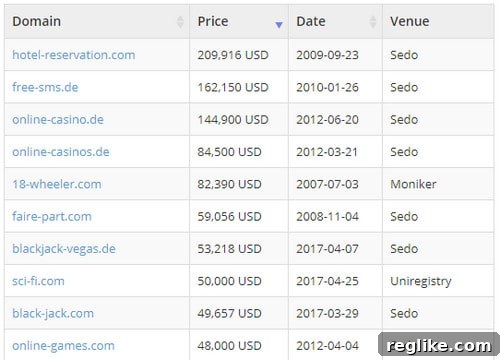
Several intriguing patterns emerge from this list. Firstly, the prominent presence of Sedo as the transaction platform is noteworthy. Sedo, being a German-based company, aligns with the observed German affinity for hyphenated domains, which likely contributes to their dominant position in these sales. Secondly, the significant number of domains in the gambling or casino space is striking. This suggests that in highly competitive and keyword-driven industries, hyphenated domains can be strategically valuable for descriptive purposes and targeting specific search queries, even if brand recall isn’t the absolute top priority. The sprinkling of .de domains among the .coms further reinforces the international appeal and specific market dynamics of hyphenated domains.
While this analysis represents only a fraction of overall domain sales, it serves as a robust and reasonable sample dataset for study. For domain investors seeking a more in-depth understanding, a NameBio Membership offers the capability to export and meticulously review this data, a resource I am seriously considering leveraging myself.
Recent Market Activity: Over $1,000 Sales
Observing recent sales exceeding $1,000 further illustrates ongoing market activity and the types of hyphenated domains currently attracting buyers:
- $6,591 – body-fit.com – 3/26/2019 – GoDaddy
- $4,455 – uni-corn.com – 3/20/2019 – Sedo
- $2,814 – blockchain-fonds.de – 3/26/2019 – GoDaddy
- $2,571 – i-u.nl – 3/21/2019 – Sedo
- $2,499 – o-ps.com – 3/19/2019 – Sedo
- $2,001 – thai-aec.com – 3/22/2019 – GoDaddy
- $1,838 – ot-hautefort.com – 3/18/2019 – DropCatch
- $1,400 – free-onlineclock.com – 3/27/2019 – GoDaddy
- $1,225 – plug-in.com – 3/20/2019 – NameJet
- $1,170 – grof-holotropic-breathwork.net – 3/23/2019 – GoDaddy
- $1,054 – heater-home.com – 3/22/2019 – DropCatch
- $1,025 – page-portal.com – 3/23/2019 – Godaddy
These examples showcase a diversity of niches, from fitness and technology to highly specific and even unusual terms, indicating that value can be found across various sectors. The consistent presence of GoDaddy, Sedo, DropCatch, and NameJet as registrars/marketplaces further solidifies the active nature of this market segment.
Weekly Average Price Trends
A look at the weekly average price graph for hyphenated domains provides a snapshot of short-term market fluctuations:
While the graph itself isn’t provided as a static image for analysis here, its existence points to the dynamic nature of these sales. Generally, weekly average prices for such domains tend to fluctuate, but often hover around a predictable “sweet spot.”
Strategic Investment: Identifying Opportunities in the Hyphenated Domain Market
While the aspiration to sell hyphenated domains for $5,000 or more is admirable, the NameBio data suggests that such high-value transactions, while possible, are less frequent. The observed “sweet spot” for hyphenated domains appears to hover around the $1,200 mark. This insight unlocks a potentially lucrative, albeit niche, investment strategy.
Savvy domain investors might consider scouring expired domain auctions for hyphenated domains in the $30-$120 range. The strategy involves acquiring these domains at a low cost, listing them on prominent aftermarket platforms like Sedo and Afternic, and aiming for a quick flip within the $1,000-$2,000 price bracket. This approach leverages the affordability of these domains as an acquisition and the existence of a consistent demand at a moderate price point.
It’s crucial to emphasize that I am not explicitly recommending this strategy to everyone. Any investment carries inherent risks, and the domain market is no exception. However, for those with a keen eye for market trends, a willingness to perform due diligence, and an understanding of domain valuation, this observed approach presents a viable pathway for investing in and potentially flipping hyphenated domains. Success in this area often relies on identifying domains with strong keywords, clear commercial intent, and relevance to specific industries or geographical areas.
Best Practices for Choosing and Utilizing Hyphenated Domains
For businesses or investors considering hyphenated domains, a few best practices can help maximize their value and effectiveness:
- Clarity Over Brevity: Use hyphens when they significantly improve the readability and understanding of a multi-word domain, especially for descriptive or niche-specific names.
- Targeted SEO: Hyphenated domains can sometimes offer an SEO advantage for highly specific, long-tail keywords, as search engines can more easily parse individual words. However, this effect is often marginal and should not be the sole decision factor.
- Brandability Check: While less brandable than their non-hyphenated counterparts, ensure the hyphenated domain still projects a professional image and aligns with your brand identity. Avoid excessive hyphens (more than two) as they can become cumbersome.
- Secure Variations: As discussed with Austin-Blades.com, always protect your primary hyphenated domain by securing key non-hyphenated and alternative spellings or abbreviations.
- Consider the Audience: If your target audience is international, particularly in regions where hyphenated domains are more common (e.g., Germany), they might be more readily accepted.
In conclusion, while non-hyphenated .com domains will likely always reign supreme for broad appeal and branding, ignoring hyphenated domain names means overlooking a significant segment of the digital landscape. They offer practical solutions for legibility, brand protection, affordability, and strategic investment, especially when direct matches are unavailable or in niche, keyword-driven, and international markets. The market data clearly demonstrates their inherent value and the potential for smart investors to carve out profitable opportunities. It’s time to view hyphenated domains not as a compromise, but as a strategic asset with untapped potential.
What has been your experience with buying and selling domains with hyphens? Share your insights and strategies below!