

My .XYZ Domain Was Blocklisted: A Deep Dive into Registry Suspensions and What I Learned
Imagine logging into your domain registrar account only to discover that a domain you legitimately own and intended to develop has been suspended. This was my recent experience with a .xyz domain I acquired a few months ago. It landed on a blocklist, bringing a swift halt to its online presence and raising questions about domain management, registry policies, and registrant notification processes.

The .xyz registry, despite its current robust efforts, has historically faced criticism. In its earlier days, the attractive pricing model of .xyz domains inadvertently made them appealing to nefarious actors, leading to a perception that they were frequently associated with spam, phishing, and other forms of online malfeasance. While the registry actively works to dispel this image and has implemented stringent anti-abuse measures, the legacy of this initial period can still impact legitimate domain owners. Today, .xyz boasts a sophisticated system designed to automatically suspend domains that trigger blocklist alerts, a critical step in maintaining a clean and secure internet environment.
However, even with the best intentions, such automated systems can have significant ramifications for legitimate registrants. My recent experience serves as a clear illustration of this.
The Unnerving Discovery: A Suspended Domain
The moment of truth arrived when I logged into my Namecheap account. A routine check turned into a startling discovery:
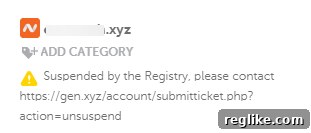 The alarming message prominently stated: “Suspended by the Registry, please contact (XYZ support URL).”
I had acquired this domain late last year with the intention of reselling it, and it was pointed to a simple “for sale” landing page. Crucially, I had no prior indication that my domain was suspended, let alone that it was completely unreachable. This lack of notification highlighted a significant gap in the communication chain. While registries are typically prohibited from contacting registrants directly due to contractual agreements with registrars, the onus falls on the registrar—in this case, Namecheap—to inform their customers of critical domain status changes. This oversight meant my domain was effectively offline, invisible, and potential sales opportunities were lost without my knowledge.
Navigating the Unblock Process: A Registrant’s Journey
Upon discovering the suspension, my immediate action was to follow the provided support URL and submit a ticket to the .xyz anti-abuse team. To my relief, the process was surprisingly efficient. Within two days, I received a clear explanation detailing precisely which blocklist my domain had appeared on, and, more importantly, the suspension was promptly lifted. This swift resolution, while reassuring, underscored the initial problem of delayed notification.
Seeking to understand the registry’s perspective and the broader implications of such suspensions, I reached out to Daniel Negari, CEO of XYZ. His comprehensive statement offered valuable insights into the registry’s proactive anti-abuse strategies and the complexities of domain management.
…if a registrant wants to contest a suspension, the XYZ Anti-Abuse Team has a form that can be filled out at gen.xyz/unsuspend. The process is relatively painless if the registrant follows all of the steps.
XYZ’s contracts with registrars prohibit us from reaching out to the registrants directly, so the registrars are responsible for contacting the registrant. We require registrars to provide reasonable customer support to registrants. We cooperate closely with our partners to ensure that there are no false positives. Our Anti-Abuse process includes a daily notice to our registrar partners that lists new suspensions of any XYZ TLDs under their management, as well as their previous suspensions.
Receiving a suspension notice may be the first time a registrant realizes their servers have been compromised for abusive activity. In many cases the registrant is not aware that their domain has been hacked and is being used to actively harm others, including their own customers. When they connect with us to unsuspend, they are relieved to find our Team mitigated the damage while they were unaware.
XYZ monitors for abuse with our in-house system and we also have an abuse feedback system that allows anyone to report abuse 24/7 at gen.xyz/abuse. If you look at Spamhaus’s “The World’s Most Abused TLDs” report, .xyz is generally ranked the same and often lower in percent of badness than most legacy TLDs https://www.spamhaus.org/statistics/tlds/.
There is a massive amount of abuse that occurs across the internet industry. Mitigation is very fragmented between individual company policies. ICANN’s requirements for a registry are simply that we monitor for abuse. However, XYZ is one of the most active registries against abuse. We do this because it is the right thing to do in two forms. One: good vs. evil. Where we have the policies to stop abuse, we will. Two: protect end users from cognitive bias. Our end users stand for being different, and different is not always easy. When your market share is less than 3 percent of the size of the establishment, you fight like hell to ensure you are doing everything you can to remove fear, uncertainty, and doubt to help pave the way for your end users’ success.
Organizations that have the means and the policies to take the abuse offline, like the XYZ Registry, gain no revenue in taking action, and yet we make efforts towards stopping it, because it is the right thing to do. It takes a village across the internet industries to continually work at stopping abuse online.
Dissecting the .XYZ Registry’s Stance on Abuse
Daniel Negari’s statement sheds considerable light on the multifaceted approach the .xyz registry takes to combat online abuse. It addresses the critical aspects of dispute resolution, registrar responsibility, registrant awareness, and the overarching philosophy behind their rigorous anti-abuse policies.
Contesting a Domain Suspension: The gen.xyz/unsuspend Portal
The existence of a dedicated form at gen.xyz/unsuspend for contesting suspensions is a crucial resource for affected registrants. Negari emphasizes that the process is “relatively painless” provided all steps are followed. This implies a clear, structured procedure, likely requiring proof of ownership, an explanation of the domain’s intended use, and possibly evidence that any abusive activity has been rectified or was a result of compromise. For registrants, knowing such a channel exists, and that it’s designed for efficiency, can significantly alleviate the stress of an unexpected suspension.
The Crucial Role of Registrars in Notification
A central point of contention in my experience was the lack of notification from my registrar, Namecheap. Negari’s statement clarifies the contractual framework: “XYZ’s contracts with registrars prohibit us from reaching out to the registrants directly, so the registrars are responsible for contacting the registrant.” This highlights a vital division of labor in the domain ecosystem. While registries handle the technical enforcement, registrars are the direct point of contact for registrants. XYZ actively supports this by sending daily notices of suspensions to their registrar partners, meaning Namecheap (and other registrars) are fully aware of any suspensions impacting domains under their management. This makes the silence from my registrar all the more concerning and underscores the importance for registrants to choose registrars known for proactive customer support and transparent communication regarding domain status changes.
Registrant Awareness and Server Compromise
Negari points out that a suspension notice can often be “the first time a registrant realizes their servers have been compromised for abusive activity.” This is a sobering reality. Many legitimate domain owners, especially those with less technical expertise, might be unaware that their website has been hacked and is being used for spamming, malware distribution, or phishing. This adds another layer of complexity to domain security. Registries like .xyz, by swiftly suspending such domains, often act as an unwitting “first responder,” mitigating further damage until the legitimate owner can regain control and clean up their compromised systems. The relief registrants feel when the XYZ Team has already “mitigated the damage while they were unaware” speaks volumes about the registry’s protective role.
Proactive Abuse Monitoring and Reporting
Beyond automated systems, XYZ maintains an in-house monitoring system and an accessible abuse feedback system at gen.xyz/abuse. This 24/7 reporting mechanism empowers the broader internet community to contribute to a safer online environment. Such transparency and accessibility are critical in combating the ever-evolving landscape of online threats.
Debunking the Myth: .XYZ and Abuse Statistics
One of the most compelling points in Negari’s statement addresses the persistent negative perception of .xyz domains. He cites Spamhaus’s “The World’s Most Abused TLDs” report, indicating that .xyz “is generally ranked the same and often lower in percent of badness than most legacy TLDs.” This statistic is crucial for legitimate .xyz domain owners and prospective buyers. It directly challenges the outdated notion that .xyz is inherently a “spammer’s paradise” and demonstrates the effectiveness of the registry’s anti-abuse efforts. This data-driven rebuttal is essential for rebuilding trust and encouraging the adoption of new TLDs like .xyz for legitimate purposes.
XYZ’s Philosophy: Beyond ICANN’s Minimums
Negari articulates a strong ethical stance regarding abuse mitigation. While ICANN’s requirements for registries merely mandate monitoring for abuse, XYZ goes significantly further, positioning itself as “one of the most active registries against abuse.” This commitment is driven by two core principles: “good vs. evil” and protecting “end users from cognitive bias.”
- Good vs. Evil: This reflects a fundamental commitment to ethical internet stewardship. Where the registry possesses the tools and policies to prevent abuse, they will deploy them. This proactive stance helps clean up the internet for everyone.
- Protecting End Users from Cognitive Bias: This point is particularly insightful. New TLDs, particularly those that gain early notoriety, often face an uphill battle against preconceived notions. .xyz, with its “less than 3 percent” market share compared to established TLDs, understands that every effort must be made to “remove fear, uncertainty, and doubt.” By aggressively fighting abuse, they pave the way for their end users to innovate and succeed without being unfairly judged by the TLD their domain uses.
The statement concludes with a powerful reminder that organizations like the XYZ Registry take action against abuse not for revenue, but because “it is the right thing to do.” It emphasizes the need for a collaborative “village” approach across the internet industry to continually combat online abuse.
Proactive Domain Management: Lessons Learned
My experience and Daniel Negari’s insights offer crucial takeaways for all domain owners, regardless of the TLD:
- Monitor Your Domains Actively: Don’t assume “no news is good news.” Regularly check your domain status through your registrar’s portal or via tools like WHOIS. Consider setting up uptime monitoring services for critical websites.
- Choose Your Registrar Wisely: Opt for registrars with a reputation for excellent customer support and clear communication. Inquire about their policies regarding domain suspensions and how they notify registrants.
- Understand Registry Policies: Familiarize yourself with the anti-abuse policies of the TLDs you use. Knowing the resources available (like gen.xyz/unsuspend and gen.xyz/abuse) can save valuable time if issues arise.
- Implement Strong Security Measures: Preventative measures are key. Use strong, unique passwords for your registrar and hosting accounts, enable two-factor authentication (2FA), keep your website software updated, and regularly back up your data. A compromised domain can quickly lead to blocklisting.
- Don’t Be Afraid of Newer TLDs: While some new TLDs faced initial challenges, many, like .xyz, have invested heavily in robust anti-abuse programs. Base your TLD choice on reputation, statistics (like those from Spamhaus), and the registry’s commitment to security, rather than outdated perceptions.
Conclusion: Vigilance and Collaboration are Key
My brief encounter with a blocklisted .xyz domain served as a powerful reminder of the dynamic and sometimes challenging landscape of internet domain ownership. While the experience of a sudden suspension was unwelcome, the efficient resolution process from the .xyz registry and the subsequent dialogue with their CEO highlighted their dedicated efforts to combat abuse and protect legitimate registrants.
Ultimately, securing the internet is a shared responsibility. Registries must maintain stringent anti-abuse policies, registrars must ensure transparent and timely communication with their customers, and registrants must remain vigilant, proactive, and informed about the status and security of their domains. By fostering this collaborative environment, we can collectively work towards a safer and more trustworthy online space for everyone.