
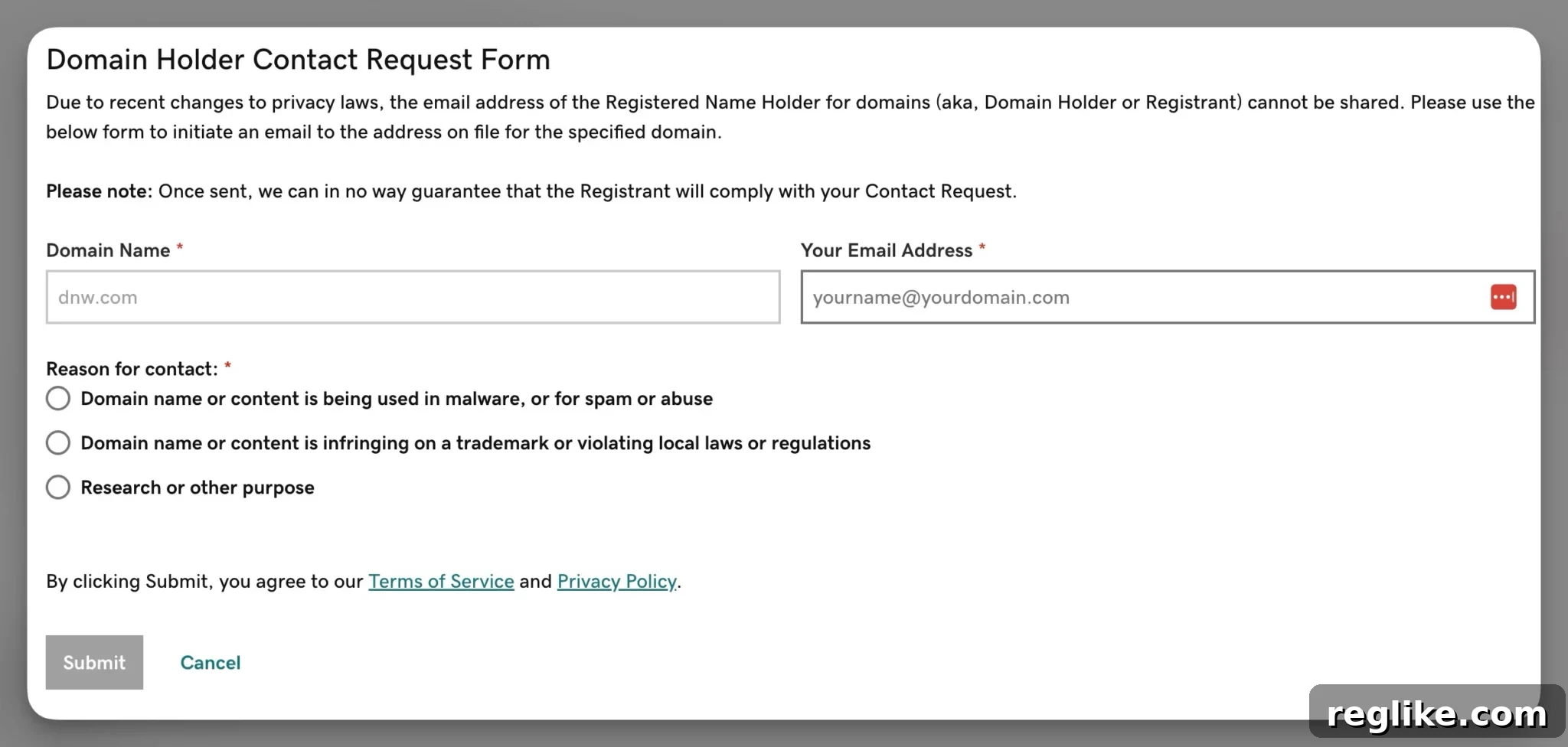
GoDaddy’s form doesn’t allow the submitter to enter their own text, and ICANN says this is acceptable.
ICANN published an advisory this week explaining how registrars must provide a means for third parties to contact domain registrants. The advisory clarifies expectations under the Registration Data Policy that took effect in August 2025, which requires registrars to collect and publish an email address for the registrant and, where applicable, the technical contact.
To protect registrant privacy, registrars commonly meet this requirement without exposing a direct email address. Two common approaches are used: providing an anonymized forwarding address or offering a web contact form. Both permit incoming messages to reach the domain owner without revealing the registrant’s real email address.
ICANN referenced a specific implementation used by an unnamed registrar in which a web form presents a list of pre-populated contact reasons. When a user selects one of those reasons, the selection is forwarded to the relevant contact along with the user’s email address. Because the submitter cannot add free-form text and must choose from predefined options, some observers questioned whether the form truly “facilitates email communication” as intended by the policy.
The registrar in question was not named in the advisory, but the implementation described is clearly GoDaddy’s. GoDaddy’s form offers three selectable options:
- Domain name or content is being used in malware, or for spam or abuse
- Domain name or content is infringing on a trademark or violating local laws or regulations
- Research or other purpose
After a selection is submitted, it is up to the registrant to determine whether and how to respond. ICANN concluded that a form using pre-populated reasons satisfies the contact requirement in the Registration Data Policy, even though it does not allow the submitter to compose a custom message.
One practical concern highlighted by industry observers is that GoDaddy’s form does not require submitters to verify the email address they provide. That means someone can submit the form while claiming to be another party, which raises questions about authenticity and potential misuse.
Domain investors and brokers have also requested that registrars add an explicit option to indicate that a contact is an inquiry to buy the domain. Such an option would help clarify intent for buyers and registrants and could streamline legitimate transactions, but ICANN’s advisory focuses narrowly on whether a selectable-reason form meets the minimum policy requirement for enabling contact.
In summary, ICANN’s advisory confirms that a web form offering predefined contact reasons and forwarding the submitter’s email to the registrant complies with the Registration Data Policy. The approach balances registrant privacy with the policy’s requirement to allow contact, though it leaves open practical concerns about verification and commercial inquiry handling that the industry continues to discuss.