
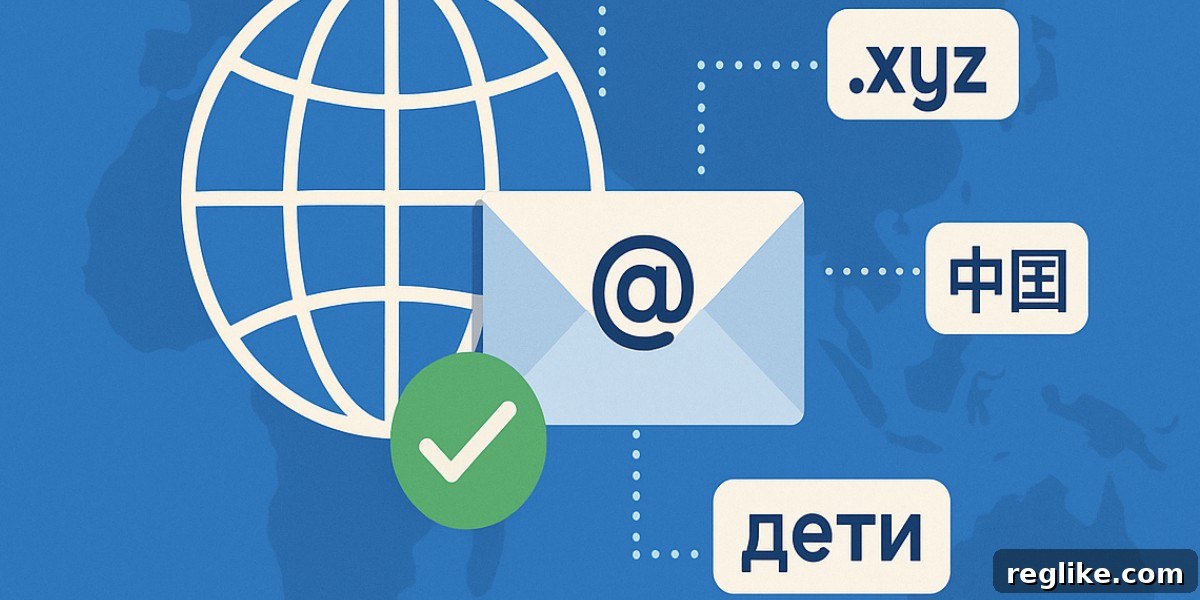
Universal Acceptance: ICANN’s Latest Stride Towards a Truly Inclusive Digital World

In an increasingly interconnected world, the dream of a truly global and inclusive internet hinges on a fundamental principle: Universal Acceptance (UA). This principle dictates that all valid domain names and email addresses, regardless of their script, length, or characters, should function seamlessly across all internet-enabled applications, devices, and systems. ICANN, the Internet Corporation for Assigned Names and Numbers, has long championed this cause, and its latest announcement marks another crucial advancement on this path.
More than a year after its internal staff gained the capability to send and receive emails from Internationalized Domain Names (IDNs), ICANN has taken a significant organizational step. The non-profit domain overseer recently announced that individuals with IDN email addresses can now confidently use them within their ICANN Account. The ICANN Account serves as the central portal through which individuals and organizations interact with ICANN’s diverse services and applications. This development underscores a deep commitment to ensuring that language and character sets do not become barriers to participation in the global digital ecosystem.
Understanding Universal Acceptance: The Foundation of a Global Internet
Universal Acceptance isn’t just a technical concept; it’s a cornerstone for digital inclusivity. At its core, UA means that every valid domain name and email address should be recognized, processed, and treated equally by all software applications. This includes not only the familiar ASCII-based domain names (those using ‘a-z’, ‘0-9’, and hyphens) but also the newer generic Top-Level Domains (gTLDs) that have expanded the internet’s namespace significantly, and critically, Internationalized Domain Names (IDNs).
IDNs allow people to use domain names in their local languages and scripts, such as Arabic, Chinese, Cyrillic, or Devanagari. For billions of internet users worldwide, IDNs represent a powerful tool for navigating the web in a more intuitive and culturally relevant way. However, the full potential of IDNs can only be realized if they are universally accepted. This encompasses several key aspects:
- Acceptance of All Valid Domain Names: Whether it’s a traditional .com, a new gTLD like .app or .xyz, or an IDN in any language, all should be recognized.
- Acceptance of All Valid Email Addresses: This extends beyond just the domain part; the local part (before the ‘@’ symbol) can also contain characters from different scripts.
- Correct Processing and Functionality: Applications should not just accept these names, but also process them correctly—from auto-linking on social media to being valid for account registrations and functioning flawlessly in email systems.
- Consistent Display: Domain names and email addresses should be displayed correctly across all platforms and devices, preventing garbled text or errors.
The Challenge and Significance of ICANN’s Step
The fact that it took ICANN, the very organization at the heart of internet governance, until last year to enable its own email system to work with IDNs, and another 18 months to extend this functionality to the ICANN Account, starkly highlights the pervasive challenge of Universal Acceptance. This isn’t a simple software update; it’s a complex, multi-layered issue that touches upon legacy systems, developer practices, and a lack of awareness across the digital landscape.
ICANN’s journey in integrating IDNs internally serves as a powerful testament to the hurdles that many organizations, small and large, still face. It underscores that even the most dedicated proponents of UA must navigate intricate technical infrastructures and historical limitations. However, by publicly demonstrating its own progress, ICANN not only shows commitment but also provides a tangible example for others to follow. When the internet’s central coordinating body embraces IDNs fully, it sends a clear signal to the rest of the ecosystem about the importance and feasibility of UA.
Why Universal Acceptance Is Critical for the Internet’s Future
The implications of full Universal Acceptance are profound and far-reaching, touching upon economic, social, and cultural aspects of the digital world.
Bridging the Digital Divide and Fostering Inclusivity
For billions, accessing the internet in a language other than their native tongue can be a significant barrier. IDNs allow users to interact with the internet in their own script, making it more accessible, intuitive, and comfortable. UA directly addresses the digital divide, ensuring that linguistic diversity on the internet is not just an ideal but a functional reality. It promotes inclusivity by allowing everyone, regardless of their linguistic background, to fully participate in the online world.
Unlocking Economic Opportunities
For businesses, UA opens up vast new markets. Companies can establish an online presence with domain names that resonate directly with local consumers, enhancing brand recognition and trust. This facilitates e-commerce, digital marketing, and service delivery in diverse linguistic communities, fostering economic growth and innovation globally. Without UA, businesses in non-ASCII regions face significant limitations in reaching their full online potential.
Ensuring a Secure and Reliable Digital Experience
When domain names and email addresses are not universally accepted, it can lead to various issues, from rejected account registrations and broken links to communication failures. This creates frustration, diminishes trust, and can even pose security risks if legitimate domains are mistakenly flagged as invalid. UA helps ensure that the internet functions reliably and predictably for all users, regardless of their chosen domain name.
The Technical and Operational Hurdles to Universal Acceptance
Achieving Universal Acceptance is no small feat due to several entrenched challenges:
- Legacy System Constraints: Much of the internet’s foundational infrastructure and older software applications were designed decades ago, based on the assumption that domain names and email addresses would only contain ASCII characters. Updating these systems can be complex, costly, and time-consuming.
- Software Developer Awareness: Many developers are still not fully aware of IDNs or the requirements for building UA-ready applications. Proper coding practices, including using Unicode-compliant functions and libraries, are essential but often overlooked.
- Input Validation and Regular Expressions: A common culprit behind UA failures is outdated input validation logic. Many applications still use regular expressions that only recognize ASCII characters, leading to the rejection of valid IDN email addresses or domain names during form submissions.
- Email System Compatibility: Email infrastructure needs to be updated to support EAI (Email Address Internationalization), which allows for the entire email address (both local part and domain part) to be in non-ASCII characters.
- User Interface and Display Issues: Ensuring that IDNs are displayed correctly across different fonts, operating systems, and browsers requires careful implementation to prevent garbled text or inconsistencies.
Driving Progress: The Universal Acceptance Steering Group (UASG)
Recognizing the scale of the UA challenge, ICANN, alongside industry partners, formed the Universal Acceptance Steering Group (UASG). This global, community-led initiative is dedicated to promoting and facilitating Universal Acceptance. The UASG works tirelessly to:
- Develop Technical Guidelines: Providing best practices and tools for developers and system administrators to make their applications UA-ready.
- Raise Awareness: Educating businesses, governments, and end-users about the importance and benefits of UA.
- Conduct Research: Identifying common barriers to UA and proposing solutions.
- Collaborate: Working with various stakeholders across the internet ecosystem to drive widespread adoption.
The progress, while steady, indicates that there is still a significant journey ahead. Even for many ASCII Top-Level Domains (TLDs), acceptance issues persist in some applications. This underscores the need for continuous advocacy, education, and technical implementation efforts.
Looking Ahead: A Truly Global and Accessible Internet
ICANN’s latest move to enable IDN email addresses within its own account portal is more than just an internal upgrade; it’s a powerful statement of intent. It serves as a beacon, guiding other organizations and developers towards a future where the internet is genuinely accessible to everyone, everywhere, in their own language.
The responsibility for achieving full Universal Acceptance is shared. Software developers must prioritize UA in their coding, businesses must update their systems, and users must advocate for its implementation. As the internet continues to evolve with new domain name extensions and services, the principles of UA become even more critical to ensure that no one is left behind in the digital revolution.
This ongoing commitment from ICANN and the collaborative efforts of initiatives like the UASG are vital steps toward building an internet that truly reflects the linguistic and cultural diversity of its global user base. The journey continues, but each stride brings us closer to a future where language is no longer a barrier to digital participation.
To delve deeper into the intricacies of Universal Acceptance and its impact, explore this insightful podcast, offering expert perspectives on the challenges and progress in this critical area.