
The intricate financial ecosystem supporting the Internet Corporation for Assigned Names and Numbers (ICANN), the global body responsible for coordinating the internet’s unique identifiers, often overlooks its fundamental cornerstone: the domain registrant. While discussions frequently revolve around registrars and registries, the ultimate source of ICANN’s funding – the individual or entity holding a domain name – remains an unsung and often unheard contributor. Understanding this crucial dynamic is paramount for ensuring transparent, equitable, and truly representative internet governance.
For years, a critical observation has been made regarding the true benefactors and contributors within the domain name system. As highlighted in a prior open letter to a former ICANN CEO, the central argument is simple yet profound:
“Remember that domain owners ultimately fund your organization. Registries and registrars merely funnel domain owners’ money to ICANN.”
This statement encapsulates the core truth of ICANN’s financial model. While several entities play vital roles in the chain of command and service delivery, the initial and indispensable monetary input originates directly from the domain registrant. Without their continuous investment in domain names, the entire system, including ICANN’s operational budget, would face a significant deficit.
Deconstructing ICANN’s Funding Flow: The Journey of a Domain Fee
To fully appreciate the registrant’s foundational role, it’s essential to visualize the journey of a domain registration fee. The process, while seemingly straightforward, involves multiple intermediaries, each taking a share before the remaining funds reach ICANN. This multi-layered transaction often obscures the direct link between the registrant’s payment and ICANN’s coffers.
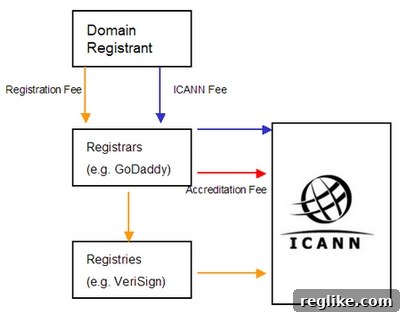
The visual representation above simplifies this complex financial pipeline. Let’s break down the distinct streams of revenue that ultimately converge to fund ICANN:
The Orange Line: Core Registration Fees and the Intermediaries
The journey begins with the orange line, which represents the primary domain registration fees. When an individual or business decides to register a domain name, they initiate this flow of capital. The process typically unfolds as follows:
- Registrant to Registrar: The registrant pays the registration fee directly to a domain registrar, such as GoDaddy, Namecheap, or Google Domains. This fee covers the cost of registering the domain for a specific period (e.g., one year).
- Registrar to Registry: The registrar retains a portion of this fee as profit for its services, which include providing a user interface, customer support, and managing the registration process. The remainder is then forwarded to the corresponding registry. For instance, if a .com domain is registered, a portion goes to VeriSign, the registry for .com and .net.
- Registry to ICANN: The registry, responsible for maintaining the central database for all domain names under a specific top-level domain (TLD), also takes a cut for its operational costs and profit. The final fraction of this initial registration fee is then passed on to ICANN. It’s worth noting that some registries have pre-negotiated fixed fee agreements with ICANN, which can sometimes allow them to retain a larger portion of the revenue, further emphasizing the indirect nature of the registrant’s contribution to ICANN.
Each step in this chain involves a service provider taking a necessary cut, illustrating how the registrant’s initial payment diminishes through various hands before reaching its final destination at ICANN.
The Blue Line: The Direct ICANN Fee
Beyond the core registration fee, there’s often a more explicit contribution from the registrant to ICANN, depicted by the blue line. This represents the specific ICANN fee charged directly to registrants. While some registrars may bundle this into the overall registration fee for simplicity, others choose to itemize it, making the ICANN portion transparent to the end-user. Regardless of how it’s presented, this fee is collected by the registrar and then passed on directly to ICANN. This blue line serves as a more direct, though still mediated, financial link between the domain owner and the global governing body.
The Red Line: Registrar Accreditation and Annual Fees
Finally, the red line illustrates additional fees paid by registrars directly to ICANN. These include accreditation fees, which registrars pay to be licensed by ICANN to offer domain registration services, and annual fees. A significant portion of these annual fees is often correlated with the number of domain names registered through that registrar. Ultimately, even these fees, though paid by the registrar, are factored into the operational costs that registrars pass on to registrants through their pricing structures. Therefore, they too originate from the vast pool of money provided by domain owners.
In essence, whether through direct contributions, a cut of registration fees, or indirectly via registrar accreditation costs, every single dollar that sustains ICANN can be traced back to the domain registrant. If the vast community of domain registrants were to disappear, ICANN’s financial foundation would crumble, underscoring their irreplaceable role in the internet’s infrastructure.
The Unheard Voice: Registrants on the Sidelines of Governance
Despite being the ultimate financial backbone of ICANN, domain registrants frequently express a feeling of marginalization within the organization’s multi-stakeholder governance model. Their interests, concerns, and perspectives often seem to take a backseat to those of more organized and well-funded entities like registries, registrars, and large corporations. This disparity creates a significant challenge for ICANN’s stated goal of inclusive and representative internet policy-making.
A poignant example of this oversight was highlighted at an ICANN new gTLD/trademark event in New York City. Phil Corwin, general counsel for the Internet Commerce Association (ICA), brought attention to a glaring omission on an evaluation form distributed at the event, as detailed in a blog post:
“…at the bottom of each page was a line reading “my interest in this matter is defined by my work as/with a:” followed by a long list of possible connections, such as registry, registrar, or large corporation – but, remarkably, with no listing for “registrant” (other than the catch all “other”). ICANN thus continues its tradition of failing to perceive the existence of registrants, as is demonstrated by its finance dashboard which shows in bar graph form that ICANN receives the vast majority of its funding from registrars and registries, but apparently not a single dollar from registrants who fail to get any bar (even though they supply nearly all the money that flows through ICANN’s contract partners). Registrants to ICANN are seemingly like plankton to Moby Dick.”
This incident is not merely a trivial oversight; it reflects a deeper, systemic issue within ICANN’s perception and engagement with its core funding base. The absence of “registrant” as a direct interest category on an official feedback form suggests a lack of recognition, implicitly demoting domain owners to a secondary or tertiary stakeholder group, despite their primary financial contribution. It sends a clear message that their direct involvement and unique perspectives might not be as valued or considered as those of other, more institutionalized stakeholders.
Furthermore, Corwin’s critique of ICANN’s finance dashboard is particularly revealing. By presenting funding primarily as coming from registrars and registries, the dashboard creates an illusion that these entities are the ultimate financial providers, rather than mere conduits. This visual misrepresentation perpetuates the invisibility of the registrant’s role and can mislead stakeholders about where ICANN’s true financial power base lies. The powerful analogy of “plankton to Moby Dick” perfectly captures this dynamic: the vast, numerous, and indispensable registrants are aggregated and consumed by larger entities, their individual contributions becoming invisible within the grand scheme, even as they form the foundation of the ecosystem.
Challenges and the Path Forward for Registrant Engagement
To be fair, the challenge of amplifying the registrant voice is multifaceted. Domain registrants are an incredibly diverse group, ranging from individual bloggers and small business owners to large corporations managing extensive domain portfolios. This diversity, coupled with geographical dispersion and varying levels of technical understanding, makes it inherently difficult for them to form a cohesive, unified voice capable of effectively advocating their interests within ICANN’s complex policy development processes. Save for dedicated groups like the Internet Commerce Association, which often operates with limited funding, robust representation for registrants remains a significant hurdle.
However, the difficulty in organizing registrants should not absolve ICANN of its responsibility to actively seek out and integrate their perspectives. Crafting policies that ignore or insufficiently address the needs of its primary funders is not sustainable for any organization, especially one tasked with global internet governance. For ICANN to maintain its legitimacy and effectiveness, it must foster an environment where the voices of domain registrants are not just acknowledged but actively sought out and meaningfully incorporated into policy decisions.
Moving forward, ICANN could explore several avenues to bridge this gap. This includes enhancing transparency around funding sources to explicitly show the registrant’s contribution, developing more accessible engagement platforms, actively soliciting feedback through channels tailored for individual domain owners, and empowering existing or new registrant advocacy groups. By genuinely embracing and elevating the domain registrant as a core stakeholder, ICANN can strengthen its governance model, foster greater trust within the internet community, and ensure that the internet’s future development truly serves all its users, starting with those who pay for its very foundation.