
Navigating ICANN’s Transparency: A Practical Guide to Information Disclosure

The Internet Corporation for Assigned Names and Numbers (ICANN) plays a pivotal role in maintaining the security and stability of the global internet’s unique identifier systems. Its decisions impact billions of users worldwide, making its transparency and accountability paramount. However, accessing specific information from such a complex, multi-stakeholder organization can often feel like an uphill battle. This guide delves into the intricacies of ICANN’s Documentary Information Disclosure Policy (DIDP), offering practical strategies to help stakeholders, researchers, and the public effectively navigate its system and obtain critical information.
When observing requests filed under ICANN’s Documentary Information Disclosure Policy (DIDP), one might initially be skeptical about the likelihood of success. The process often appears challenging, leading many to anticipate denial. Yet, a closer look reveals a more nuanced reality where persistence and a strategic approach can yield tangible results.
Understanding ICANN’s Documentary Information Disclosure Policy (DIDP)
At its core, the DIDP empowers any individual or entity to formally request the release of documents pertinent to ICANN’s operations, policy development, and decision-making processes. It functions similarly to freedom of information (FOIA) requests found in many governmental jurisdictions, providing a structured mechanism to gain insight into the specific information held by ICANN. The policy’s primary objective is to illuminate ICANN’s internal deliberations, communications, and ultimate decisions, fostering greater understanding and trust among its diverse global community.
For an organization that operates at the nexus of global internet governance, ICANN’s commitment to transparency is a frequent topic of debate. While it functions as a private corporation, ICANN consistently publishes a vast majority of its meeting records, policy documents, and procedural guidelines. This significant volume of public information often leads to the perception of substantial transparency. However, this very commitment, paradoxically, can sometimes obscure more than it reveals, creating a “transparency paradox.”
The Challenge of Information Overload
ICANN itself has acknowledged this challenge. In its most recent Transparency Report, the organization candidly stated:
…the Board, community, and org have produced and accumulated thousands of pieces of unstructured content spread across 38 different public sites. This content continues to grow by up to 30% each year. The org currently surfaces this content through multiple unconnected platforms with differing foundational technologies that are non-scalable, may be vulnerable, and are no longer fit for purpose.
This vast, decentralized, and rapidly expanding archive of content presents a formidable barrier to effective information retrieval. Imagine trying to find a needle in a haystack, only the haystack is continuously growing and spread across dozens of disparate locations. For stakeholders, academics, journalists, and everyday internet users seeking specific details about a policy, a historical decision, or ongoing deliberations, this content sprawl can be incredibly frustrating. It’s akin to a legal discovery process where one party overwhelms the other with an abundance of irrelevant data, hoping to bury crucial information.
The issue is further compounded by the regression in search and notification tools. For instance, the discontinuation of MyICANN, a valuable daily digest that tracked website changes on ICANN.org, was a significant step backward. Its replacement offers a far less comprehensive service, capturing only a fraction of new content. This makes proactive monitoring and discovery of new information significantly more challenging, pushing requesters towards the DIDP as a last resort rather than a supplementary tool.
DIDP Outcomes: A Mixed Bag of Results
A recent review of DIDP outcomes paints a revealing picture of the policy’s effectiveness. Notably, 28% of all DIDP requests received responses that simply directed the requester to publicly available information. This statistic is critical for several reasons. It suggests that:
- The requested information, while public, was not easily discoverable by the requester through ICANN’s existing fragmented platforms.
- ICANN, in some cases, might not have fully satisfied the requestor’s perception of what was being sought, instead offering a pointer to a broader repository.
- There’s a significant gap between ICANN’s commitment to publishing information and the actual usability and discoverability of that information.
This outcome can be profoundly frustrating for requesters who invest time and effort into crafting a formal DIDP submission, only to be redirected to content they struggled to find initially. It underscores the need for both improved internal information management at ICANN and more precise request formulation by users.
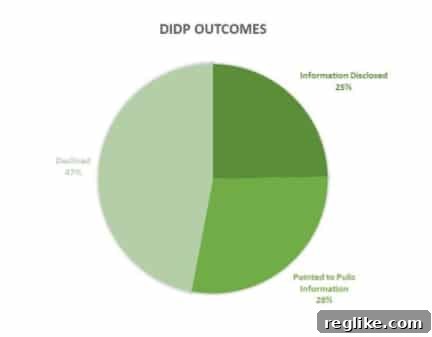
The chart above further clarifies the overall landscape of DIDP requests:
- 25% Information Disclosed: A quarter of requests successfully lead to the disclosure of new, non-public information. This demonstrates that DIDP can indeed be an effective tool when properly utilized and when the requested documents fall outside the scope of nondisclosure conditions.
- 28% Pointed to Public Info: As discussed, a significant portion of requests are met by directing users to existing public resources. This highlights the discoverability problem within ICANN’s vast content ecosystem.
- 47% Declined: Nearly half of all DIDP requests are outright declined. Understanding the reasons behind these denials is crucial for improving the success rate of future submissions.
Common Grounds for DIDP Denial
ICANN’s DIDP outlines several specific conditions under which requests can be denied. To increase the likelihood of success, requesters must understand these potential pitfalls:
- Documents Not in ICANN’s Possession: ICANN can only release documents that it actually holds. Requests for information held by third parties or documents that were never generated by ICANN will be denied.
- Publicly Available Information: If the requested information is already accessible through ICANN’s public archives, websites, or other official channels, the request may be denied or met with a referral to those public sources. This often frustrates requesters, as detailed above.
- Not Responsive to the Request: The request must be clear and specific enough for ICANN staff to identify relevant documents. Vague or overly broad requests are often deemed not responsive and consequently dismissed as overly burdensome to process.
- Subject to Defined Conditions of Nondisclosure: This category encompasses the most extensive and often contentious reasons for denial. These conditions are designed to protect sensitive information but can also be broadly interpreted, including:
- Confidential Documents Submitted by Third Parties: Information provided by external organizations or individuals under an explicit agreement of confidentiality.
- Documents Compromising DNS Safety and Security: Information that, if disclosed, could reveal vulnerabilities in the Domain Name System or pose risks to its operational integrity.
- Privileged Documents: Legal advice, attorney-client communications, or other legally protected information.
- Compromising ICANN’s Deliberative Decision-Making Process: This is arguably the broadest and most subjective condition. It aims to protect the internal discussions, evolving policy positions, and sensitive negotiations that precede final decisions, ensuring a safe space for open discourse without fear of premature public scrutiny impacting outcomes.
While these conditions serve valid purposes, the inherent subjectivity in interpreting some of them, particularly “compromising deliberative decision-making,” can be a source of contention and perceived lack of transparency.
Proposed Reforms and Future Outlook for DIDP
Recognizing the ongoing challenges and community feedback, ICANN has explored potential revisions to the DIDP, which has been in place since 2009. A summary report of public comments on these proposed changes was recently released. While the fundamental aspects of the DIDP and the initial response process are unlikely to undergo radical transformation, significant changes are being considered for the appeal mechanism for failed requests.
Historically, the only avenue for appealing a denied DIDP request was through ICANN’s Reconsideration process. This mechanism, unfortunately, has proven largely ineffective for DIDP-specific appeals, with a 100% failure rate for such requests. This stark statistic underscores the critical need for a more robust and impartial review process.
The proposed changes aim to introduce a dedicated review mechanism for DIDP decisions. Potential options being discussed include leveraging ICANN’s Ombudsman’s office or establishing a separate, independent complaint officer. The goal is to provide requesters with a more accessible and potentially more successful pathway to challenge denials. However, public comments on these proposed changes have expressed criticism regarding the scope and independence of these new options, suggesting that the community desires a stronger, more truly independent review. Persistent users of the DIDP process, who are often deeply invested in specific policy areas, stand to benefit most from an improved appeals system.
Strategies for Maximizing Your DIDP Request Success
Given the complexities and the mixed track record of DIDP requests, crafting an effective submission requires strategic thinking. Based on past outcomes and proposed future changes, here are several key recommendations:
1. Be Exceptionally Specific
Overly broad or vague requests are the most common reason for dismissal, often cited as being too burdensome for ICANN staff to fulfill. Instead of asking for “all documents related to WHOIS policy,” narrow your focus. Specify date ranges, particular committees or working groups, specific policy proposal numbers, or the names of individuals involved. For example, “I request all internal communications (emails, memos, meeting minutes) between the GAC and the Board regarding the Expedited Policy Development Process (EPDP) on the Temporary Specification for gTLD Registration Data, specifically between January 1, 2019, and March 31, 2019, related to the treatment of non-public registration data.” This level of detail significantly improves the chances of a relevant and manageable response.
2. Focus on Context, Not Preemption
Many requesters make the mistake of trying to “prove” in their initial submission that the information they seek does not fall under any of the Defined Conditions of Nondisclosure. This tactic has historically proven ineffective and can be counterproductive. ICANN staff are trained to apply the policy criteria. Instead, concentrate your efforts on clearly articulating the context of your request. Explain what you hope to learn from the documents and why this information is important to you, your organization, or the broader public interest. For example, instead of arguing “this can’t compromise deliberative process,” explain, “Understanding the evolution of this policy discussion is crucial for our research on internet governance models and will inform future community contributions.”
3. Don’t Shy Away from Challenging Nondisclosure Conditions
Even if you suspect certain documents might fall under a nondisclosure condition, do not hesitate to ask for them. ICANN staff are expected to apply a “balancing test” in such situations. This test weighs the public interest in knowing the information against the harm that would result from its disclosure under a nondisclosure condition. If your stated public interest is compelling enough, it might outweigh the default nondisclosure.
Furthermore, with the proposed reforms to the DIDP, staff may be explicitly expected to seek authorization from third parties or other relevant entities to waive confidentiality conditions. This potential shift is a significant positive development, as it introduces an active duty on ICANN’s part to explore disclosure possibilities rather than automatically defaulting to denial based on a perceived confidentiality claim. By clearly articulating the public interest, you strengthen the staff’s hand in making such a request for waiver.
Conclusion: A Path Forward for Enhanced Transparency
While the journey to pry information from ICANN via the Documentary Information Disclosure Policy can be challenging and sometimes frustrating, it is not without its merits. The DIDP, despite its current limitations, remains a vital tool for promoting accountability and ensuring that ICANN’s decisions are subject to appropriate scrutiny. By understanding the policy’s mechanisms, recognizing the common pitfalls, and adopting a strategic approach to crafting requests, stakeholders can significantly increase their chances of success. Moreover, with ongoing reforms and a growing emphasis on more robust review mechanisms, the effectiveness of DIDP is poised for potential improvement. Persistent engagement and strategically formulated requests are key to leveraging this policy for a more transparent and accountable internet governance ecosystem.