
The Evolving Landscape of Web Navigation: The Case of iOS7’s Hidden .com Shortcut
The digital world is constantly reshaping how we interact with information and services. While grand technological leaps often capture headlines, subtle shifts in user interface design can have profound, long-term implications. One such evolution, introduced with Apple’s iOS7 operating system, subtly altered the prominence of the familiar “.com” shortcut, sparking conversations within the domain name industry and beyond.
For many, particularly digital natives, navigating the internet is an intuitive process, often starting with a simple web address. My own daughter, whose primary gateway to the internet had been an iPad, recently encountered this subtle shift firsthand. Handing her my laptop one day, I observed her scrutinizing the physical keyboard with a look of genuine perplexity. “Where’s the dot com key, daddy?” she innocently inquired, highlighting a fundamental difference in how generations perceive and access web addresses.
Her question, seemingly simple, perfectly encapsulates a broader phenomenon that has many within the tech and domain name communities asking similar questions. Apple’s decision to reposition the dedicated “.com” button in its iOS7 update might appear minor, but it represents a significant move, reflecting a changing internet landscape and Apple’s vision for mobile user experience. For an industry built on the foundational importance of domain names, especially the ubiquitous .com, such a change warrants close examination.
Historically, the “.com” top-level domain (TLD) has been the undisputed king of the internet. It’s the default, the expected, the one most users instinctively type. Its prevalence led many virtual keyboards, including Apple’s earlier iOS versions, to feature a dedicated button for quick entry. This not only streamlined the typing process but also reinforced .com’s status as the primary identifier for commercial entities and, by extension, almost any website.
Understanding the Shift: Where Did .com Go in iOS7?
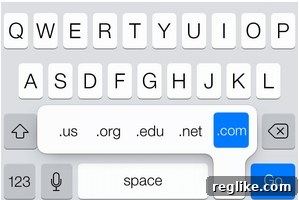
The good news for .com loyalists is that the TLD hasn’t vanished entirely. It’s still readily accessible, but its interaction has evolved. Instead of a standalone button, the “.com” option is now nested within a longer press of the standard period (.) button on the virtual keyboard. This contextual menu, which appears upon a sustained touch, reveals a selection of popular TLDs, with .com still proudly holding the first position. This design choice, while perhaps a slight detour for muscle memory, opens the door to a more versatile and less .com-centric approach to web address entry on mobile devices.
If you press and hold the . button on an iOS7 (or later) keyboard, here’s what you’ll typically see:
(Picture from Name.com)
As the image illustrates, .com remains the initial and most prominent choice, underscoring its enduring importance. However, it’s joined by several other established TLDs: .net, .edu, .org, and .us. This curated list suggests Apple’s recognition of the diverse purposes and organizational structures that define the internet today. The inclusion of these specific TLDs isn’t arbitrary; each serves distinct segments of the online world, and their presence in this shortcut menu legitimizes their status alongside .com.
A Closer Look at the Selected TLDs: Beyond .com
- .com: While no longer exclusively for commercial entities, .com remains the go-to for businesses, personal blogs, and general-purpose websites globally. Its brand recognition is unparalleled.
- .net: Originally intended for network-related organizations, .net has evolved into a popular alternative to .com, often used by businesses, technology companies, and service providers when their desired .com is unavailable.
- .edu: This TLD is strictly reserved for accredited post-secondary educational institutions in the United States. Its presence highlights the importance of academic and research content on the web.
- .org: Predominantly used by non-profit organizations, charities, and community groups, .org signifies a mission-driven entity. It conveys trustworthiness and public service.
- .us: A country-code top-level domain (ccTLD) specifically for the United States, .us is often chosen by individuals, businesses, and government entities that wish to emphasize their American identity and target a local audience.
The inclusion of .us also leads to an interesting conjecture: it’s highly probable that the specific country-code TLDs (ccTLDs) displayed in this menu are dynamically determined by the user’s geographic location or device settings. For instance, a user in the United Kingdom might see .uk, while a user in Germany might see .de. This intelligent adaptation caters to local internet navigation habits and reinforces the importance of geographical identity online.
The Elephant in the Room: The Absence of New gTLDs
One striking observation from Apple’s TLD shortcut menu is the complete absence of any of the “new gTLDs” (generic top-level domains) that have proliferated since the early 2010s. The Internet Corporation for Assigned Names and Numbers (ICANN) initiated a program to expand the number of available TLDs significantly, leading to the introduction of hundreds of new options like .app, .blog, .store, .tech, .xyz, as well as city-specific TLDs like .london or .nyc. Some of these newer TLDs have achieved considerable registration numbers, even surpassing some of the established TLDs in certain niches.
Why would Apple omit these? Several factors could be at play. The sheer volume of new gTLDs makes it impractical to include them all. Apple likely prioritized TLDs with established global recognition and distinct, widely understood purposes. The decision could also reflect a conservative approach, waiting to see which new gTLDs gain widespread adoption and user familiarity before integrating them into such a fundamental UI element. For SEO professionals and digital marketers, this omission highlights a continued challenge for new gTLDs in achieving the same level of default recognition and ease of access as their older counterparts. While search engines generally treat all TLDs equally from an SEO perspective, user perception and ease of typing still play a role in brand recall and direct navigation.
The Future of Domain Navigation: Will .apple Appear?
The question of whether a brand-specific TLD, such as .apple, might someday appear in this shortcut menu is a fascinating one that delves into the future of digital branding and corporate identity. Many large corporations, including Apple, Google, and Amazon, have invested in their own brand TLDs (e.g., .apple, .google, .amazon). These offer unparalleled brand control and a unique digital space for their products and services.
If Apple were to include .apple in its own keyboard shortcut, it would be a powerful statement. It would signal a significant shift towards brand TLDs becoming a standard part of internet navigation, potentially inspiring other companies to push for similar integration. Such a move would allow Apple to further consolidate its digital ecosystem, making it even easier for users to access Apple-related content directly through a branded domain. However, it would also raise questions about fairness, potential self-preference, and the role of platform owners in shaping internet accessibility.
The inclusion of corporate TLDs could redefine how users perceive and interact with specific brands online. Imagine typing “support.apple” instead of “support.apple.com.” While seemingly minor, these subtle changes influence user behavior over time, potentially strengthening brand loyalty and streamlining access to proprietary content.
Broader Implications for User Experience and the Domain Industry
Apple’s adjustment to the .com shortcut, while small, is indicative of larger trends in web navigation. As mobile devices become the primary interface for the internet for billions, user interface design takes on paramount importance. Simplifying the keyboard, even if it means an extra tap or a long press for a formerly dedicated function, can be seen as an effort to declutter and optimize the mobile typing experience.
For the domain name industry, this subtle shift underscores the ongoing evolution of how users find and access websites. Direct typing of full domain names is becoming less common, with users increasingly relying on search engines, bookmarks, predictive text, and app-based access. However, brand recognition and memorable domain names remain crucial for direct navigation and offline marketing efforts.
The move by Apple also highlights the power that major tech platforms wield in shaping user habits and influencing the prominence of certain web standards. By curating the list of TLDs available in its shortcut, Apple subtly endorses certain extensions while implicitly downplaying others. This isn’t necessarily a judgment on the value of new gTLDs but rather a reflection of current user behavior and market penetration.
In conclusion, the disappearing dedicated “.com” key in iOS7 is more than just a minor UI tweak. It’s a snapshot of the internet’s ongoing evolution – a move from a .com-dominated landscape to a more diversified, albeit still hierarchically structured, domain space. It nudges users towards a slightly different interaction model, acknowledges the importance of other established TLDs, and sets the stage for future debates about the inclusion of new gTLDs and brand TLDs. As devices continue to evolve, so too will the ways we access the vast, interconnected world of the internet, making every button and every shortcut a point of fascinating discussion and strategic importance.