
Unveiling the Tactics: A Company’s Bid to Trademark .secure and Its Implications for Digital Commerce
The intricate world of intellectual property, particularly within the digital realm, frequently witnesses ingenious attempts to navigate existing laws. A compelling case in point is the persistent effort by entities to secure trademarks for generic terms, especially those pertaining to top-level domains (TLDs). This ongoing struggle highlights a fundamental tension between the desire for exclusive brand identity and the need for open, accessible identifiers in the vast landscape of the internet. The U.S. Patent and Trademark Office (USPTO) is a battleground where these competing interests often collide, and applicants continuously explore novel strategies to gain an advantage.
One such intriguing saga involves Asif LLC, a company that has drawn attention for its ambitious trademark applications. In the digital sphere, where security and trust are paramount, the “.secure” identifier holds significant perceived value. Consequently, any attempt to control or exclusively associate with such a term warrants close examination. Asif LLC’s journey, which began with its application for the .secure trademark, illustrates the creative lengths to which some companies will go to assert rights over digital real estate that is typically considered public domain. This case is not just about a single trademark application; it illuminates broader issues concerning the definition of “use in commerce” and the future of digital branding.
The Genesis of a Contention: Asif LLC and the .secure Application
The narrative of Asif LLC’s foray into trademarking TLDs began in earnest. In August, the company officially filed an application for the .secure trademark. This move immediately raised eyebrows among intellectual property experts and domain industry observers. The initial application for .secure was followed by another notable filing: an application for .bank. These choices are far from arbitrary; both “.secure” and “.bank” are perceived as highly valuable and trustworthy identifiers in the digital economy, especially in an era rife with cybersecurity concerns and the increasing reliance on online financial transactions. Securing a trademark for such terms, even if indirectly, could grant a significant competitive edge or control over how certain services are branded and perceived online.
The core challenge with trademarking TLDs directly stems from long-standing USPTO policy. Historically, the USPTO has been reluctant to grant trademarks for top-level domains themselves, considering them functional identifiers rather than distinctive brand elements. A TLD like “.com,” “.org,” or “.net” serves to categorize and organize the internet’s naming system, much like an address suffix. Granting exclusive rights to such generic, functional elements could stifle competition and create monopolies over common linguistic or technical components of the internet. Therefore, applicants seeking to trademark TLDs must devise alternative approaches to overcome this inherent hurdle, often by recharacterizing the nature of their intended “mark.”
Navigating the Legal Landscape: The “Domain Registration Services” Strategy
Understanding the USPTO’s strict stance against trademarking TLDs directly, Asif LLC adopted a widely recognized tactic within the intellectual property community. Rather than claiming trademark rights over “.secure” as a top-level domain itself, the company strategically rephrased its application. It asserted that it sought the trademark for “domain registration services” associated with “.secure.” This subtle but crucial distinction aims to circumvent the USPTO’s reluctance to grant trademarks for generic TLDs. By framing the application around a service – the act of registering domains – rather than the domain suffix itself, applicants hope to present their claim as a legitimate service mark, thereby increasing its chances of approval.
This approach hinges on the premise that while the TLD itself might be generic, the *service* of registering domains under that TLD, when presented distinctively, could be trademarkable. It’s a fine line, as the distinctiveness of the service often relies heavily on the generic term it seeks to trademark. For the USPTO, the critical question becomes whether the public perceives “.secure” as a brand identifier for a specific domain registration service offered by Asif LLC, or simply as a descriptive or generic term indicating secure services in general. This distinction is vital for preventing the monopolization of terms that should ideally remain free for common use by all.
The Crucial Element: Allegations of “Use in Commerce”
A fundamental requirement for obtaining a trademark in the United States is demonstrating “use in commerce.” This principle dictates that a trademark must be actively used in connection with goods or services offered to the public before it can be registered. Mere intent to use is often insufficient for full registration; actual, bona fide commercial use must be proven. This is where Asif LLC’s strategy took another interesting turn. The company, having filed its application, then needed to provide evidence that it was actively using “.secure” in commerce for domain registration services. This step is critical, as without it, the application would likely falter.
So, how did Asif LLC attempt to prove this commercial use for a TLD that doesn’t yet exist in the public domain and for a service it presumably just created? The ingenious, albeit somewhat unconventional, method involved leveraging existing infrastructure. The company purportedly signed up for a GoDaddy reseller account, a common service that allows individuals or businesses to white-label GoDaddy’s domain registration services and present them as their own. By doing so, Asif LLC could technically “offer” domain registration services, albeit indirectly, thereby generating the necessary “specimen” of use required by the USPTO.
Dissecting the Specimen: Evidence of Use in Practice
The evidence submitted by Asif LLC to the USPTO provides a fascinating glimpse into this strategy. The specimen, a screenshot, was intended to demonstrate the actual use of “.secure” in commerce for domain registration services. Let’s analyze the visual evidence presented:
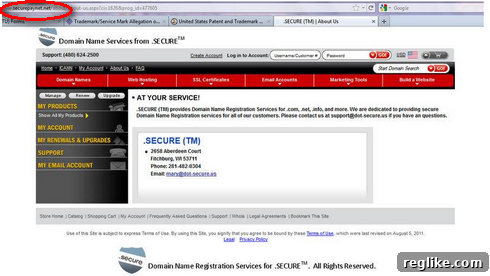
This image, purporting to show the company’s “domain registration services,” reveals several key details. Crucially, the address visible in the top corner of the screenshot is `securepayment.net`. This URL is instantly recognizable to those familiar with domain hosting and reselling as GoDaddy’s standard URL for its reseller sites. This confirms the underlying mechanism: Asif LLC was not operating an independent, fully-fledged domain registrar. Instead, it was utilizing a white-label service provided by one of the largest domain registrars in the world.
Further reinforcing this point, investigative efforts revealed that visiting `http://dot-secure.us` would redirect users to this same GoDaddy reseller site. This redirection creates the illusion of a dedicated service operating under the “.secure” banner, thereby serving as a tangible manifestation of “use in commerce” for the purposes of the trademark application. The redirect mechanism allows Asif LLC to present a branded front while relying entirely on a third-party service for the backend functionality. While clever, this raises important questions about the authenticity and distinctiveness of the “service” being offered. Is this truly a unique service under the “.secure” brand, or merely a generic reselling operation trying to co-opt a highly desirable term?
Broader Implications: The Battle for Generic Terms in the Digital Age
The case of Asif LLC’s “.secure” trademark application is more than an isolated incident; it’s emblematic of a broader struggle within intellectual property law. The digital era has introduced unprecedented challenges to traditional trademark principles, particularly concerning generic terms and functional identifiers. As the internet expands and new naming conventions emerge (like the proliferation of new generic top-level domains, or gTLDs), the line between a distinctive brand mark and a descriptive or generic term becomes increasingly blurred.
The USPTO’s long-standing policy to reject trademarks for generic TLDs is rooted in the public interest. If companies could trademark “.secure,” “.health,” or “.shop” as TLDs, it would grant them monopolistic control over entire categories of online activity, potentially stifling competition and innovation. These terms are inherently descriptive of the type of content or service one might expect to find. Allowing a single entity to exclusively claim them, even under the guise of “domain registration services,” could set a dangerous precedent, leading to a landscape where common digital terms are privatized.
Furthermore, the context of new gTLDs, introduced by ICANN (the Internet Corporation for Assigned Names and Numbers), adds another layer of complexity. Many new gTLDs, such as “.bank,” “.insurance,” and indeed “.secure,” were created with specific requirements for enhanced security and trust. Operators of these TLDs often have strict eligibility criteria and operational mandates to ensure that the domains registered under them meet high standards. An attempt to trademark “.secure” for domain registration services, separate from the actual operator of the .secure gTLD (which would be a distinct entity if such a gTLD were delegated), introduces potential confusion and conflict within the domain name ecosystem. It underscores the critical difference between a technical identifier managed by ICANN and a brand asset protected by trademark law.
Scrutiny and the Future of Such Applications
Applications like Asif LLC’s are typically subjected to intense scrutiny by the USPTO. Trademark examiners evaluate not only the evidence of “use in commerce” but also the inherent distinctiveness of the mark itself. Key questions arise: Does the public perceive “.secure” as a source indicator for Asif LLC’s domain registration services, or as a term that simply describes the nature of security services? Is the use of a GoDaddy reseller account truly “bona fide use” in commerce that establishes distinctiveness for the mark, or is it a manufactured use primarily intended to fulfill a legal requirement?
The definition of “bona fide use” is critical. It implies a genuine intention to conduct commercial activity and not merely to reserve a mark. While using a reseller account creates a functional service, the USPTO might question whether this constitutes sufficient distinctiveness for a generic term like “secure” when applied to domain registration. Competitors, industry bodies, or even the general public could also oppose such an application, arguing that the term is generic, descriptive, or that its exclusive use would be detrimental to the public interest.
The outcome of cases like Asif LLC’s “.secure” application will help shape the evolving landscape of intellectual property in the digital age. It highlights the ingenuity of applicants in finding loopholes and the constant challenge faced by regulatory bodies like the USPTO to adapt traditional laws to new technological realities. As the internet continues to grow and diversify, the debate over who can claim ownership of generic terms and identifiers will undoubtedly persist, demanding careful consideration and a balanced approach to protect both innovation and public access.
Conclusion: The Ever-Evolving Frontier of Digital Trademarks
The ongoing saga surrounding Asif LLC’s application for the .secure trademark serves as a potent illustration of the dynamic and often contentious intersection between traditional trademark law and the rapidly evolving digital environment. It underscores the creative methods employed by companies to assert rights over valuable digital identifiers, even when those identifiers are widely considered generic or functional. From strategically framing an application around “domain registration services” to ingeniously demonstrating “use in commerce” via a white-label reseller platform, the tactics employed reflect a deep understanding of legal frameworks and a determination to push their boundaries.
Ultimately, the USPTO is tasked with the delicate balancing act of upholding the foundational principles of trademark law – preventing consumer confusion and fostering fair competition – while adapting to the unique complexities of top-level domains and the digital economy. The scrutiny placed on applications like these ensures that generic terms, crucial for the clarity and accessibility of the internet, do not become monopolized. As the digital landscape continues to expand and new forms of online interaction emerge, the precedents set by cases involving terms like “.secure” will play a pivotal role in defining the future of intellectual property, branding, and governance in the digital realm for years to come.