
U.S. District Judge Orders Immediate Halt: Canvas.com Forced to Cease Domain Use in Major Trademark Dispute
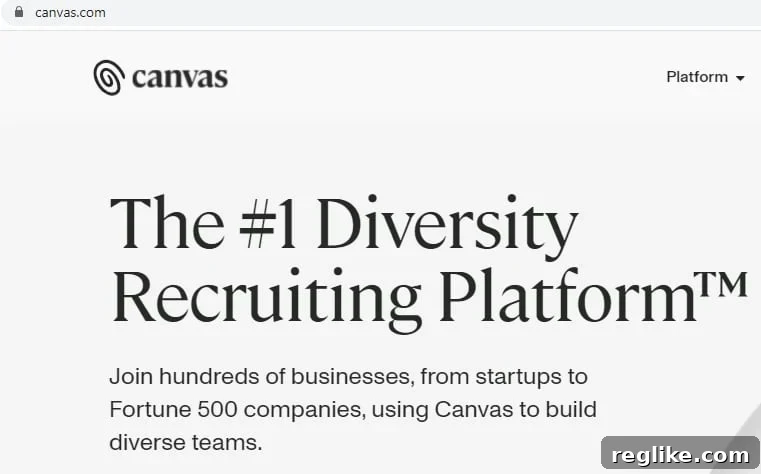
In a landmark decision that sends ripples through the digital branding and intellectual property landscape, U.S. District Judge Dale Kimball has granted a preliminary injunction against Canvas, Inc., mandating that the company immediately cease all use of its highly coveted domain name, Canvas.com. This ruling stems from a contentious trademark infringement lawsuit filed by Instructure, Inc., the long-established provider of the popular Canvas learning management and portfolio platform.
The injunction represents a significant victory for Instructure, which has vigorously protected its “Canvas” trademark for over a decade. For Canvas, Inc., a diversity recruiting platform formerly known as Jumpstart, this order means a swift and potentially disruptive rebranding effort, highlighting the critical importance of thorough due diligence in domain acquisition and brand naming, especially when dealing with widely recognized terms.
The Genesis of the Dispute: Two Canvases in the Digital Sphere
The heart of this legal battle lies in the clash of two distinct businesses operating under the identical, albeit generic-sounding, “Canvas” moniker. On one side, we have Instructure, Inc., a pioneer in educational technology, whose “Canvas” platform has become synonymous with online learning and student portfolio management. Launched over ten years ago, Instructure’s Canvas is a global leader, empowering millions of students and educators to connect, learn, and showcase their academic and professional achievements to potential employers.
On the other side is Canvas, Inc., the defendant in this case, which embarked on a rebranding journey last year after securing the premium domain name Canvas.com through a lease-to-own arrangement. Prior to this, the company operated as “Jumpstart.” With its new identity and domain, Canvas, Inc. aimed to establish itself as a prominent diversity recruiting platform, connecting diverse talent with leading companies. Their business model inherently involves helping individuals present their professional profiles and work, a service Instructure argued directly overlapped with the portfolio-showcasing aspects of its own platform, leading to potential consumer confusion.
Instructure’s complaint hinged on the argument that Canvas, Inc.’s use of Canvas.com infringed upon its well-established trademark. They contended that because both platforms cater, in part, to individuals looking to present their work or profiles to employers, there was a high likelihood of confusion among consumers and businesses, thereby diluting Instructure’s brand and leveraging its hard-earned goodwill.
Judge Kimball’s Ruling: Prioritizing Established Brand Protection
Judge Kimball’s detailed order indicates a strong alignment with Instructure’s position. The preliminary injunction, by its nature, is granted when a court believes the plaintiff has a high likelihood of succeeding on the merits of the case, will suffer irreparable harm without the injunction, and when the balance of hardships favors the plaintiff. In this instance, the judge found compelling evidence for all these criteria favoring Instructure.
A pivotal aspect of the judge’s reasoning centered on the comparative investment and market presence of both entities. Instructure has dedicated extensive resources – tens of millions of dollars – over more than a decade to cultivate and promote its Canvas brand. This substantial, long-term investment has solidified “Canvas” as a recognized and trusted name in its sector. In stark contrast, Canvas, Inc. had only adopted the “Canvas” brand and its corresponding domain for a mere few months prior to the legal challenge.
The judge explicitly stated that the near-term harm Instructure would face by allowing Canvas, Inc. to continue using the infringing mark far outweighs the damage Canvas, Inc. would incur by rebranding, even if that rebranding were only temporary pending a final judgment. This sentiment was eloquently captured in the court’s statement:
In this case, Instructure has marketed and sold its services under the canvas mark for over a decade – investing tens of millions of dollars in promoting its products under its mark during this time. To allow Canvas Tech to trade off of the goodwill and reputation that Instructure built would be a significant harm to Instructure. Further, Instructure is not requesting that Canvas Tech no longer promote and sell its services. Instructure is only requesting that Canvas Tech stop using the canvas mark – a mark by which Canvas Tech has been branded for just a few months. While it is true that granting a preliminary injunction against Canvas Tech would force Canvas Tech to rebrand, at least temporarily, the court finds that this harm is minimal in comparison to Instructure’s. Thus, the balance of hardships here favors Instructure.
This ruling underscores the legal system’s commitment to protecting established brands and intellectual property, sending a clear message to companies seeking to adopt generic or widely used terms for their branding, particularly when a similar mark already holds significant market recognition.
Immediate and Far-Reaching Consequences for Canvas.com
The implications of this preliminary injunction for Canvas, Inc. are immediate and profound. Changing a company’s domain name and brand is an monumental undertaking, requiring meticulous planning, significant financial outlay, and extensive logistical execution. It impacts every facet of a business, from marketing materials and digital presence to internal communications and customer recognition.
The court’s order mandates an almost instantaneous cessation of all activities associated with the Canvas mark and domain:
Defendant, and each of its respective officers, agents, servants, employees, and attorneys, and any other persons who are in active concert or participation with any one of them,
ARE HEREBY PRELIMINARILY ENJOINED AND RESTRAINED pending the final hearing and determination in this action from (a) Continuing to sell, advertise, or promote
any product or service using the Canvas Mark, or any other mark that is confusingly similar to the Canvas Mark; and (b) Continuing to use, advertise, promote, or redirect any
other websites to the www.canvas.com domain.Within 15 days of the date of this Order, Defendant shall remove or destroy all signs, posters, pictures, billboards, advertisements, or other printed matter that displays the
Canvas Mark in any manner;Within 15 days of the date of this Order, Defendant shall remove all internet posts, pictures, or other material (including but not limited to on Defendant’s websites,
Facebook, Twitter, Instagram, YouTube and other social media pages) that display the Canvas Mark in any manner.
This directive is exceptionally stringent. Within merely 15 days, Canvas, Inc. must scrub all traces of the “Canvas” brand from its physical and digital presence. This includes not only its own websites but also all social media profiles, advertisements, and any other printed or digital collateral. Such an aggressive timeline presents immense operational challenges, necessitating a complete overhaul of its brand identity, online presence, and communication strategy within a remarkably short period. The potential disruption to search engine rankings (SEO), email addresses, and established customer touchpoints will be substantial.
The Anti-Cybersquatting Protection Act (ACPA) and “Resetting the Clock”
Adding another layer of complexity and concern for Canvas, Inc., the judge’s order also delved into a critical aspect of domain name law concerning the Anti-Cybersquatting Protection Act (ACPA). The ACPA was enacted to protect trademark owners from individuals who register, traffic in, or use a domain name with a bad-faith intent to profit from the goodwill of a trademark belonging to someone else.
A particularly worrying sign for Canvas, Inc., and potentially for the entity that leased the domain to them, is the judge’s apparent inclination to side with courts that interpret ACPA as “resetting the clock” when a domain name is transferred to a new owner. This interpretation suggests that even if a domain name was originally registered before a trademark became famous, a subsequent transfer or re-registration to a new entity could trigger a new examination under ACPA, especially if the new owner acts in bad faith.
The court noted a key piece of evidence in this regard:
This Domain Report shows that between March 15, 2021 and April 1, 2021, the named registrar and the named registrant identified in the domain report for canvas.com changed. If the new listed registrar and registrant are truly new entities that entered into a new contract, then that would be a re-registration during the time in which Instructure’s canvas brand has been famous.
This observation is crucial because it implies that the acquisition of Canvas.com by Canvas, Inc. (or the entity facilitating the lease-to-own deal) might be viewed as a new “registration” event under ACPA, occurring at a time when Instructure’s “Canvas” mark was undeniably famous. This legal interpretation could significantly strengthen Instructure’s overall case, beyond mere trademark infringement, by potentially establishing a claim of cybersquatting. It also raises questions about the due diligence performed by all parties involved in the lease-to-own agreement for Canvas.com, especially regarding potential trademark conflicts.
The Path Forward: Appeal and Broader Implications
As expected in such high-stakes legal battles, Canvas, Inc. has announced its intention to appeal the preliminary injunction. An appeal process could introduce new arguments, challenge the judge’s findings, or seek a stay of the injunction. However, overturning a preliminary injunction, especially one so strongly worded, can be a challenging endeavor. The appellate court will typically review whether the district court abused its discretion in granting the injunction.
Regardless of the appeal’s outcome, this case serves as a powerful reminder for businesses navigating the digital economy:
- Trademark Due Diligence is Paramount: Before adopting a brand name or acquiring a domain, comprehensive trademark searches are essential to identify potential conflicts.
- Domain Acquisition Risks: Acquiring premium, generic-sounding domains comes with inherent risks, especially if a similar mark is already famous in an overlapping industry. Lease-to-own agreements or domain transfers can also introduce complex legal nuances, particularly under ACPA.
- The Value of an Established Brand: Long-term investment in brand building creates significant goodwill and robust legal protection.
- The Speed of Digital Law: Courts are increasingly willing to issue swift and impactful orders to protect intellectual property in the fast-paced digital world.
The ongoing legal saga between Instructure and Canvas, Inc. will continue to be closely watched by intellectual property lawyers, domain investors, and brand strategists alike. It highlights the complexities of brand protection in an era where digital identities are central to business success, and the courts are increasingly prepared to enforce trademark rights with immediate and far-reaching consequences.