
Kred Domains: Pioneering Unified Digital Identity with Blockchain DNS Integration
In an increasingly interconnected digital world, the need for seamless, user-friendly online identification has never been greater. Kred is stepping up to this challenge, introducing its innovative .Kred domain name that uniquely bridges the gap between traditional DNS and cutting-edge blockchain technology. This approach distinguishes .Kred from existing domain solutions, promising a more integrated and intuitive experience for users navigating both the conventional internet and the decentralized web.
The core of Kred’s innovation lies in its novel integration strategy. Unlike other attempts to link domain names with blockchain, .Kred leverages its unique position as a ‘dot-brand’ Top-Level Domain (TLD) under ICANN’s stringent new TLD program. This strategic choice allows Kred to implement a controlled environment that ensures unparalleled synchronization and user experience across diverse digital platforms.
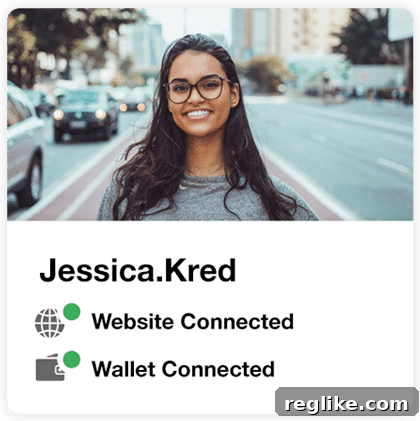
Understanding .Kred: A Dot-Brand TLD with a Difference
To fully appreciate Kred’s distinctive approach, it’s essential to understand the nature of a Top-Level Domain (TLD) and specifically, a ‘dot-brand’ TLD. A TLD is the last segment of a domain name, such as .com, .org, or .net. ICANN (the Internet Corporation for Assigned Names and Numbers) oversees the global domain name system, and its new TLD program opened the door for companies to apply for their own branded TLDs.
Kred, a prominent company known for assigning social media influence scores to individuals and brands since 2011, successfully applied for .Kred as a dot-brand TLD. Dot-brand domains are unique in that they are typically reserved for the exclusive use of the brand itself or its affiliates. This means they come with specific restrictions not applicable to generic TLDs. For instance, dot-brand domains cannot be openly sold through traditional registrars in the same way .com or .net domains are. While this might seem like a limitation, Kred ingeniously transforms this restriction into a significant advantage for its blockchain implementation.
Bridging Web2 and Web3: The .Kred Advantage for Users
One of the primary goals of .Kred is to simplify the digital identity landscape for its users. In today’s digital age, individuals often manage multiple identities: a website domain for their online presence, and a complex string of characters for their cryptocurrency wallet addresses. Kred seeks to unify these identities under a single, memorable .Kred domain.
Users who register a .Kred domain name gain dual functionality: they can deploy traditional websites accessible via any standard web browser, and simultaneously leverage the domain on the Ethereum Name Service (ENS). ENS is a decentralized, open, and extensible naming system based on the Ethereum blockchain, designed to simplify cryptocurrency transactions by replacing lengthy, complex wallet addresses with human-readable names. With .Kred, sending and receiving cryptocurrency becomes as straightforward as sending an email, using an easy-to-remember domain instead of a cumbersome alphanumeric string. This echoes the original purpose of domain names, which replaced hard-to-recall IP addresses with user-friendly names.
Why Kred’s Controlled Environment Matters for Blockchain Integration
The inherent restrictions of dot-brand domains are precisely what empower Kred to offer a superior, synchronized experience. Because nameservers—the core components that direct domain traffic—cannot be freely changed by third-party registrars, Kred maintains tight control over the domain’s configuration. This allows the Kred Top Level Domain Registry to ensure that DNS records (for traditional websites) and ENS records (for blockchain identities) remain perfectly synchronized. This level of control is paramount for security, reliability, and user trust in a unified digital identity system.
While traditional registrars won’t independently sell .Kred domains, Kred is enabling broader access through a reseller API. This strategy allows the company to partner with trusted registrars while still retaining the crucial oversight necessary for its innovative integration. This careful balance ensures widespread availability without compromising the integrity of the synchronized DNS/ENS service.
The Technical Backbone: How Kred Achieves Seamless Synchronization
Kred’s technical architecture is designed for robust and automatic synchronization, a critical feature for a domain attempting to bridge two distinct naming systems. Kred elaborates on the intricate process:
When a Kred Domain is registered, an ENS Kred Domain Token is generated and deposited into the user’s wallet, granting its holder access to control the name on both ENS and DNS. The Kred Top Level Domain Registry maintains a daemon that monitors the Ethereum blockchain and looks for updates to the DNS information stored against .Kred ENS tokens. These changes are validated, and then automatically propagated through to the .Kred DNS server infrastructure with no further input needed from the token holder, within a minute of the transaction being written to the blockchain. The .Kred DNS servers effectively act as a cache of the EthDNS information.
This explanation highlights several key innovations:
- Tokenized Ownership: Each .Kred domain is represented by an ENS Kred Domain Token, which resides in the user’s cryptocurrency wallet. This token acts as a key, granting the holder complete control over their domain’s settings on both traditional DNS and the Ethereum blockchain. This approach aligns with the principles of Web3, where users have direct ownership and control over their digital assets.
- Real-time Blockchain Monitoring: A dedicated daemon (a background process) continuously monitors the Ethereum blockchain for any updates associated with .Kred ENS tokens. This includes changes to linked wallet addresses, subdomains, or other configurations.
- Automated Propagation: Once changes are detected and validated, the daemon automatically propagates them to Kred’s DNS server infrastructure. This fully automated process ensures that updates are reflected on traditional DNS servers almost immediately (within a minute of the blockchain transaction confirming), without any manual intervention from the domain holder.
- DNS as a Blockchain Cache: The .Kred DNS servers effectively serve as a synchronized cache of the EthDNS information. This design optimizes performance and reliability, ensuring that while the source of truth resides on the blockchain, traditional web users can access the domain’s associated website quickly and efficiently.
Competitive Landscape: .Kred vs. Other Blockchain-Enabled Domains
While Kred’s approach is highly innovative, it’s not the only player exploring the intersection of domains and blockchain. MMX, another domain registry, offers an ENS integration with its .luxe TLD. However, there are fundamental differences that underscore Kred’s unique advantages.
.luxe is a traditional Top-Level Domain, meaning it operates under conventional domain registration and transfer protocols. This implies that while it can be connected to a wallet, the process involves more manual steps and potential complexities compared to .Kred. Crucially, if a .luxe domain is sold or transferred through traditional means, the associated wallet address could easily become out of sync with the new domain owner. This introduces a risk of misdirected payments or a fragmented digital identity, which Kred’s tight integration explicitly avoids.
Furthermore, it’s important to compare .Kred and .luxe with native blockchain domains like ENS’s own .eth domains. While .eth domains are fundamental to the decentralized web and offer robust blockchain identity, they generally do not resolve to websites in normal web browsers without specialized browser extensions or gateway services. This limitation means that for broad mainstream adoption, a domain that can function seamlessly across both traditional web browsers and blockchain applications holds a significant advantage. Both .luxe and .Kred fulfill this requirement, allowing users to access websites in any standard browser while also benefiting from blockchain integration.
Endorsement from the Forefront of Decentralized Naming
The significance of Kred’s work has not gone unnoticed by leaders in the blockchain space. Brantly Millegan, the Director of Operations for ENS (Ethereum Name Service), openly praised Kred’s efforts, stating, “Kred is doing really innovative work combining DNS and ENS. This is a great step toward our goal of leveraging the Ethereum blockchain to complement and expand the usefulness of DNS.” This endorsement from a key figure at ENS highlights the potential of Kred’s model to advance the utility and integration of decentralized naming systems within the broader internet ecosystem.
A Unique Royalty Model: Fostering Aftermarket Liquidity
Beyond its technical innovations, .Kred introduces a compelling financial model that could significantly impact the domain aftermarket. A unique aspect of .Kred domains is that the original registrant can receive a royalty when their domain is subsequently sold in the future. This novel twist incentivizes early adoption and could foster greater liquidity and a more dynamic marketplace for .Kred domains. By giving original owners a continued stake in their domain’s value, Kred aligns with the Web3 ethos of empowering users and potentially creates a self-sustaining ecosystem for domain trading, similar to how royalties function in the NFT (Non-Fungible Token) market.
Kred’s Ecosystem and Rollout Strategy
Kred’s journey into the domain space is built upon an established user base. Since its launch in 2011, over 300,000 individuals have registered for a Kred score, indicating a significant community interested in digital influence and identity. Among these, approximately 6,000 premium account holders have already been granted a .Kred domain name, providing an initial cohort of users to experience the integrated system.
The rollout of .Kred domains is structured in phases to ensure a smooth and strategic launch:
- Brand Pre-registration: Brands had an exclusive window to pre-register .Kred domain names at Domains.Kred until March 20. This phase allows businesses and organizations to secure their digital identity before wider public availability.
- Premium Domain Auction: Starting March 20, a curated selection of approximately 2,500-3,500 premium .Kred domains will be auctioned on OpenSea, one of the world’s largest digital asset trading platforms. This move strategically positions .Kred domains as valuable digital assets, leveraging the growing interest in NFTs and decentralized marketplaces.
- General Availability: General availability for .Kred domains at Domains.Kred will commence on April 20, opening the opportunity for the broader public to register their preferred domains.
Conclusion: Paving the Way for a Unified Digital Future
Kred’s innovative approach with the .Kred domain represents a significant leap forward in bridging the traditionally separate worlds of DNS and blockchain. By leveraging the unique characteristics of a dot-brand TLD, Kred has engineered a system that ensures seamless synchronization between traditional websites and blockchain-based identities. This not only simplifies cryptocurrency payments but also offers a more robust, reliable, and user-friendly digital identity experience.
With its technical ingenuity, strategic rollout, and unique royalty model, .Kred is poised to play a pivotal role in the evolution of digital identity. It provides a compelling model for how future domain names can integrate with Web3 technologies, offering users greater control, enhanced functionality, and a unified presence across the entire digital landscape. As the internet continues to evolve, Kred’s vision offers a clear path towards a more integrated and decentralized future.