
The .LTD Domain: Unpacking Its Role as a Global Corporate Identifier and Its Resonance in China

The digital landscape is constantly evolving, with new domain extensions (gTLDs) emerging to cater to specific niches and identities. Among these, the .LTD top-level domain stands out as a unique identifier tailored specifically for companies. Its simple, universally recognized abbreviation for “Limited” or “Limited Company” positions it as a natural choice for businesses looking to establish a clear, professional online presence. Recently, while exploring Chinese domain news, the .LTD extension frequently appeared, prompting a deeper dive into its adoption, particularly within the dynamic Chinese market, and its overall trajectory since its launch.
The Universal Appeal of the .LTD Domain
In many parts of the world, including the UK, Commonwealth nations, and across Asia, the designation “Ltd” or “Co., Ltd” is a standard component of a company’s legal name. It signifies a limited liability company, a structure that protects shareholders from personal responsibility for the company’s debts beyond the amount of their initial investment. This fundamental legal structure is recognized globally, making the .LTD domain extension intuitively appealing for countless businesses worldwide. When a company uses a .LTD domain, it immediately communicates its legal status and professional standing to customers, partners, and investors, fostering trust and credibility from the outset.
Beyond its inherent meaning, the .LTD domain offers practical advantages. One of its most compelling features is its affordability. Unlike some premium or highly sought-after domain extensions, .LTD domains are remarkably accessible, often costing less than $10 for initial registration. This low barrier to entry makes it an attractive option for startups, small and medium-sized enterprises (SMEs), and even larger corporations looking for cost-effective branding alternatives or supplementary domain names. The combination of clear corporate identity and economical pricing presents a strong value proposition for businesses aiming to solidify their digital footprint.
.LTD’s Distinctive Resonance in the Chinese Market
The appeal of the .LTD domain is particularly pronounced in China, where the “Co., Ltd” or “Limited” designation is ubiquitous in company names. This cultural and legal alignment makes the .LTD extension a very natural and logical choice for Chinese enterprises seeking an online identity that mirrors their real-world corporate branding. The clarity and directness of the .LTD domain resonate strongly in a market where trust and official status are highly valued in business interactions.
To gauge the real-world adoption of these domains by end-users, a simple search method involves using a search engine like Baidu with the query “site:ltd”. This technique allows for the discovery of websites actively utilizing the .LTD extension. A recent Baidu search for “site:ltd” yielded a substantial 334,000 results, indicating significant uptake within the Chinese digital ecosystem. Among these results were numerous prominent Chinese companies across diverse sectors. For instance, TYmetro.ltd, a key player in road infrastructure, Max.ltd, a well-known domain registrar itself, and IIM.ltd, a company at the forefront of robotics innovation, all demonstrate the practical application and acceptance of this domain by established businesses. These examples underscore how Chinese companies are leveraging .LTD to create memorable and contextually relevant online addresses that align seamlessly with their corporate identities.
Unpacking the Data: Registration Trends and Market Dynamics
While the intuitive appeal and strong adoption in specific markets like China are evident, a closer look at registration data from sources like Namestat.org provides a more comprehensive picture of the .LTD domain’s journey. According to Namestat.org, the .LTD extension was officially launched in 2016. Early interest was robust, leading to a peak in registrations at approximately 655,000 domains in 2018. The data also confirms that a significant majority of these early buyers originated from China, reinforcing the cultural and business relevance discussed earlier.
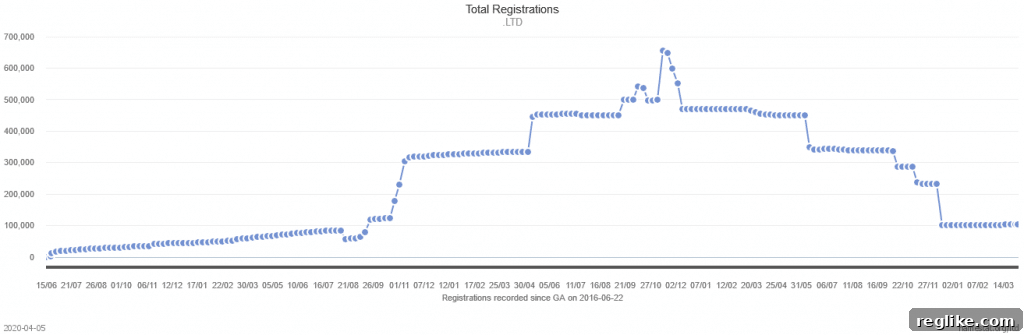
However, the registration numbers have seen a noticeable decline since their peak in 2018. Currently, the total number of active .LTD registrations stands at approximately 104,000, as visually represented in the chart above taken from Namestat.org. This trend is not entirely uncommon among new gTLDs, which often experience an initial surge driven by novelty and early adopter enthusiasm, followed by a period of market correction and stabilization. Several factors could contribute to this decline, including increased competition from other new gTLDs, potential saturation of desirable names, shifts in marketing strategies by registries, or perhaps a general recalibration of expectations within the domain investment community. Despite the overall decline, the persistent base of over 100,000 registrations still signifies a dedicated segment of users who find value in the .LTD extension, particularly those businesses for whom the “Limited” designation holds direct relevance.
The Secondary Market: Valuations and Investor Outlook
The vitality of a domain extension can often be gauged not only by initial registrations but also by activity in the secondary market – where previously registered domains are bought and sold. Data from platforms like Namebio, which tracks domain sales, offers insights into the perceived value and investment potential of various TLDs. For the .LTD extension, reported sales have been relatively scarce, indicating a less active secondary market compared to more established or popular domain extensions. Namebio lists only eight transactions for .LTD domains, which is a very modest number over its lifespan.
| Domain | Price | Year |
|---|---|---|
| Co.ltd | $115,000 | 2016 |
| Home.ltd | $2,300 | 2017 |
| 1000miglia.ltd | $500 | 2018 |
| Millemiglia.ltd | $500 | 2018 |
| Scarf.ltd | $450 | 2017 |
| Law.ltd | $275 | 2017 |
| HDbank.ltd | $199 | 2018 |
| Anpaper.ltd | $199 | 2018 |
Upon reviewing the sales table, one transaction immediately stands out: “Co.ltd” selling for an impressive $115,000 in 2016. This figure is a significant outlier and likely reflects the premium value of an exceptionally short, generic, and highly relevant domain name that directly corresponds to a common corporate abbreviation. Such premium sales are often indicative of brand-defining assets rather than typical market valuations. The other sales listed are considerably lower, ranging from $199 to $2,300, which is more aligned with the lower end of the domain secondary market. The limited number of reported sales and the generally modest prices (excluding the outlier) suggest that, for now, the .LTD extension has not developed into a highly speculative investment vehicle for domain investors. Instead, its primary value appears to lie with end-users – businesses that directly benefit from its corporate identifier status for their operational websites and branding.
Strategic Considerations for .LTD Domain Adoption
For businesses, especially those legally structured as limited companies, the .LTD domain offers a direct and unambiguous online identity. It provides an immediate signal of corporate status, which can be particularly advantageous in international markets where establishing credibility quickly is crucial. Its affordability means businesses can secure a highly relevant domain name without a significant financial outlay, allowing them to allocate resources to other critical areas of their operations. Companies should consider how a .LTD domain integrates with their overall branding strategy and whether it reinforces their professional image. For many, it can serve as a primary domain or a valuable secondary domain that redirects to their main site, enhancing their digital presence.
For potential investors, the .LTD domain presents a more nuanced picture. While the initial registration costs are low, the subdued secondary market activity suggests that quick flips or substantial returns may be challenging, with the exception of truly premium, generic, and short names. Investors interested in this space would need to conduct thorough due diligence, focusing on names that have strong intrinsic value for specific industries or highly recognizable brands. The long-term viability of the .LTD extension might depend on increased marketing efforts by the registry, broader global adoption, and a clearer demonstration of its utility beyond its current niche. As with any investment, understanding market trends, potential demand, and the unique selling points of individual domain names is paramount.
Conclusion: The Enduring Niche of the .LTD Domain
The .LTD domain extension holds a distinct and valuable position in the vast digital landscape as a clear, concise, and globally recognized corporate identifier. Its strong resonance in markets like China, where the “Ltd” designation is deeply embedded in business culture, highlights its practical utility for countless companies. While registration data shows a stabilization after an initial peak, the consistent base of users underscores its enduring relevance for businesses seeking to align their online presence with their legal corporate identity. The secondary market, though not highly active, points to its primary value being for direct end-users rather than speculative investors, with notable exceptions for truly premium names.
In essence, the .LTD domain is not merely another extension; it’s a statement of corporate status and professionalism. For businesses operating as limited companies, it offers an intuitive and cost-effective way to build trust and communicate their identity online. As the digital world continues to evolve, the .LTD domain is poised to remain a vital tool for companies looking for a distinct and meaningful presence, especially in markets where its “Limited” designation holds profound significance. For anyone considering adopting or investing in this domain, the advice remains clear: conduct thorough research, understand its unique niche, and evaluate its long-term potential within the specific context of your goals.