
Unveiling Key Trends in the gTLD Marketplace: Insights from ICANN’s Health Index
The Internet Corporation for Assigned Names and Numbers (ICANN) has taken a significant step towards greater transparency and market understanding with the publication of its beta version of the gTLD Marketplace Health Index. This comprehensive report, made available today in PDF format, offers a wealth of data and critical insights into the evolving landscape of generic Top-Level Domains (gTLDs). As industry stakeholders, brand owners, domain investors, and everyday internet users alike seek to comprehend the intricate dynamics of the domain name system, such reports become invaluable. This analysis delves into some of the most compelling graphs and data points presented within the index, focusing exclusively on gTLDs and intentionally excluding country code Top-Level Domains (ccTLDs) to provide a clearer picture of the generic domain space.
Understanding the gTLD Marketplace Health Index
ICANN’s gTLD Marketplace Health Index is designed to serve as a vital diagnostic tool, providing a holistic view of the domain market’s vitality. Its objective is to assess the overall health, stability, and growth trajectory of the gTLD ecosystem. By tracking various metrics, from registration volumes and renewal rates to dispute resolution trends and market competition, the index aims to equip policymakers, registrars, registries, and the wider internet community with evidence-based insights. A “healthy” marketplace, in this context, implies an environment characterized by robust competition, user choice, security, and an equitable balance of interests among all participants. The beta release signals ICANN’s commitment to iterative improvement and encourages community feedback to refine these critical market indicators.
The Resurgence of Second-Level Domain Growth Post-New gTLD Introduction
One of the most striking revelations from ICANN’s report concerns the growth patterns of second-level domain additions. Historically, the expansion of the domain name system, particularly within the traditional .com, .net, and .org spaces, experienced periods of saturation and deceleration. The market for new, desirable second-level domains appeared to be maturing, leading to a perceived slowdown in additions. This trend suggested a potential ceiling for growth within the confines of the established gTLD landscape, posing questions about the long-term sustainability of traditional domain registration models.
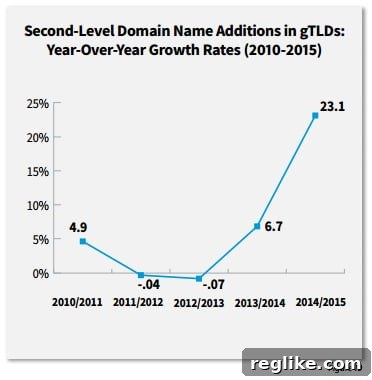
However, the data presented in the index dramatically illustrates a pivotal shift. The graph clearly indicates that the introduction of new Top-Level Domains (new gTLDs) served as a powerful catalyst, revitalizing the market for second-level domain registrations. Prior to this expansion, the rate of new domain additions was noticeably slipping, hinting at market fatigue or a lack of fresh inventory. The launch of hundreds of new gTLDs, such as .tech, .shop, .xyz, .online, and myriad others, injected unprecedented choice and innovation into the domain space, fundamentally altering the supply-demand dynamics.
This infusion of new options allowed businesses, individuals, and organizations to find more relevant, specific, and memorable domain names that better aligned with their brands, interests, or industry sectors. It opened up new branding opportunities, catered to niche markets, and provided geographic or interest-based identifiers that were previously unavailable or hard to acquire within the crowded legacy gTLD space. The resulting surge in new second-level domain additions underscores the significant impact of expanded choice on market demand and growth. It demonstrates that the demand for online identity remains strong, provided there is a diverse and innovative supply of domain options. This trend is a testament to the success of ICANN’s new gTLD program in fostering competition and innovation, breathing new life into a market that might have otherwise stagnated and highlighting the continuous need for adaptability in the digital ecosystem.
GeoTLDs Outpace IDNs in Registration Volume: A Closer Look
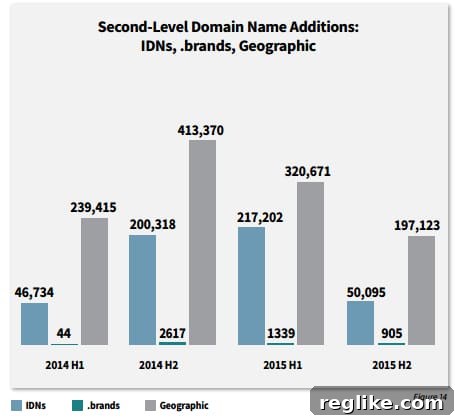
Another fascinating aspect highlighted by the ICANN report is the comparative popularity between Geographic Top-Level Domains (GeoTLDs) and Internationalized Domain Names (IDNs) in terms of registration volume. The data suggests that GeoTLDs currently hold a lead over IDNs, presenting an intriguing dynamic in the global domain market and raising questions about differing adoption drivers.
Understanding GeoTLDs and Their Appeal
GeoTLDs are domain extensions that explicitly represent specific geographical locations, such as .london, .paris, .nyc, or .berlin. Their primary appeal lies in their ability to provide a strong sense of local identity and community, making them highly attractive for localized digital strategies. For businesses and individuals operating within these specific regions, a GeoTLD offers a powerful branding advantage, immediately signaling local presence, authenticity, and commitment to the community. They help create a distinct digital storefront that resonates directly with local customers and fosters a stronger connection to the region they serve. The directness and clarity of a GeoTLD make them an optimal choice for localized marketing campaigns, often leading to higher visibility in local search results and enhanced trust among regional audiences who prefer to support local enterprises.
The Importance and Challenges of IDNs
Internationalized Domain Names (IDNs), on the other hand, are domain names that contain characters from non-Latin scripts, such as Arabic, Chinese, Cyrillic, or Devanagari. IDNs are undeniably crucial for making the internet truly global and accessible to billions of users worldwide who do not primarily use Latin-based alphabets. They allow users to navigate the web in their native languages, removing significant linguistic barriers and promoting digital inclusivity across diverse cultures. Despite their profound importance for global accessibility and linguistic diversity, the report indicates lower registration volumes for IDNs compared to GeoTLDs, suggesting underlying challenges in their widespread adoption.
Explaining the Volume Disparity
Several factors might contribute to this disparity. GeoTLDs often cater to established economic hubs with strong business communities and significant online activity, making their adoption for branding and local SEO relatively straightforward and immediately beneficial. The concept of a location-specific domain is often easily understood and immediately actionable for marketing purposes, requiring less user education. In contrast, IDNs face a more complex set of challenges. These include slower adoption rates due to varying levels of internet literacy in non-Latin script regions, technical compatibility issues across different platforms and browsers (though steadily improving), and a general lack of widespread awareness among the broader public about their availability and benefits. Furthermore, the complexities of keyboard layouts and input methods for non-Latin scripts can sometimes present usability hurdles for a broader user base, impacting their ease of use. While the long-term growth potential for IDNs remains immense as internet penetration deepens globally and technology evolves to better support them, the current data reflects the ongoing journey towards full IDN integration and pervasive adoption, suggesting a need for continued advocacy and infrastructure development.
Declining Cybersquatting Arbitration Losses for Domain Owners
The ICANN report also sheds light on critical trends in domain name dispute resolution, particularly concerning cybersquatting arbitration cases. The data reveals a positive trend for domain owners: they are losing fewer cybersquatting arbitration cases than in previous periods, an observation that holds significant implications for both brand owners seeking to protect their intellectual property and domain registrants defending their assets.
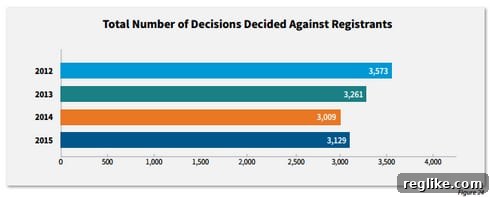
Comparing the recent period to 2012-2013, there’s a clear reduction in the number of cases where domain owners are found to be cybersquatting. This trend is particularly noteworthy because the data for 2014-2015 explicitly includes the new Uniform Rapid Suspension (URS) cases. URS is a relatively new mechanism, introduced primarily for the new gTLD space, designed for clear-cut cases of trademark infringement. It offers a faster and often less expensive route for trademark holders to suspend infringing domains compared to the more traditional and widely recognized Uniform Domain-Name Dispute-Resolution Policy (UDRP), which typically results in domain transfer. The inclusion of URS cases, which are generally meant for more straightforward infringements, would hypothetically lead to an increase in lost cases for domain owners, making this observed decline even more significant.
Percentage of Cybersquatting Cases Lost by Domain Owners
To further contextualize this trend and provide a clearer understanding of the success rate for complainants in these disputes, the report also provides a graph illustrating the percentage of time a domain name owner loses a cybersquatting arbitration case.
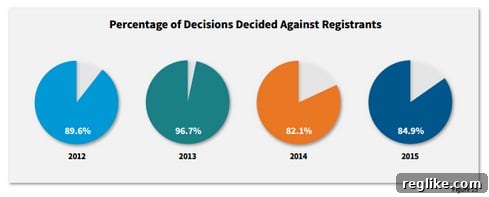
Here too, the trend generally points downwards, indicating a decreasing likelihood for domain owners to lose a cybersquatting case. As with the absolute numbers, the inclusion of URS cases in the latter two years makes this observation even more compelling. Given that URS is specifically intended for straightforward trademark abuses that warrant rapid suspension, one might anticipate an increase in the percentage of owners losing cases, as these typically represent more obvious infringements where the complainant’s claim is strong. The fact that the percentage of losses is still declining suggests several possibilities that contribute to this positive shift for domain registrants:
- Increased Registrant Awareness and Due Diligence: Domain owners may be becoming more educated about trademark law, domain registration policies, and best practices for domain selection, leading to fewer registrations made in bad faith or without proper checks.
- More Selective Filings by Complainants: Trademark holders and their legal representatives might be exercising greater discretion in filing UDRP or URS complaints, only pursuing cases with strong merit and clear evidence of cybersquatting. This reduces the number of weaker cases that might have otherwise led to a dismissal, thereby skewing the overall success rate for complainants downwards.
- Evolution of Panel Decisions and Policy Interpretation: Dispute resolution panels may be applying clearer and more consistent standards, or interpreting existing policies in a way that provides more robust protection to legitimate domain registrants, requiring complainants to meet a higher evidentiary bar.
- Shift in Registration Behavior in New gTLDs: The overall quality and intent behind new gTLD registrations might be higher than initially feared, with fewer purely speculative or intentionally infringing registrations entering the market, leading to fewer legitimate grounds for cybersquatting complaints.
This trend signifies a maturation of the domain dispute resolution ecosystem. It suggests that while trademark protection remains paramount for brand integrity, the system is also evolving to ensure a fairer and more balanced process for domain registrants, potentially reducing the burden on legitimate owners to defend their registrations against less meritorious complaints. For both brand owners and domain investors, understanding these subtle but significant shifts is crucial for developing effective domain management and dispute resolution strategies in an ever-complex digital world.
Conclusion: A Dynamic and Evolving gTLD Landscape
ICANN’s gTLD Marketplace Health Index offers an invaluable snapshot of a dynamic and continuously evolving domain name landscape. The insights gleaned from this beta report underscore several critical developments that are shaping the future of the internet’s addressing system:
- The transformative power of new gTLDs in reigniting second-level domain growth, offering expanded choices and fostering innovation, thereby proving the market’s capacity for sustained expansion with new inventory.
- The current preference for GeoTLDs over IDNs in terms of registration volume, highlighting distinct market drivers (local identity vs. global accessibility) and ongoing challenges for full global linguistic integration, signaling areas for future growth and development.
- A noteworthy positive trend for domain owners in cybersquatting disputes, indicating either enhanced registrant awareness, more judicious complaint filings, or a maturing dispute resolution process that balances trademark protection with legitimate registrant rights, fostering a more equitable environment.
These trends are not merely statistical observations; they represent fundamental shifts in how the internet’s addressing system is being utilized and governed. For businesses, understanding these shifts can inform crucial branding strategies, market entry decisions into new gTLD spaces, and robust intellectual property protection efforts. For individual registrants, they highlight the importance of careful domain selection and adherence to policy to protect their online identities. As ICANN continues to refine and publish these reports, they will undoubtedly remain a cornerstone for navigating the complexities and opportunities within the generic Top-Level Domain market. The journey towards a truly healthy, secure, and accessible global domain name system is ongoing, and comprehensive data analysis like that provided by the Health Index is indispensable to that endeavor, guiding stakeholders towards informed decisions in this pivotal digital space.